
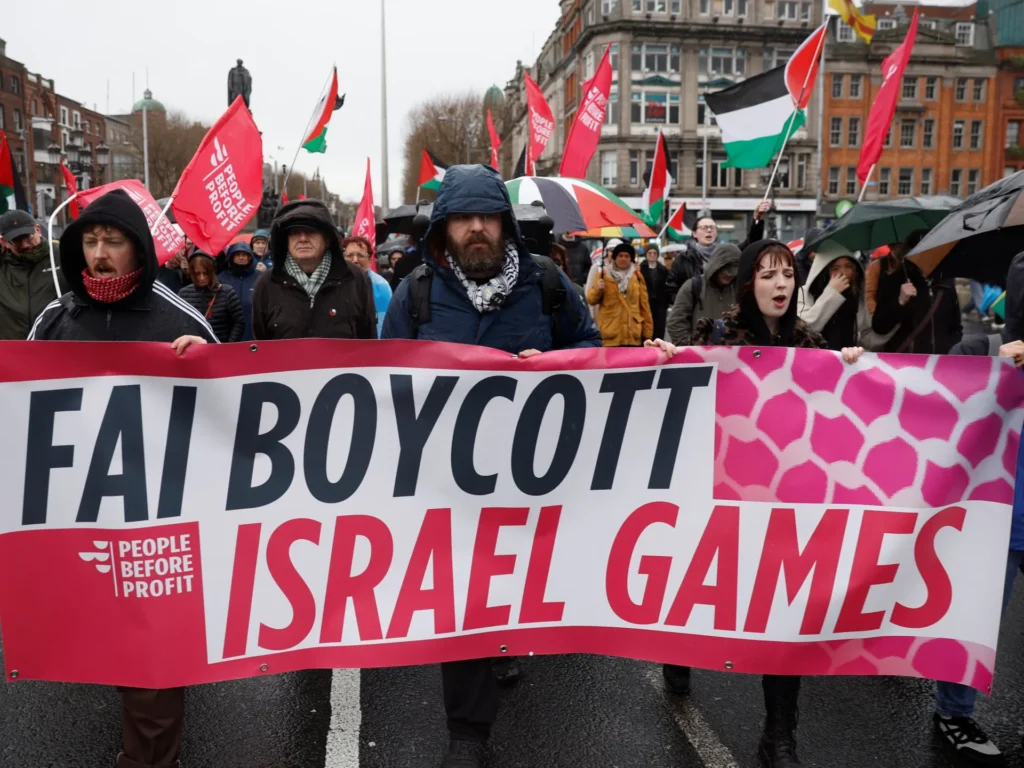
Controversy Surrounds Ireland vs. Israel Match Amid Calls for Boycott
When the governing body of European football released the schedule for its upcoming Nations League in February, one particular match quickly sparked intense debate. The Republic of Ireland and Israel were drawn into the same group in League B for the 2026-27 UEFA Nations League, leading to significant backlash from Irish fans, athletes, and public figures. This uproar focuses on the ongoing violence in Gaza and has fueled demands for a boycott of the match, regardless of potential repercussions.
The Match Details
As the date approaches, the fixture between Ireland and Israel remains on schedule despite mounting criticism. Irish football officials are facing increasing pressure not to send a team, while responses from Israeli representatives have also been pointed. These teams will clash twice within an eight-day timeframe under the backdrop of heightened political tensions and growing dissent among the Irish populace.
The matches are set to take place in a home-and-away format, with Ireland playing its home match in Debrecen, Hungary, on Sunday, September 27, and Israel hosting its game in Serbia on October 4.
Why Is This Match Happening?
Both Ireland and Israel are members of UEFA, which oversees European football. As such, they participate in tournaments organized by UEFA to advance in international football standings. The Nations League facilitates matchups between closely ranked nations, and Ireland and Israel find themselves in Group B3 alongside Austria and Kosovo.
Calls for a Boycott
Since the announcement of the fixture on February 12, the Football Association of Ireland (FAI) has been under immense pressure to boycott the games due to Israel’s actions in Gaza and Ireland’s solidarity with Palestine. In May, prominent Irish athletes joined forces with celebrities in promoting a campaign initiated by Irish Sport for Palestine, urging a boycott of the Israel match. A United Nations inquiry confirmed in June that Israel was committing acts classified as genocide in Gaza.
The advocacy group contends that Israel has violated statutes established by UEFA and FIFA by permitting teams to play on Palestinian territory, calling for Israel’s suspension from both organizations. Last November, 93% of FAI members voted to compel their leadership to advocate for Israel’s expulsion based on these statutes. The collective, known as “Stop the Game,” includes signatures from League of Ireland players, previous managers, and influential figures like Louise Quinn.
International human rights organizations have also joined the chorus, urging UEFA and FIFA to disqualify Israel from competitions. Amnesty International stated, “It’s unacceptable that Israel will participate despite clear evidence that the Israeli football association continues to support illegal settlements. When rules are breached amid ongoing occupation and atrocities, turning a blind eye is not an option.”
Official Responses from Ireland
Despite the ongoing controversy, Ireland’s Prime Minister Micheal Martin has endorsed the matches. He pointed out the complexities of intertwining sports and politics. “We have consistently criticized and opposed Israeli government actions in Gaza. While we condemn the Hamas attacks, sports often pose challenges when intersecting with political matters,” he expressed.
FAI Chief Executive David Courell previously stated that the team must honor its commitments or risk jeopardizing the future of Irish football. Last week, national coach Heimir Hallgrimsson responded to boycott advocates, asserting, “We aren’t competing amid genocide; we are standing against it.”
Public Sentiment in Ireland
The call for a boycott has resonated with many in Ireland, supported by various public polls that reveal a significant majority opposing the match. A recent PFA poll indicated that 63% of respondents preferred no engagement in the upcoming fixtures, while a similar survey by the Irish Mirror showed that 71% would back the FAI in a decision to withdraw.
Bohemian FC, known for its pro-Palestine stance, has also voiced strong support for the boycott, urging the FAI to step back from participating in the match. Pat Fenlon, the club’s Director of Football, argued that the FAI has a responsibility to take a principled stance on Gaza. “This would be a historic move, setting a precedent of standing against injustice,” he emphasized.
Club officials noted that despite potential consequences, many fans believe that withdrawing is the correct course of action. FAI’s decision could reveal what the organization values more – money or the moral imperative to stand in solidarity with the Palestinian people. Luke O’Rodrian, the club’s communications director, criticized the FAI for its perceived inaction.
Israel’s Reaction
In response to Hallgrimsson’s remarks, the Israeli Football Association asserted, “We aren’t engaging in ignorance or hypocrisy; we take the field against a coach who embodies those traits.” Prime Minister Martin defended Hallgrimsson, stating Israel’s remarks are “unacceptable,” adding that “the world cannot overlook the reality of the situation.”
Match Venues and Logistical Issues
The first leg of the match will occur at Nagyerdei Stadion in Debrecen, Hungary, with the second leg being Ireland’s “home” match at TSC Arena in Backa Topola, Serbia. Israel has not played any international matches at home since September 2023 due to UEFA restrictions over security concerns. The October 4 game would have been hosted in Dublin, but it was relocated due to the protests and boycott calls. This match will occur behind closed doors, and the Irish state broadcaster RTE will have limited coverage, omitting additional analysis and advertising.
Consequences of a Boycott
UEFA has no standardized penalties for teams that refuse to participate in a Nations League match. Potential consequences for a boycott could range from fines to point deductions. Bohemian FC referenced a report indicating that Latvia, Lithuania, and Estonia faced a walkover loss and fines for refusing to play against Belarus.
O’Rodrian noted that there is immense frustration among grassroots supporters towards the FAI, believing that the organization exaggerated possible repercussions to push their delegates to favor participation. Fenlon maintained that regardless of potential sanctions, the moral imperative of refusing to engage with Israel outweighs the risks. “We are talking about a human cost that far exceeds any financial or reputational concerns,” he said.
Conclusion
The upcoming Ireland vs. Israel match has ignited a fierce debate over the intersection of sports and international politics. With strong calls for a boycott echoing throughout Ireland, the repercussions of the FAI’s decisions could have lasting implications on both the sport and the stance of an entire nation regarding humanitarian issues.
- The upcoming Ireland vs. Israel Nations League matches have sparked significant debate amid calls for a boycott.
- Pressure on the Football Association of Ireland (FAI) is mounting due to Israel’s actions in Gaza.
- Public sentiment heavily favors withdrawing from the matches, with several polls indicating substantial support for a boycott.
- The situation highlights the complex relationship between sports and global politics, prompting discussions on responsibility and solidarity.