
The Rising Toll of Congenital Anomalies in Gaza: A Growing Health Crisis
Gaza – In the neonatal unit at Nasser Hospital situated in southern Gaza, newborns are battling for their lives against severe congenital anomalies—conditions that health professionals believe are deeply tied to the dire consequences of ongoing conflicts in the region.
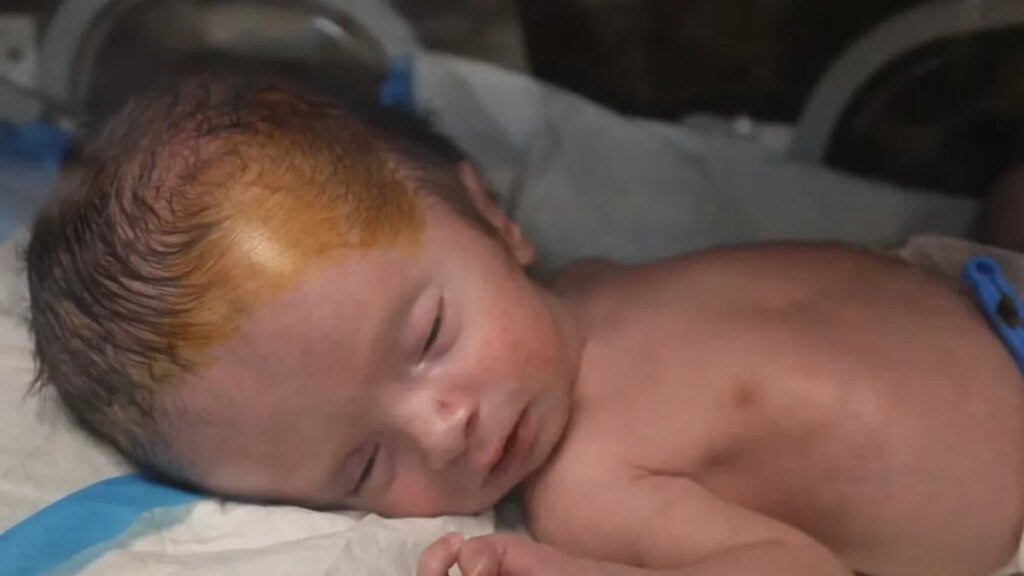
Among these infants is two-month-old Osama, who entered the world with a heart defect and enlarged ventricles in his brain. His mother, Najia Zurub, has been by his side continuously since his birth.
“I was pregnant during the war, and it took a toll on me due to the scarcity of food,” she recalls, explaining that living in tents without access to safe drinking water significantly affected her health during pregnancy. The immense stress ultimately led to an early delivery. Medical staff have confirmed that Osama’s condition is not hereditary; he is her first child and there is no family history of such complications.
Osama shares his ward with two-week-old Ahmed, who shows symptoms of hydrocephalus—an accumulation of cerebrospinal fluid that puts pressure on brain tissues—and two-month-old Suheir, born with multiple deformities impacting her mouth and ears. Earlier in the day, the neonatal unit housed five infants with congenital anomalies; however, baby Fatama had to be rushed to intensive care, and another infant, Iyal, tragically passed away.
An Unprecedented Surge
While pinpointing the exact origins of individual congenital anomalies can be challenging, health officials in Gaza assert that the current spike in cases is unlike anything seen before.
Data from the Ministry of Health reveals a doubling of congenital anomaly cases in 2025 compared to 2022, alongside a 140 percent increase in the stillbirth rate over the same timeframe. Last year, there were 457 neonatal fatalities, reflecting a 50 percent rise from pre-war numbers.
Zaher al-Wahidi, the director of the Health Information Unit at the Ministry of Health, has identified five primary contributors to these alarming statistics: widespread hunger, a drastic decline in healthcare services, extreme overcrowding, exposure to contaminated water sources, and the ongoing ramifications of sustained airstrikes.
Asaad al-Nawajha, a pediatrician and specialist in neonatology at Nasser Hospital, voiced his serious concerns about internal anomalies affecting vital organs. He explained that these conditions typically arise when a fetus encounters adverse environmental conditions during the critical first trimester. With medical resources significantly dwindling, some of the affected babies may unfortunately remain untreatable.
A Systemic Collapse
The ongoing conflict has resulted in the tragic loss of at least 20,000 children in Gaza. Additionally, many Palestinian women are physically prevented from carrying their pregnancies to term due to the war’s devastation. During the most intense bombing, live births in the region dropped by over 30 percent. Although numbers have slightly rebounded recently, they remain significantly lower than pre-conflict levels.
Even though a “ceasefire” was instituted last October, casualties continue to mount, with many Palestinians noting that daily assaults on Gaza persist.
For the fragile newborns in Nasser Hospital, the cessation of bombing offers little comfort. Though they may have survived the immediate threat from airstrikes, these infants are now grappling with the long-standing effects of a war that has left deep physical and emotional scars.
- Gaza faces a significant rise in congenital anomalies and stillbirths due to the ongoing conflict.
- Health officials report a doubling of congenital anomalies since 2022.
- Widespread hunger and poor healthcare services have dramatically impacted maternal and infant health.
- Despite a ceasefire, the challenges for newborns in Gaza persist as they navigate the aftermath of war.