
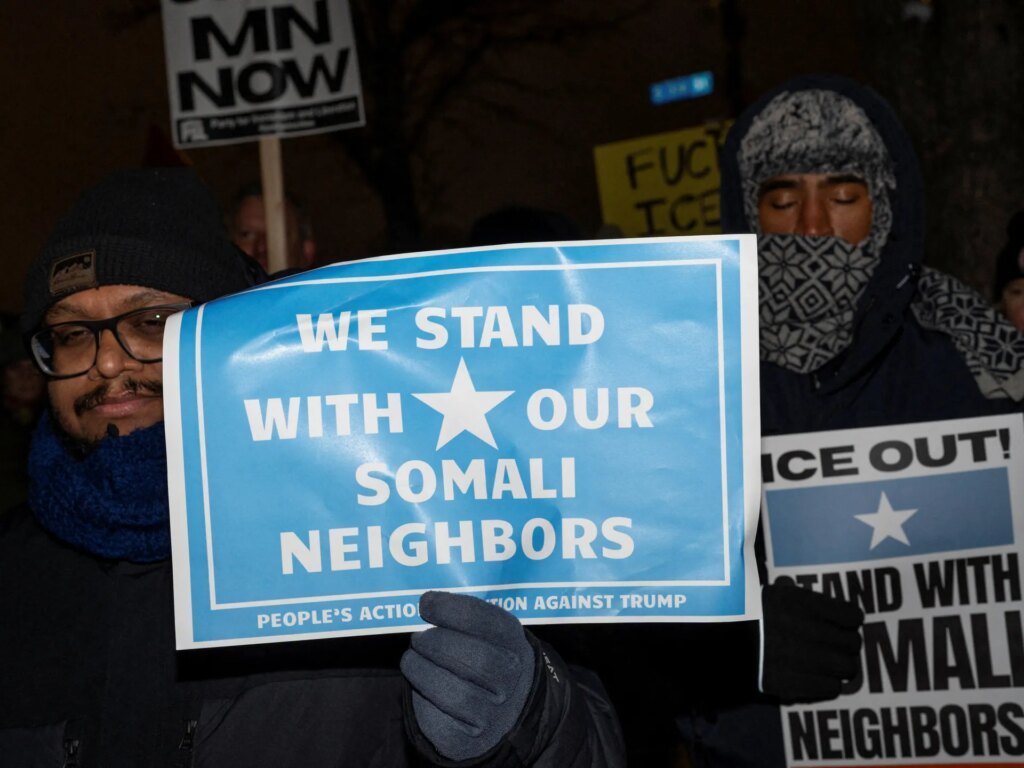
Trump’s Controversial Comments on Somali Americans Spark Outrage
Recently, former President Donald Trump directed attention to Somali Americans by suggesting the administration might move to revoke citizenship from those found guilty of fraud. These statements come after the federal government withheld $185 million in subsidies for low-income daycare services, which are reportedly linked to fraudulent activities in Minneapolis, particularly involving Somali American-operated centers.
Rhetoric and Response
In a post on Truth Social, Trump asserted that “much of Minnesota fraud, up to 90%, is caused by people that came into our Country, illegally, from Somalia.” He did not stop there, also targeting Congresswoman Ilhan Omar by labeling her as “one of the many scammers.” He further declared, “Send them back from where they came, Somalia, perhaps the worst, and most corrupt, country on earth.”
White House spokesperson Karoline Leavitt backed Trump’s statements in a Fox News interview, stating that the administration is considering the possibility of denaturalization for Somali Americans convicted of fraud, emphasizing that this remains an option available to the president and the Secretary of State.
Legal Context of Citizenship Revocation
The idea of revoking citizenship is not entirely new; Trump and his allies have previously indicated intentions to strip citizenship from various naturalized individuals. Legal experts maintain that while it is technically possible to revoke citizenship, such cases are quite rare and require substantial evidence that the individual was naturalized under false pretenses.
Immigrant Community Targeting
Throughout his political journey, Trump has frequently employed divisive rhetoric against immigrant communities. His tough stance against immigration was evident during his initial presidential campaign in 2016, where he accused Mexico of sending “rapists” and criminals to the U.S. More recently, he has made provocative claims about various immigrant groups, including baseless allegations concerning Haitians in Illinois.
In more concentrated attacks against Somali Americans, Trump referred to them in derogatory terms and criticized the legal means through which they entered the country, alleging they are “destroying America.” Such comments have garnered sharp criticism from lawmakers and community organizations, who have branded them as overtly racist.
Government Actions and Investigations
In alignment with his rhetoric, Trump’s administration has ramped up immigration enforcement in Minnesota, launching a thorough audit of Somali immigrants and prioritizing investigations into fraud claims. This comes on the heels of allegations that nearly $9 billion in social assistance was misused, coupled with claims of approximately $300 million misused during the COVID pandemic.
Attorney General Pam Bondi announced that the Justice Department has charged 98 individuals in Minnesota as a part of this expansive fraud investigation, with a noteworthy majority of those charges involving persons of Somali descent. However, many of these cases originated before Trump’s current term.
Local Leadership Weighs In
Minnesota Governor Tim Walz has countered Trump’s narrative, asserting that fraud is indeed a serious issue just like in any other state, but that authorities have been diligently working to remedy this problem for years. In response to Trump, Walz remarked on social media that the former president is exploiting a situation that he seems indifferent to, thereby harming the livelihoods of Minnesotans.
The Role of Social Media in Framing the Narrative
Much of the current scrutiny around Somali American-operated daycares can be traced back to a viral video from conservative YouTuber Nick Shirley, who claimed these centers were responsible for fraud totaling up to $100 million. Administration officials, including Bondi, have often referenced Shirley’s allegations as part of their justification for the heightened investigations.
FBI Director Kash Patel also acknowledged, in a social media post, that the bureau had increased its personnel and resources to tackle the alleged fraud schemes based on recent reports from social media. However, concerns about the validity of Shirley’s claims have arisen, especially after a CBS News investigation revealed that nearly all of the daycares mentioned in the video possessed valid licenses and had been inspected by state regulators within the past six months, with no definitive evidence of fraud found.
Conclusion
The ongoing discourse surrounding the Somali American community highlights the intersection of immigration, race, and legal systems in the United States. Trump’s remarks and subsequent actions have sparked dialogue and pushed some to reflect on the treatment of immigrants in society. As investigations continue, the outcomes remain to be seen, but they will undoubtedly influence perceptions and policies related to immigration and citizenship.
- Trump has suggested revoking citizenship for Somali Americans convicted of fraud, raising legal and ethical questions.
- The administration’s actions coincide with allegations of widespread fraud tied to Somali American-operated daycares.
- Criticism of Trump’s rhetoric emphasizes its perceived racism and divisiveness against immigrant communities.
- Investigations into fraud claims have revealed mixed evidence, questioning the validity of public narratives.