
US-Iran Tensions Escalate: Military Presence Grows Amid Indirect Talks
The ongoing tensions between the United States and Iran have heightened recently, with a significant military buildup in the Middle East coinciding with indirect negotiations. White House spokesperson Karoline Leavitt urged Iran to consider a deal with the US, framing it as a “wise” choice. This development follows a complex backdrop of recent discussions between the two nations, with differing interpretations emerging from both sides.
The Current Situation
As US and Iranian officials engage in indirect conversations, the messaging around these talks exhibits contrasting narratives. While Iranian representatives claimed agreements on essential principles, US Vice President JD Vance asserted that Iran still hadn’t addressed all of Washington’s critical demands. During a recent press briefing, Leavitt reinforced the US stance, suggesting that a compromise with President Trump would benefit Iran.
Trump’s Firm Stance
President Trump, who has previously threatened military action against Iran in response to its domestic crackdowns, hinted at potential escalations via a post on Truth Social. He warned UK Prime Minister Keir Starmer against continuing an agreement that would transfer control of the strategically important Chagos Islands in the Indian Ocean to the UK. Despite this, the agreement ensures that the UK and US maintain joint operations at an airbase on Diego Garcia, the largest of the islands.
“Should Iran decide not to make a deal, it may be necessary for the United States to use Diego Garcia, and the Airfield located in Fairford, in order to eradicate a potential attack by a highly unstable and dangerous regime,” Trump stated.
US Military Buildup
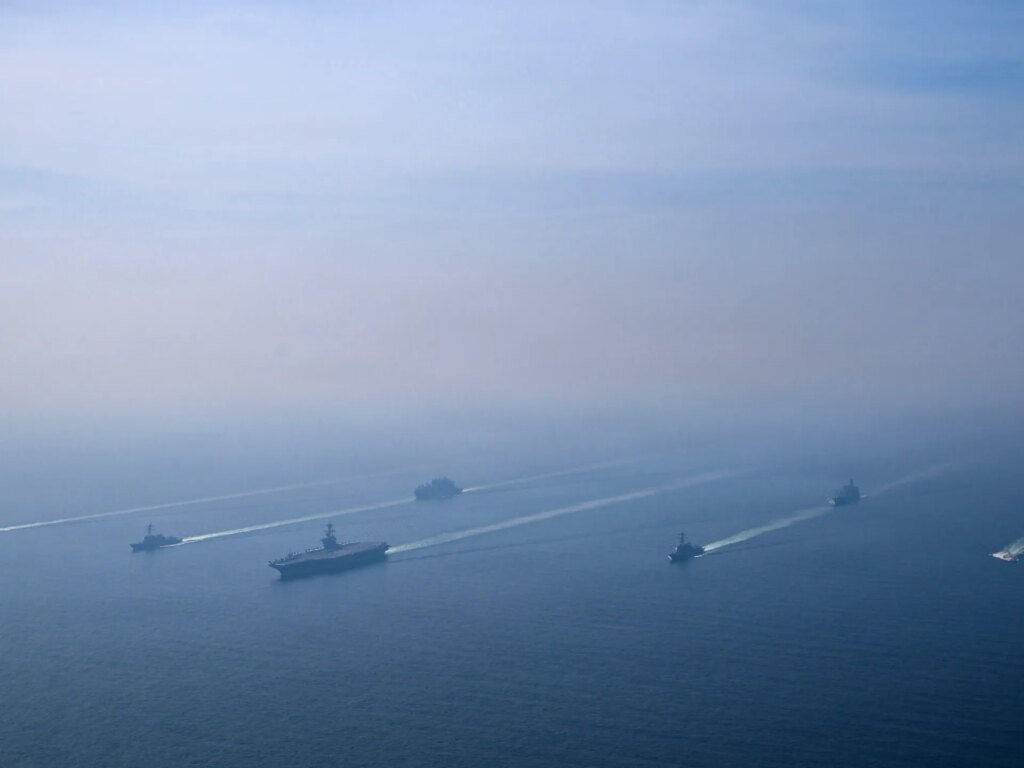
As warnings heighten, the US has increased its military presence in the Middle East. The Pentagon is currently housing the USS Abraham Lincoln, alongside nine destroyers and three littoral combat ships. Additionally, sources noted that more assets, including the USS Gerald R. Ford, the world’s largest aircraft carrier, are en route from the Atlantic. This deployment extends to a fleet of aircraft, comprising F-22 Raptors, F-15s, F-16s, and KC-135 refueling aircraft, essential for sustainable operations in the area.
Iran’s Position
In response to the mounting pressures, Iranian President Masoud Pezeshkian expressed that Iran does not desire conflict, emphasizing that yielding to US demands is not an option. He stated, “From the day I took office, I have believed that war must be set aside. But if they are going to try to impose their will on us, should we accept that?” This statement came amid military exercises launched by Iran’s Islamic Revolutionary Guard Corps in the Strait of Hormuz, emphasizing their strength.
Iran’s Supreme Leader, Ayatollah Ali Khamenei, previously cautioned that any renewed US military actions would trigger a wider escalation throughout the region. Moreover, Iran’s Foreign Affairs Ministry indicated that top diplomat Abbas Araghchi had recently conversed with Rafael Grossi, head of the United Nations nuclear watchdog, about the ongoing framework for future nuclear negotiations.
Background on the Nuclear Deal
Trump’s withdrawal from the Joint Comprehensive Plan of Action (JCPOA) in 2018 significantly influenced the current landscape, leading to a series of sanctions under a “maximum pressure” campaign. Efforts to establish a new nuclear deal have seen little progress since then, with Tehran insisting that discussions focus on their nuclear initiatives, which they claim are solely for peaceful purposes. While Iran is open to making concessions for sanctions relief, Washington’s conditions appear to extend beyond what Tehran considers acceptable, particularly regarding its ballistic missile program.
Conclusion
The future of US-Iran relations remains uncertain as indirect talks continue amid military threats and escalating tensions. Both sides must navigate a complex landscape of demands and expectations to avoid further conflict and work towards a resolution that addresses both security concerns and nuclear ambitions.
- The US has ramped up its military presence in the Middle East amid rising tensions with Iran.
- Indirect talks between US and Iranian officials reflect differing narratives on progress and agreements.
- Iran asserts it does not seek war but is unwilling to capitulate to US demands.
- The status of the nuclear deal continues to be a contentious issue with stalled negotiations.