
Myanmar’s Elections Amid Ongoing Conflict: A Critical Examination
Yangon, Myanmar – As voters head to the polls in parts of Myanmar this Sunday, many view the election as an attempt by military leaders to legitimize their regime, nearly five years after the ousting of Nobel Laureate Aung San Suu Kyi.
This multi-phase election is taking place against a backdrop of civil unrest, where ethnic armed groups and opposition militias are fiercely clashing with the military for dominance over swathes of territory, from the borders with Bangladesh and India in the west to the frontiers with China and Thailand in the north and east.
Civil War and Limited Voting
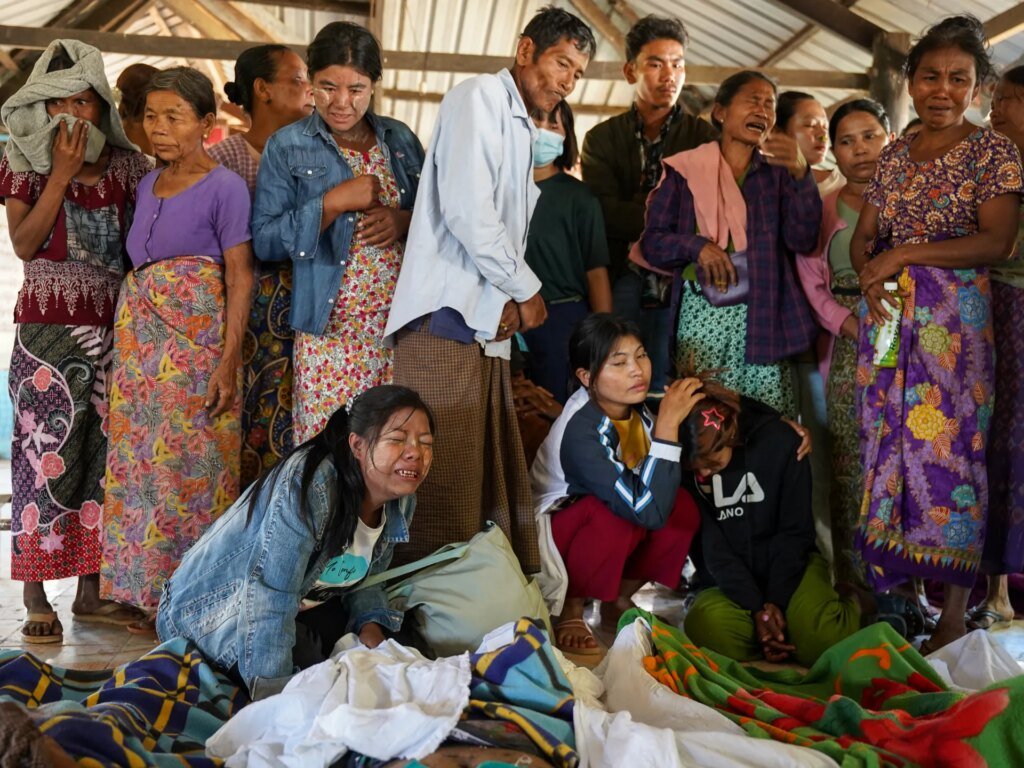
In the central region of Sagaing, only a third of the townships will participate in the voting process on Sunday, with subsequent phases planned for January. Voting has unfortunately been entirely cancelled in other areas due to escalating violence, including aerial bombings and arson attacks.
Esther J, a local journalist, noted, “The military is deploying troops and burning villages under the guise of ‘territorial dominance.’ Many believe this strategy is aimed at influencing the election.” She added that there has been no visible campaign activity in most places, stating, “No one is campaigning or encouraging people to vote.”
Throughout the country, elections have been cancelled in 56 of the 330 townships, and further cancellations are anticipated. The ongoing conflict, resulting from the 2021 coup, has led to approximately 90,000 deaths and displaced over 3.5 million individuals, according to various monitoring organizations and the United Nations. Nearly half of the 55 million people in Myanmar require humanitarian aid.
According to local reports, residents in Sagaing show little interest in the election, with many expressing a desire for the revolutionary forces to prevail over the military.
Changing Dynamics on the Battlefield
Throughout last year, the Myanmar military appeared to suffer significant losses. A concerted offensive by the Three Brotherhood Alliance, comprising ethnic armed groups and opposition militias, gained considerable ground, with the military nearly being ousted from western Rakhine state and losing control of a major military hub in Lashio, northeast of the country.
This operation, referred to as “1027,” represented the most significant challenge to the military’s authority since the 2021 coup. However, the momentum shifted this year following intervention from China.
In April, a deal brokered by Beijing led to the Myanmar National Democratic Alliance Army’s peaceful surrender of Lashio. The military subsequently regained control of several pivotal towns across northern and central Myanmar. A further agreement was reached in late October, facilitating the withdrawal of the Ta’ang National Liberation Army from key gold mining towns.
Research fellow Morgan Michaels from the International Institute for Strategic Studies (IISS) remarked, “The Myanmar military is definitely on the rise. If this trend continues, they could regain a dominant position within one to two years.”
Part of this resurgence can be attributed to a new conscription campaign and an expanded drone fleet, which has allowed the military to mobilize between 70,000 to 80,000 new recruits since mandatory service was introduced in February 2024. These recruits include many with technical skills, thereby enhancing the military’s operational capabilities.
According to the Armed Conflict Location & Event Data Project (ACLED), air and drone attacks carried out by the military have surged by roughly 30% this year, resulting in nearly 2,600 air attacks that claimed 1,971 lives — the highest casualty figures since the coup. Myanmar now stands as the third highest globally for drone operations, trailing only Ukraine and Russia.
China’s Role and Strategic Interests
Analysts suggest that China’s active role in the situation stems from concerns over stability along its borders. Einar Tangen, a Beijing-based analyst, described the crisis in Myanmar as a “hot mess,” asserting that China aims to maintain peace in the region to protect vital trade routes linked to the China-Myanmar Economic Corridor.
Although Beijing has had its reservations about the military, its recent engagement has become evident through the meetings between President Xi Jinping and coup leader Min Aung Hlaing. During an August meeting in Tianjin, Xi expressed support for Myanmar’s sovereignty and the need for unity among its political factions.
China sees the election as a means to foster more predictable governance. While Russia and India have also shown support for the electoral process, the United Nations and several Western nations have labeled it a “sham.” Tangen noted that while Western countries have vocally criticized the military, they have yet to engage substantively with the opposition forces.
A Stalemate In Conflict
The military’s territorial recovery has been modest. In northern Shan state, it has managed to reclaim just 11.3% of previously lost territory, according to the Institute for Strategy and Policy – Myanmar. The Arakan Army continues to launch offensives, threatening military strongholds in western Rakhine State.
Despite some victories, analysts maintain that the military remains in a weakened position compared to pre-coup levels. This sentiment is echoed by Khin Zaw Win, who emphasized that the military’s territorial gains should not be overstated, particularly as opposition forces remain fragmented.
The military-backed Union Solidarity and Development Party has fielded numerous candidates and is expected to dominate the upcoming government. Meanwhile, Aung San Suu Kyi’s National League for Democracy has been disbanded, and she remains detained.
Khin Zaw Win speculated that the election likely won’t influence the ongoing war and that the military may be misinterpreting recent gains as a sign for military victory. However, he also noted that China’s mediation could lead to a potential resolution of the conflict.
In conclusion, Myanmar’s elections are set against a complex and bloody backdrop of civil war, military resurgence, and shifting geopolitical interests, particularly from China. The outcome remains uncertain, but the humanitarian and political crises continue to unfold.
- Myanmar’s elections are viewed as attempts by the military to legitimize their rule post-coup.
- Civil unrest and violence overshadow the electoral process, with many voters expressing disinterest.
- China’s involvement is vital for stability and trade routes in the region.
- The military has regained some control but remains significantly challenged by opposing forces.