
Trump Responds to China’s Military Drills Around Taiwan
Former President Donald Trump has expressed a nonchalant attitude towards China’s recent live-fire military exercises that encircle Taiwan. He emphasized his positive rapport with Chinese President Xi Jinping, stating that Xi has not mentioned any military concerns to him. These exercises, which began as a surprise simulation of an attack by the People’s Liberation Army (PLA), have ignited discussions about Taiwan’s security and China’s intentions in the region.
China’s Military Exercises Explained
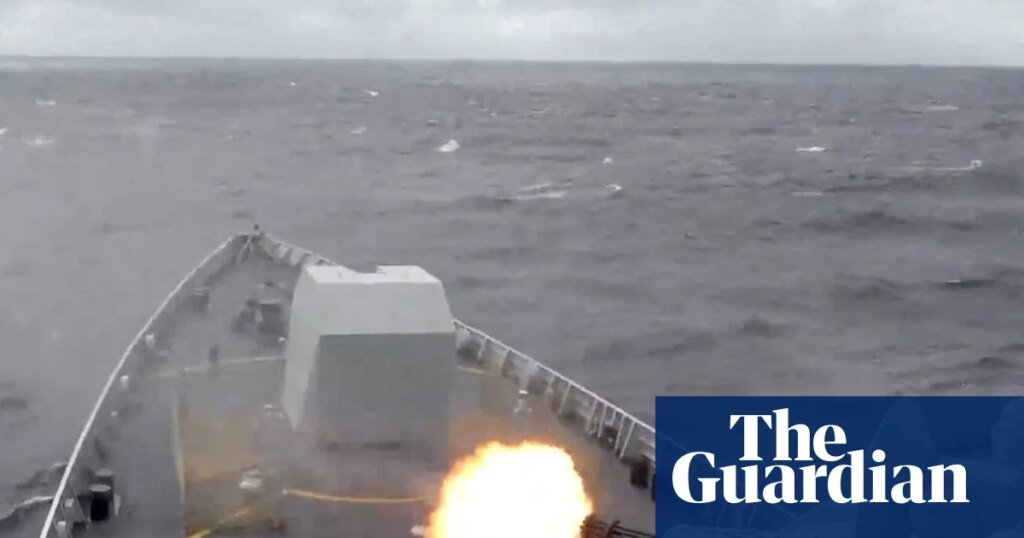
The PLA, the military branch of China’s ruling Communist Party, initiated a series of large-scale drills near Taiwan on Monday, continuing into Tuesday. These exercises included live missile launches into the Taiwan Strait and the deployment of various military assets, such as destroyers, frigates, and aircraft. The aim, according to the PLA, was to test “sea-air coordination” and target neutralization capabilities against maritime threats.
Beijing’s long-standing stance is that Taiwan is a part of China, intending to prepare for a potential takeover by 2027, according to years-old U.S. intelligence assessments. In the meantime, China has employed various forms of intimidation towards Taiwan, aimed at persuading it to accept what is termed “peaceful reunification.”
According to Taiwan’s defense ministry, there was significant military activity in the vicinity, detecting four navy ships, 14 coast guard vessels, one surveillance balloon, and a staggering 130 aircraft, including drones, within a 24-hour period as part of the drills named “Justice Mission 2025.”
Trump’s Position on the Military Drills
Amidst these tensions, Trump remarked on Monday about the military drills, recalling his positive relationship with Xi. He stated, “I certainly have seen it … I don’t believe he is going to be doing it,” implying he does not expect an invasion to occur. “Nothing worries me,” Trump added, reflecting a sense of calm regarding the situation.
While the U.S. stands as Taiwan’s most significant ally against potential aggression from Beijing, Trump’s previously inconsistent stance regarding China and Taiwan is notable. Although he met Xi in October, he mentioned that discussions about Taiwan did not occur. A more formal meeting is planned for next year in Beijing.
The Context of the Exercises
On Tuesday morning, live rocket fire from Pingtan, a Chinese coastal area closest to Taiwan, was observed. The PLA confirmed that their long-range drills achieved their desired outcomes in the northern waters surrounding Taiwan.
Taiwan’s defense minister criticized the drills as blatant disregard for international norms, asserting that they aim to undermine Taiwan’s combat capabilities and stir discord within Taiwanese society.
The PLA’s narrative around these exercises focuses on simulating blockades of essential Taiwanese ports and countering foreign interference. An attack on Taiwan could trigger military support from the U.S. and potentially Japan, raising tensions even further.
Historical Background and Future Implications
This recent round of military exercises marks the sixth and largest operation targeting Taiwan since 2022, when China’s military retaliation followed a visit by former U.S. House Speaker Nancy Pelosi. While such military drills involve extensive planning and general training, the PLA frequently links them to provocative actions from Taiwan or the U.S. Recent comments from Chinese officials directly tied the exercises to a record $11 billion arms sale to Taiwan approved by the U.S. government.
Wang Yi, China’s foreign minister, condemned U.S. arms sales, asserting, “In response to continuous provocations by pro-independence forces in Taiwan, we must of course resolutely oppose and forcefully counter them.”
In contrast, Taiwan’s population largely rejects the idea of Chinese governance and supports maintaining the current status. President Lai Ching-te underscored Taiwan’s commitment to defending its sovereignty while advocating for responsible actions to avoid escalating conflict.
Conclusion
The developments surrounding the military drills in the Taiwan Strait reflect heightened tensions in the region and pose questions about future relations between Taiwan, China, and the U.S. As military maneuvers escalate, the underlying complexities of international relations and national sovereignty become increasingly critical.
- Trump downplays China’s military drills near Taiwan, citing his relationship with Xi Jinping.
- China’s military exercises focus on asserting control over Taiwan, with significant naval and aerial presence.
- Tensions rise as Taiwan’s defense minister voices concerns over international norms.
- The situation raises questions about U.S. involvement and future relations in the Taiwan Strait.