
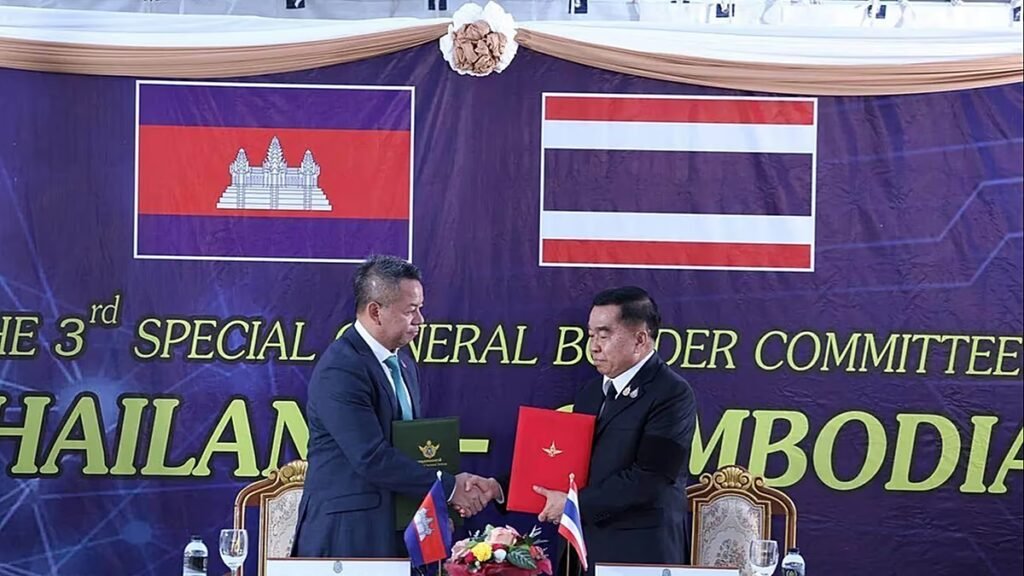
Thailand and Cambodia Sign Ceasefire Agreement Amidst Border Conflict
On Saturday, Thailand and Cambodia reached a significant ceasefire agreement aimed at resolving weeks of armed conflict along their shared border, which has escalated due to territorial disputes. This agreement is a critical step in stabilizing the region and mitigating further military engagements.
Details of the Ceasefire
The ceasefire took effect around noon local time and places stringent restrictions on military movements and airspace violations by both nations. Notably, Thailand has acknowledged conducting airstrikes targeting Cambodia up to the morning of the agreement, creating further urgency for the ceasefire.
Key Provisions of the Agreement
- The ceasefire mandates a halt to all military actions and an immediate cessation of airspace violations for military purposes.
- Thailand is required to return 18 Cambodian soldiers held since earlier conflicts after maintaining the ceasefire for 72 hours.
- Both nations reaffirm their commitment to a prior ceasefire from July, alongside several de-escalation measures aimed at preventing future hostilities.
Negotiation Background
The agreement was formalized by Cambodia’s Defence Minister, Tea Seiha, and Thailand’s Defence Minister, Nattaphon Narkphanit, at a border checkpoint following three days of discussions among military representatives. This dialogue was part of the ongoing General Border Committee efforts.
Previous ceasefires, brokered originally with Malaysian involvement, were notably influenced by former U.S. President Donald Trump, who applied pressure to ensure an agreement was reached under the threat of trade repercussions. Despite these efforts, underlying tensions have persisted, resulting in sporadic violence and a damaging propaganda war that has left both sides with significant casualties.
Impact of the Conflict
Since the renewed fighting began on December 7, casualties have mounted, with Thailand reporting 26 military and one civilian death, as well as 44 civilian fatalities from the conflict’s collateral damage. Cambodia has not officially disclosed its military casualty figures but reported 30 civilian deaths and numerous injuries. Thousands have been evacuated from dangerous areas on both sides of the border.
Ongoing Border Tensions
Each nation has accused the other of instigating the recent violence while claiming self-defense. In addition to military concerns, the ceasefire demands adherence to international agreements against landmine use, which has been a significant issue for Thai soldiers responding to injuries from newly planted mines allegedly placed by Cambodian forces. Cambodia contends these mines are remnants from its long civil war.
Future Cooperation
A significant clause of the agreement emphasizes maintaining accurate information and refraining from spreading false narratives, which could further escalate tensions. The two countries also agreed to recommence efforts to delineate the border accurately and to collaborate on combating transnational crimes, particularly those linked to organized crime syndicates operating online.
Conclusion
The ceasefire agreement signifies a hopeful turn in the ongoing tensions between Thailand and Cambodia, addressing both immediate military concerns and the broader issues related to border disputes, political relations, and economic challenges. Continued cooperation and dialogue will be crucial in ensuring lasting peace and stability in the region.
Key Takeaways
- Thailand and Cambodia signed a ceasefire to halt ongoing military conflicts along their border.
- The agreement includes provisions for repatriating captured soldiers and measures against the use of landmines.
- Both nations are committed to refraining from spreading false information regarding the conflict.
- Future collaboration will focus on delineating borders and combating organized crime across borders.