
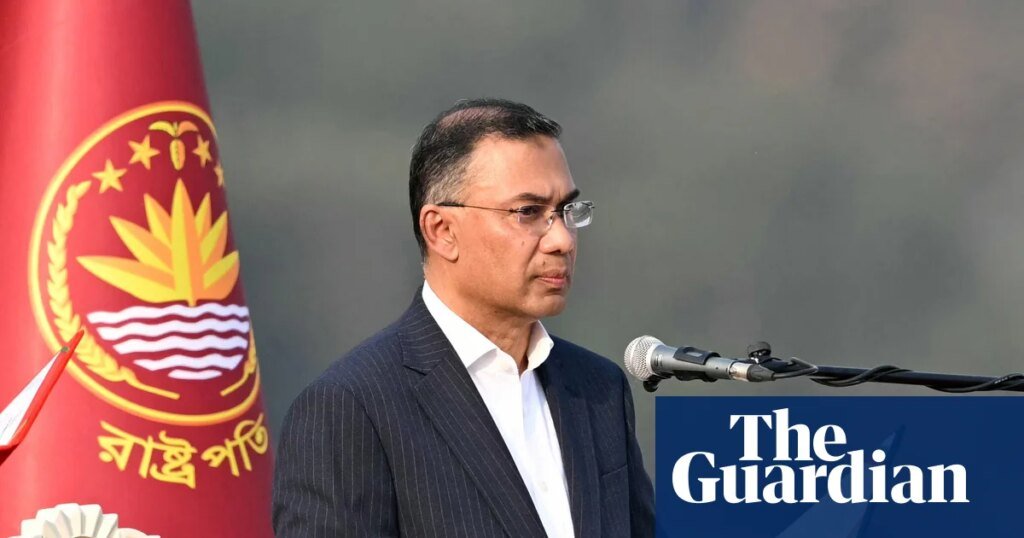
Bangladesh Welcomes New Leadership as Tarique Rahman is Sworn In
In a significant political shift, Tarique Rahman has officially taken the oath of office as Bangladesh’s new prime minister. This event marks a remarkable resurgence for the Bangladesh Nationalist Party (BNP) and signifies an end to the tumultuous period that resulted in the ousting of Sheikh Hasina in 2024.
Return to Elected Governance
Rahman’s swearing-in ceremony restores an elected government after 18 months of caretaker rule overseen by Nobel laureate Muhammad Yunus. The BNP’s return is especially notable, ending a two-decade absence from power. For many citizens, this transitional moment represents hope for a future free of oppression and a promising pathway to economic recovery.
Outside the parliament, emotions ran high with excitement and anticipation. Kamal Mia, a 38-year-old citizen, expressed his optimism: “Today feels different. We want our leaders to focus on lowering prices, tackling corruption, and allowing people to live without fear.”
Rahman’s Political Heritage
At the age of 60, Rahman carries a rich political legacy; his mother was the late Khaleda Zia, a former prime minister, while his father, Ziaur Rahman, was a founding figure of the BNP and played a crucial role in Bangladesh’s 1971 independence before his assassination in 1981.
With the BNP achieving a significant victory in the recent elections, securing 212 out of 300 seats in the Jatiya Sangsad, the party is poised to exert considerable influence. An alliance with the Islamist party Jamaat-e-Islami added 77 seats to this historic win.
An Unconventional Swearing-In Ceremony
In a departure from traditional practices, the swearing-in took place outdoors, emphasizing a fresh start. In addition to Rahman, 25 cabinet ministers and 24 junior ministers pledged their allegiance to serve.
Having returned from self-imposed exile in London just before his mother’s passing, Rahman acknowledged the serious challenges the new government must tackle, such as economic recovery and rampant corruption. Key issues anticipated to shape the early agendas include inflation, job creation, law enforcement, and institutional reforms, as Bangladesh’s economy continues to face significant hurdles.
“Our first task is to restore order within institutions,” stated Amir Khasru, a prominent BNP leader recently appointed in the cabinet.
Governance and Foreign Relations
Political analysts emphasize that demonstrating effective governance will be essential in overcoming monumental challenges posed by a history of corruption and patronage politics. Rahman labeled China as a “development friend,” signaling a commitment to strengthening economic relations with Beijing while also aiming to enhance ties with Western nations and mend relations with neighboring India, which holds strategic importance.
India’s interest was evident as they sent a high-level delegation, including the lower house speaker, to the ceremony, indicating a desire to improve bilateral relations. Additionally, a minister from the UK attended, highlighting international attention on this transition.
Rise of New Political Voices
The recent elections also ushered in fresh perspectives with the emergence of the youth-led National Citizen Party, a group formed by young activists during the recent protests, securing six parliamentary seats. This shift indicates that the Gen Z demographic is beginning to carve out a space within the political landscape. Furthermore, voters approved a new two-term limit for prime ministers and measures to enhance judicial independence.
As supporters lined Manik Mia Avenue waving red and green flags, the atmosphere was filled with hope. Nila Begum, 33, reflected on the sentiment: “We’ve endured so much negativity for too long—today represents a chance for positivity and stability.”

A Shift in the Political Landscape
The protests led by students and young activists ultimately forced Hasina into exile, a move that strained India-Bangladesh relations as she remains in India. A Bangladeshi tribunal sentenced her in absentia for her government’s violent suppression of protests, alleging “crimes against humanity.”
Although Hasina claims these charges are politically driven, her secular center-left Awami League was barred from participating in the elections.
With a turnout of 59.44%, the results countered criticisms from the Awami League about the election’s legitimacy, according to a senior analyst from a global monitoring agency. However, integrating the Awami League into the new political framework will require careful navigation.
Conclusion
The inauguration of Tarique Rahman marks a pivotal moment in Bangladeshi politics, offering a glimmer of hope for a nation seeking stability and economic revitalization. As the new administration takes the helm, the eyes of the world will be watching to see how they address the pressing challenges ahead.
- Tarique Rahman sworn in as Bangladesh’s new prime minister, signaling a shift in power.
- The BNP returns to governance after 20 years, bringing hope for economic rejuvenation.
- New electoral laws introduce term limits and enhance judicial independence.
- International attention on Bangladesh as leaders aim for improved foreign relations.