
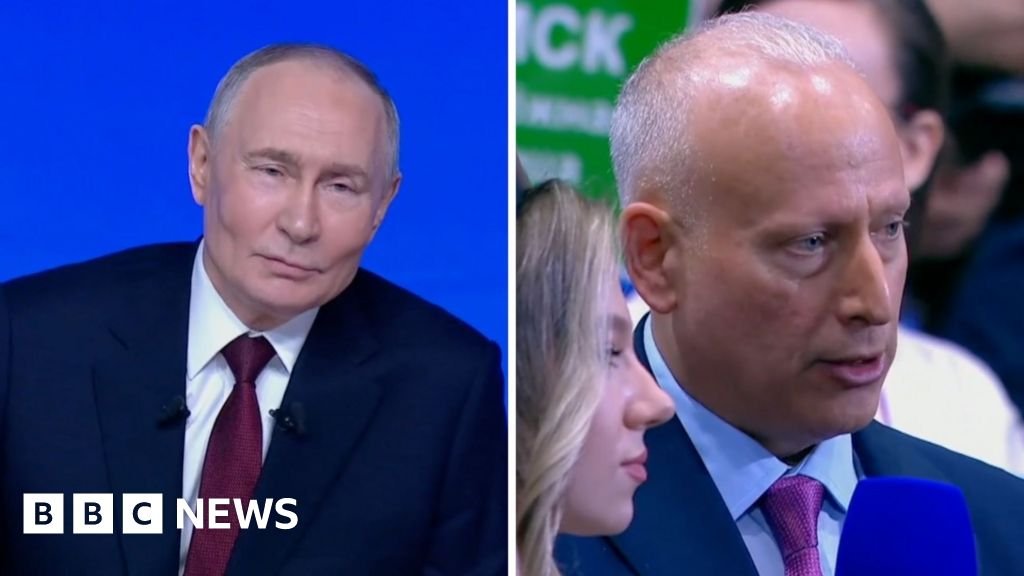
Understanding the Dynamics of Questioning Vladimir Putin
As reporters frequently engage world leaders with questions, few scenarios are as daunting as putting one to Vladimir Putin, the Russian president known for his authoritarian regime and aggressive foreign policy. This article delves into what it’s like to confront him, especially in the context of the ongoing conflict in Ukraine and accusations of Russia’s chaos-inducing actions abroad. Imagine posing such a question live, with millions of Russian viewers tuned in—it’s a situation fraught with responsibility.
The Question That Matters
When I took the opportunity to question President Putin, I focused on the future of Russia. “What kind of future are you planning for your country and your people?” I asked. I also probed about ongoing political repression, stating, “Will the future be like the present, where public dissent is punishable by law? Will the hunt for enemies intensify? Are mobile internet outages expected to increase? Will there be new ‘special military operations’?”
Putin’s Response
As I posed my questions, Putin jotted down notes before addressing my inquiries. He justified Russia’s controversial foreign agent law, which has labeled numerous critics as “foreign agents.” “We didn’t create this system,” he asserted. “This law was established in various Western nations, including the US in the 1930s. In fact, those laws are much stricter.”
In reality, the Russian foreign agent law is severe, limiting the involvement of labeled individuals in public life and leading to potential criminal charges from minor infractions. However, once I finished my question, I found the microphone was taken from me, preventing further discussion on my points.
Shifting the Conversation
The moderator quickly redirected the conversation, bringing up another question. “What’s going to happen with the BBC, given its multi-billion dollar lawsuit from the US president?” anchor Pavel Zarubin inquired.
In an unexpected alignment, Putin sided with President Trump, revealing the complicated geopolitical chess game at play around media narratives. He then returned to my earlier question about special military operations, stating, “There won’t be new operations if you treat us with respect and honor our interests, just as we have attempted to do with you, unless you betray us like you did with NATO’s eastward expansion.”
Putin’s Grievances and Future Prospects
From his words, an undercurrent of resentment towards the West was evident. Putin argued that Western leaders have consistently disrespected Russia, alleging years of deception and false claims regarding Moscow’s intentions. “What kind of nonsense is that?” he retorted, dismissing fears of a Russian attack on Europe.
Conversely, many European leaders remain deeply skeptical about Moscow’s trustworthiness, particularly after Russia’s denials of aggressive intentions leading up to the invasion of Ukraine. Accusations against Russia for violating European airspace, conducting cyber-attacks, and sabotage have only fueled this distrust.
A Possible Olive Branch?
As Putin concluded his responses, there seemed to be an olive branch extended towards Europe. “We’re prepared to stop hostilities immediately, provided Russia’s medium- and long-term security is guaranteed, and we are open to cooperation.” However, if Russia ties its security concerns to its maximalist demands in Ukraine, European leaders are likely to remain apprehensive.
Conclusion
Engaging with Vladimir Putin is not just about asking hard questions; it’s about navigating a complex world of political tensions, historical grievances, and deeply entrenched mistrust. The stakes are high, and the implications of these exchanges resonate far beyond the immediate context.
- Questioning Putin reveals the complexities of Russian politics and international relations.
- Putin’s justifications for repressive laws highlight significant human rights concerns in Russia.
- Despite claims of readiness for cooperation, skepticism from Europe persists due to past actions.
- The dynamics of questioning a leader like Putin reflect the broader geopolitical climate.