
Russia Deploys Nuclear-Capable Missiles in Belarus Amid Tensions
In a significant escalation of military presence, Russia has confirmed the deployment of its latest nuclear-capable missile system in Belarus. This announcement follows claims from Moscow that Ukraine executed a large-scale drone assault targeting Vladimir Putin’s residence.
A Symbolic Show of Force
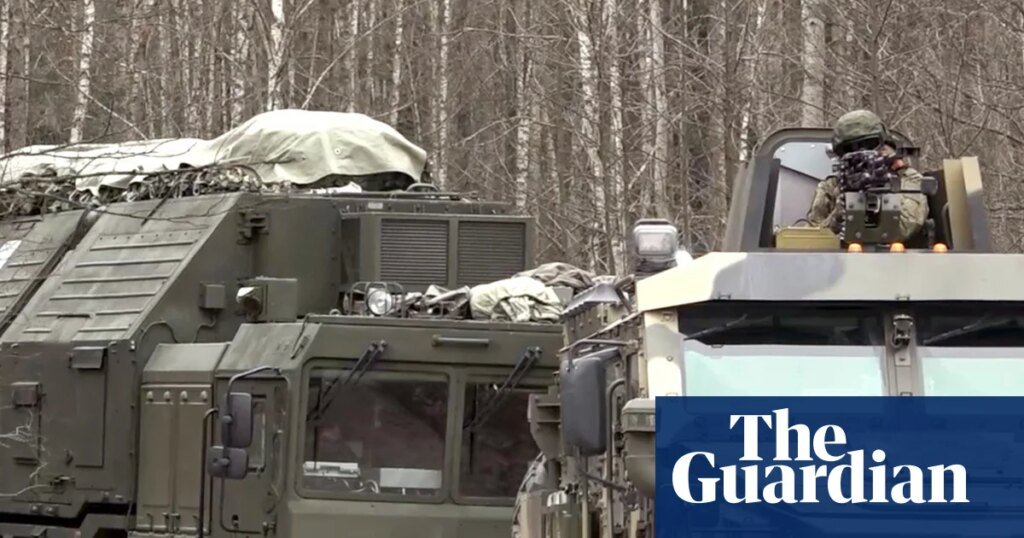
Footage released by Russia’s Ministry of Defense featured the new Oreshnik missile maneuvering through a snowy forest. Soldiers were observed camouflaging combat vehicles with green netting and raising flags at an airbase in eastern Belarus, just near the Russian border. This visual display appears to be part of a broader strategy to intimidate European nations and prepare the Russian populace for a potential escalation in the ongoing war with Ukraine.
Details on Missile Deployment
Belarusian President Alexander Lukashenko announced that ten Oreshnik missile systems will be stationed within his country’s borders. This move, made public during a meeting on Monday, was highlighted by Putin’s reaffirmation of his ambition to annex more territory in Ukraine, particularly focusing on the southern city of Zaporizhzhia.
Reactions and Warnings
Russia’s Foreign Minister, Sergei Lavrov, indicated that retaliatory actions would be taken against Ukraine, revealing that specific targets have already been identified. His comments followed claims of a Sunday night attack involving 91 Ukrainian drones directed at the Russian presidential palace in the Novgorod region.
However, the Kremlin has yet to provide substantive evidence to back its accusations. Dmitry Peskov, spokesman for Putin, mentioned that no proof would be released since all the missiles were reportedly intercepted. He avoided commenting on the absence of debris from any supposed attack.
Local residents in the area reportedly did not observe any explosions or anti-aircraft fire, according to independent news sources. No air raid alerts were issued, and there were no social media posts showing typical evidence of military strikes, such as smoke or flames.
Ukraine’s Response
Ukraine’s Foreign Minister, Andrii Sybiha, countered Russia’s narrative, asserting that the accusations were fabricated. “Almost a day passed, and Russia still hasn’t provided any plausible evidence to its accusations. And they won’t. Because there’s none. No such attack happened,” he posted on social media.
Despite acknowledging that Donald Trump had publicly supported Russia’s version of events following a phone call with Putin, Sybiha refrained from criticism, noting the broader implications of such claims. His irritation was also evident in his comments regarding India, Pakistan, and the UAE, whose concern over the situation he felt only bolstered Russian propaganda.
Military Engagements
Ukrainian commanders reported the consistent presence of Russian kamikaze drones over a government palace used by President Zelenskyy, with one officer detailing successful interceptions of drones in the Koncha-Zaspa area south of Kyiv.
“Whenever there are large-scale attacks, they fly over our area. We often shoot them down here,” the officer explained, sharing video evidence of one drone operating over the winter landscape.
Diplomatic Efforts
Ukrainian leadership is eager to keep diplomatic efforts for resolving the conflict in the spotlight, especially following Zelenskyy’s recent two-hour meeting with Trump in Florida. They discussed a 20-point peace plan involving post-war security guarantees from the U.S., which Congress must approve.
No advancements were made regarding the future of the eastern Donbas region—a highly contested territory that Putin insists must come under Russian control. Zelenskyy has categorically ruled out ceding any land to Russia, proposing instead the establishment of a demilitarized zone, contingent upon a ceasefire lasting at least 60 days.
Zelenskyy also pointed out that Russian claims of an attack were attempts to divert attention from his productive dialogue with Trump and other positive developments involving U.S. and Ukrainian negotiations. “They want to undermine any hopeful outcomes in this format,” he added.
Future Engagements
Zelenskyy is scheduled to meet with European allies on January 6 in France at a conference hosted by President Emmanuel Macron, where discussions will focus on Europe’s role in peacekeeping initiatives. A subsequent meeting is expected between European leaders and Trump’s administration in Washington.
Commentators have expressed concern that U.S. security commitments may be hollow if Trump is predisposed to accepting Russia’s narratives. Professor Phillips O’Brien of the University of St Andrews noted, “If the potential ceasefire monitoring will be done by the same people who believe Russia’s statements, we are in big trouble.”
Conclusion
The recent deployment of Russia’s nuclear-capable missiles in Belarus marks a crucial moment in a rapidly escalating conflict. As military maneuvers intensify and diplomatic exchanges continue, the world watches closely to see how these developments could impact the already fragile balance in Eastern Europe.
- Russia has deployed Oreshnik missile systems in Belarus as tensions rise.
- Doubts continue over Russia’s claims of an attack on Putin’s residence.
- Ukraine’s leadership counters accusations, emphasizing the need for diplomatic solutions.
- Future discussions in Europe may shape the geopolitical landscape amid this crisis.