
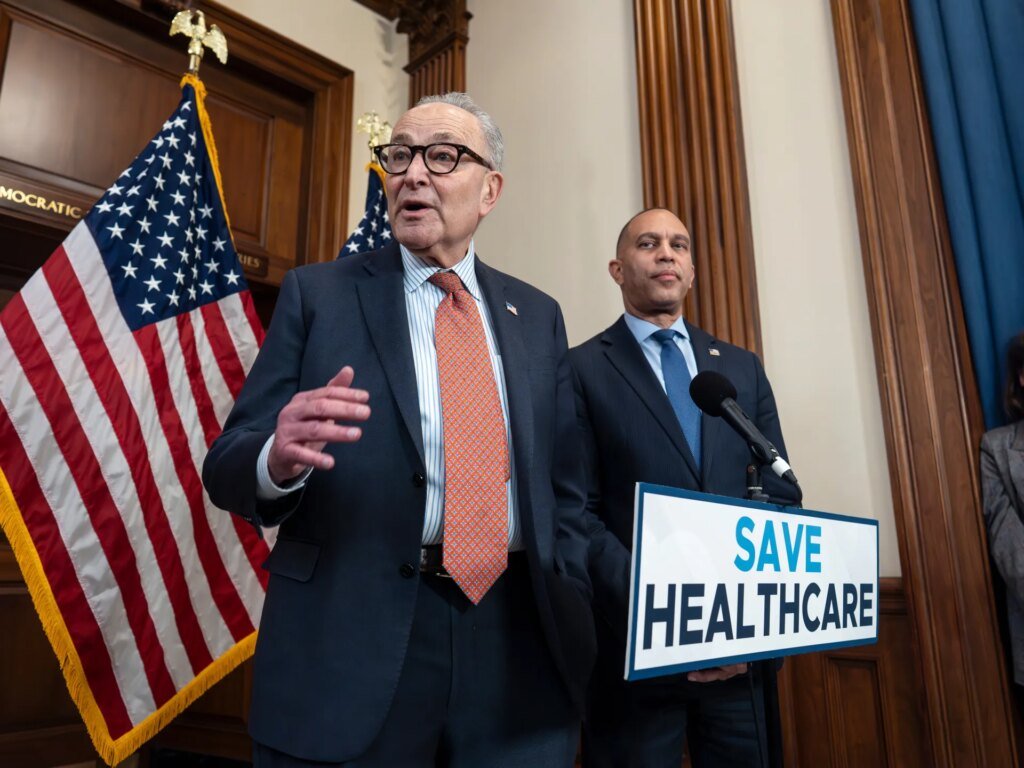
Healthcare Subsidy Extension Faces Uncertain Future
The future of expanded federal healthcare subsidies, introduced during the pandemic, appears bleak as its expiration date on December 31 approaches. Internal dissent among Republican leaders has added to the complexities of the situation. Recently, four centrist Republicans joined forces with Democrats in the House of Representatives to support an extension of these subsidies, commonly linked to the Affordable Care Act (ACA), or “Obamacare.”
House Vote Outcome
In a narrow vote of 204 to 203, the House effectively halted a push by Democrats, backed by four Republicans, for an expedited three-year extension of the ACA subsidies. The Democrats voiced strong opposition, claiming that Republican leadership prematurely ended the voting process while several members were still attempting to cast their votes.
“That’s outrageous,” remarked Democratic Representative Jim McGovern from Massachusetts during the heated exchanges.
The Impact on Americans
As the clock ticks down to January 1, approximately 24 million Americans who rely on the ACA may face steep increases in their insurance costs unless Congress intervenes. On the day of the contentious vote, 26 House members were still waiting to participate when leadership decided to close the proceedings. Although it’s uncommon, it’s not unheard of for House leadership to shorten a contested vote.
Democratic Representative Rosa DeLauro of Connecticut expressed frustration with this decision, emphasizing, “It’s playing games when people’s lives are at stake.”
Political Ramifications
This incident illustrates ongoing frustrations surrounding healthcare subsidies, set to expire at year-end. The vote also served as a crucial test for House Speaker Mike Johnson’s leadership. Typically, Johnson has the authority to decide which bills proceed to vote, yet his authority has recently been challenged by “discharge petitions,” allowing a majority to compel action on particular issues.
On this occasion, Democrats utilized such a petition to push for a vote on renewing healthcare subsidies for the upcoming year. Their proposal seeks a three-year extension, supported by the four centrist Republicans: Mike Lawler (NY), Brian Fitzpatrick, Robert Bresnahan, and Ryan MacKenzie (all from PA).
Republican Proposals and Opposition
While Democrats advocate for the extension, Republicans are rallying around their own legislation known as the Lower Health Care Premiums for All Americans Act. Although this bill aims to reduce some insurance premiums, it faces criticism for potentially increasing others and decreasing overall healthcare subsidies. The nonpartisan Congressional Budget Office (CBO) indicated that this legislation could lead to a reduction of insurance coverage for about 100,000 individuals each year until 2035, along with projected federal deficit savings of $35.6 billion.
The Road Ahead
With a slim majority of 220 seats in the 435-member House, Republicans are under pressure as Democrats work to gain control in the forthcoming 2026 midterm elections. Notably, three of the centrist Republicans who sided with Democrats represent Pennsylvania, a state with politically diverse voter sentiments.
As affordability takes center stage leading into the midterms, even if the Republican-led House approves healthcare legislation this week, it is unlikely the Senate will address it before an upcoming recess that halts legislative proceedings until January 5. By that time, several Americans could be grappling with significantly higher health insurance premiums, prompting some to reconsider their coverage options.
Wednesday’s debate might galvanize both Democrats and certain Republicans to revisit these pressing issues in January, even as many will already be facing the fallout of increased premiums. “I think that that will help prompt a response here in the Senate after the first of the new year,” remarked moderate Republican Senator Lisa Murkowski, indicating hope for future action.
Conclusion
The battle over healthcare subsidies encapsulates ongoing political tensions in Congress. As the January deadline looms, the potential impacts on millions of Americans’ healthcare coverage hang in the balance, with both sides gearing up for further discussions come the new year.
Key Takeaways
- Expanded federal healthcare subsidies may expire on December 31 unless Congress acts.
- A recent House vote saw centrist Republicans join Democrats in a bid to extend these subsidies.
- Proposed Republican legislation could lead to reduced healthcare subsidies and increased uninsured rates.
- Future discussions on healthcare affordability are likely in January as millions anticipate potential premium hikes.