
The Fascinating Origins of Christmas Cards
Each year, approximately one billion Christmas cards are sent in the United States and the United Kingdom alone, marking a cherished tradition that connects millions worldwide. But before the age of emails and messaging apps like WhatsApp, these warm wishes were expressed through beautifully illustrated paper cards featuring themes like the Holy Family, Santa Claus, or beautifully adorned trees. These cards were mailed out and delivered by postal workers, reaching even the most remote locations. Remarkably, this custom, which has blossomed into a global industry worth around $20 billion as of 2024, began almost by accident in the early 19th century.
The Birth of the Christmas Card
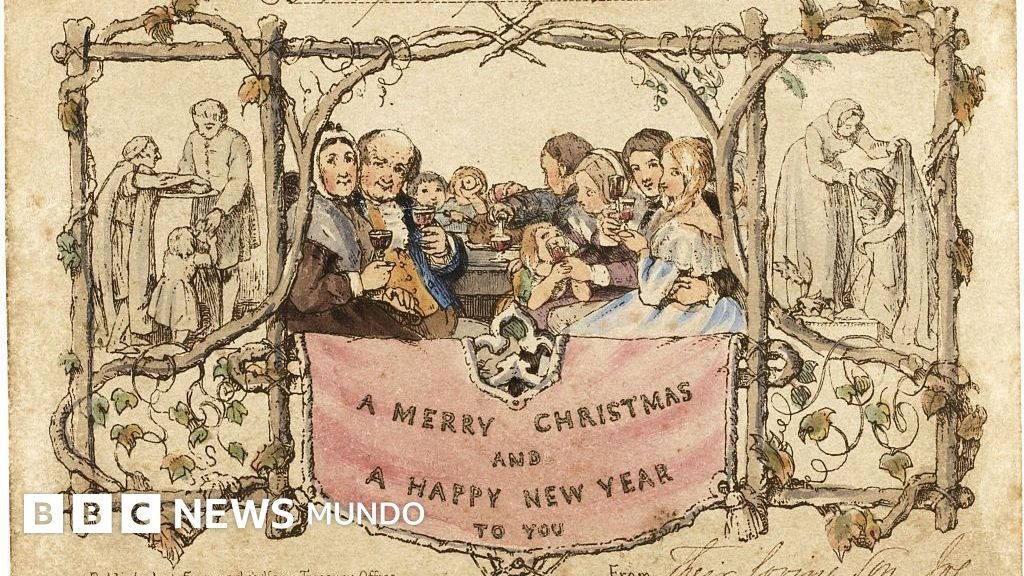
The very first recorded Christmas card was sent in December 1843 in the UK, during Queen Victoria’s reign. Its creator was Henry Cole, an influential public servant, educator, inventor, and arts patron known for founding the iconic Victoria and Albert Museum in London. Seeking a way to respond to the countless Christmas greetings piling up on his desk, Cole approached his artist friend, John Callcott Horsley, to help design a card. The scene depicted a family of various ages gathered around a table in celebration, complemented by the message: “A Merry Christmas and a Happy New Year to you.”
This card featured a hand-colored central illustration along with monochrome sketches: one side depicted a man feeding adults and children in need, while the other showed a woman covering someone who was cold. The intention was clear: celebrating Christmas is also about generosity and kindness. At the top of the card, the word “To” was included, alongside a blank line for the recipient’s name, with “From” similarly positioned at the bottom for the sender’s name.
Responding to Social Expectations
On December 16, after receiving the sketch, Cole rushed to a printing press and ordered a thousand copies. What motivated him to create this card? The sheer number of unanswered Christmas letters—nearly a thousand—he had amassed, which he found daunting to reply to. Historian Ace Collins notes that it was considered impolite in Victorian England not to respond to personal letters. Cole, being a highly visible figure, had an exceptionally challenging workload, having reformed the postal service while engaging in various artistic and literary pursuits—making his dilemma even more pressing.
In an effort to simplify his correspondence during the busy holiday season, Cole proposed a card to his artist friend that could efficiently convey his holiday greetings without neglecting social etiquette. Marsha Walton, a curator at the Shere Museum in Cole’s birthplace, corroborates this, suggesting that his invention arose from a practical need—a way to manage his overflowing mailbox.
The Early Days of Christmas Card Sending
The cards Cole sent were sold for a shilling—about six dollars today—under the pseudonym Felix Summerly. To promote his creation, he placed an ad in a newspaper announcing, “Now published, a Christmas greeting card: or an emblematic picture of an ancient English festival to perpetuate fond memories among dear friends.” Although the initial reception was limited due to high cost, the idea gained traction among the affluent. By the following year, many recipients returned to the same printing house to order their own cards, and by 1845, it became fashionable for wealthy Brits to exchange customized artworks.
However, it wasn’t until the 1860s that the practice became widespread. This shift occurred when card printing became more affordable, allowing people from all classes to participate. Collins notes that Cole’s initiative to address his holiday greetings provided a practical demonstration of the postal system reforms he championed, which transitioned from a confusing tariff system to a simplified one-penny flat rate, facilitating more extensive postal service use.
Cultural Shifts and the Evolution of the Holiday
The introduction of Cole’s card coincided with the publication of Charles Dickens’ classic “A Christmas Carol,” a tale that redefined Christmas in England. At the time, the holiday was often disregarded by the Church of England, still regarded as a raucous event filled with excess. Collins explains that earlier Christmas carols often conveyed requests for food or money from the wealthy.
In contrast, Germany and Eastern Europe celebrated Christmas as a family-centered affair. When Queen Victoria married German Prince Albert, he introduced German Christmas customs to the British monarchy, transforming the holiday into one focused on family and children. Cole’s card reflected this new spirit of Christmas, reinforcing the concept of familial connections and nurturing the concept of the holiday as a time for warmth and generosity.
A Groundbreaking Tradition
Throughout his life, Cole initiated significant projects like the Great Exhibition of 1851 and the construction of the Royal Albert Hall, yet he could not have anticipated that his Christmas card idea would evolve into a thriving industry. Collins asserts that this innovation laid the groundwork for the greeting card industry, inspiring future cards for occasions like Valentine’s Day and birthdays.
In fact, recent data indicate that nearly one billion Christmas cards were sent in the U.S. and UK in 2024 alone. Beyond the festive spirit, Cole’s concept also led to the creation of Christmas stamps that fundraised for causes such as polio research. Cole passed away in 1882, at age 74, having witnessed how his straightforward solution evolved into a beloved tradition embraced by millions across the globe.
Conclusion
The story of the Christmas card is not just about sending warm wishes; it is about social connections and the evolution of holiday traditions. From its humble beginnings in the 19th century to its current status as a global phenomenon, the Christmas card continues to bring people together, fostering a spirit of generosity and celebration.
- The first Christmas card was sent in 1843 by Henry Cole in the UK.
- It was designed to help Cole manage a backlog of Christmas greetings.
- The practice of sending Christmas cards became widespread in the 1860s.
- Today, billions of Christmas cards are exchanged annually, embodying the spirit of the holiday.