
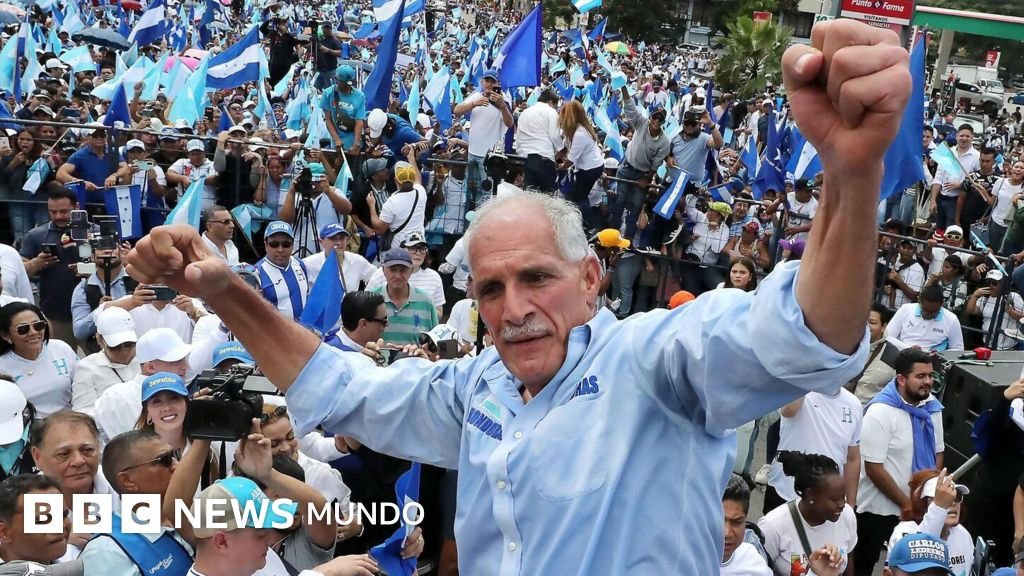
Nasry Asfura Declared President-Elect of Honduras Amid Controversy
After nearly a month of uncertainty following the recent elections, conservative candidate Nasry “Tito” Asfura has officially been declared the president-elect of Honduras, securing 40.26% of the votes according to the National Electoral Council (CNE). Asfura expressed his readiness to govern in a celebratory message on social media, assuring the public, “Honduras, I am prepared to govern. I won’t let you down.” This announcement comes amidst claims of electoral fraud that have sparked considerable debate.
Opposition Response
The opposition candidate, centrist Salvador Nasralla, who garnered 39.39% of the votes, has denounced the election results as fraudulent, refusing to recognize the CNE’s announcement. He took to social media to assert, “There are thousands of records with inconsistencies that you can verify on your phone or computer. The issue resolves by counting the votes in the ballot boxes. Stop misleading the people!”
Shortly after the election results were revealed, U.S. Secretary of State Marco Rubio congratulated Asfura, who had Donald Trump’s backing during the campaign. Rubio stated via social media, “The people of Honduras have spoken: Nasry Asfura is the next president of Honduras.” He urged all parties to respect the confirmed results to ensure a peaceful transition of power.
Background of Nasry Asfura
Nasry Juan Asfura Zablah, son of Palestinian immigrants, began his public career in the Central District Municipality in the 1990s, holding various operational and managerial positions through different municipal administrations. Analysts suggest that this initial experience in local government shaped his pragmatic approach, focusing on executing projects and tackling practical issues.
Asfura’s political journey took a significant turn in 2005 when he first ran in the National Party’s primary elections for the Central District mayoralty. He adopted the catchy slogan “¡Papi a la orden!”—a colloquial phrase aimed at conveying approachability and service. Although he lost that primary, the slogan resonated with party members and the public, becoming his most recognizable political brand.
Political Rise and Administration
His political ascent culminated with his election as mayor of the Central District in 2013, a position he was re-elected for in 2017, totaling nearly eight years in the role. During his tenure, he proudly reported the completion of 1,142 projects, including major infrastructure endeavors such as bridges, overpasses, and road expansions designed to alleviate congestion in the capital city. His initiatives also included paving over 200 kilometers of roads and implementing drainage and flood mitigation projects in vulnerable neighborhoods, earning him considerable popularity.
After an unsuccessful bid for the presidency in the 2021 general elections against the current left-leaning president, Xiomara Castro, Asfura emerged as the frontrunner in 2025, winning the internal primaries with 75.8% of the vote against former first lady Ana García, solidifying his position as a leading nationalist candidate.
Campaign Proposals
Asfura’s campaign was built around a comprehensive package of initiatives under the “Vision 5 Stars” framework, which integrates economic, social, and environmental goals. A major focus of his campaign is to invigorate the economy and create jobs—two critical challenges that Honduras faces.
He pledged to attract private and foreign investment by simplifying bureaucratic processes, ensuring legal security, and fostering public-private partnerships in infrastructure and tourism. His aim is to reduce the country’s informal employment rate, which exceeds 70%. Furthermore, Asfura is advocating for the deregulation of the economy to stimulate growth.
In addition, he promised to digitize government processes, decentralize resources to local municipalities, and ensure equitable public administration. In terms of social issues, Asfura plans to expand technical and digital education, enhance healthcare facilities, and broaden housing programs for low-income families.
Security is another pressing concern for the Central American nation. Asfura vows to bolster police capabilities and reclaim public spaces with a strategy focused on community prevention and presence. His environmental agenda emphasizes a transition to renewable energy sources, improving energy efficiency, and protecting forests and watersheds, distinguishing him from other conservative leaders in the region.
On the international front, Asfura seeks to establish a preferential alliance with the United States, renew relations with Taiwan, and strengthen ties with Israel, distancing himself from regimes like Venezuela while leveraging these partnerships to attract investment and support orderly labor migration.
Controversies
Asfura’s tenure in public office has not been without its controversies and ethical questions. In 2020, the Special Prosecutor’s Unit Against Corruption (UFERCO) filed a request for immunity against him, citing alleged abuse of authority, fraud, and embezzlement linked to a suspect diversion of 29.4 million lempiras (approximately $1.12 million) from the Central District Municipality between 2017 and 2018. The Supreme Court of Justice halted the process, determining that it must await an audit from the Superior Court of Accounts.
The case has resurfaced recently, with Asfura’s supporters claiming it is politically motivated, aimed at damaging his electoral prospects. Additional scrutiny has emerged regarding his association with Sulambiente, a waste management company that received a substantial payout following a failed contract in San Pedro Sula, in which he had been a shareholder. Furthermore, Asfura was mentioned in the Pandora Papers in 2021 as an alleged shareholder of an offshore company registered in Panama, though the inquiry did not find any criminal wrongdoing.
On the opposing side, Salvador Nasralla accused CNE officials of acting under the influence of “organized crime” and continues to reject Asfura’s victory. He also alleged that former president Juan Orlando Hernández orchestrated electoral fraud. Manuel Zelaya, the former president of Honduras and husband to the outgoing president, asserted before the announcement that the CNE was engaged in an illegal act that could be seen as an electoral coup.
Conclusion
The election of Nasry Asfura as president of Honduras has sparked significant debate, particularly surrounding allegations of fraud and ethical concerns from his past. As he embarks on his new role, the nation watches intently, hoping for the promised changes to improve the socio-economic landscape of Honduras.
- Nasry Asfura declared president-elect of Honduras with 40.26% of votes.
- Opposition candidate Salvador Nasralla claims electoral fraud and refuses to accept results.
- Asfura’s campaign focused on economic growth, job creation, and social development.
- Controversies surrounding Asfura’s previous administration and ethical issues persist.