
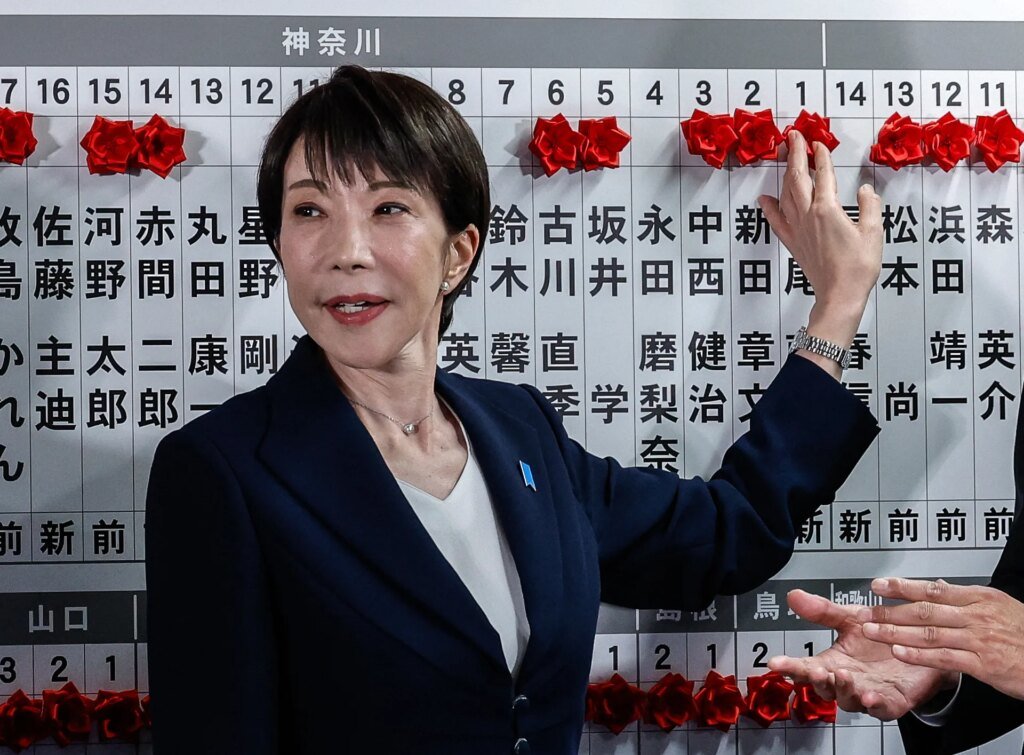
Takaichi’s Party Poised for Major Victory in Japan’s Lower House Election
Japanese Prime Minister Sanae Takaichi is on track for a significant win in the recent lower house elections, with forecasts indicating her party could secure between 274 to 328 of the 465 available seats. This projection positions her Liberal Democratic Party (LDP) well beyond the 233 seats needed for a simple majority, according to exit polls from a major public broadcaster.
In coalition with the Japan Innovation Party, also known as Ishin, Takaichi’s LDP could potentially capture as many as 366 seats in the more influential lower chamber of parliament. The party’s success is seen as a pivotal moment following a snap election called just three months prior to reshape the political landscape.
Commitment to Responsible Fiscal Policy
After the promising projections, Takaichi emphasized the importance of a responsible and proactive fiscal policy to ensure the country’s financial sustainability. “We aim to prioritize necessary investments and uphold fiscal responsibility,” she stated in her remarks to the press.
Despite Takaichi’s rising popularity, her party has been marred by funding and religious scandals over the years. The LDP has been in power for most of Japan’s post-war history, and this election was seen as a chance to rejuvenate its image, especially after the discontent surrounding its governance.
Her proposal to suspend the eight percent sales tax on food in light of rising prices has raised some concerns among investors. Doubts linger on how the country, which holds the highest debt-to-GDP ratio among advanced economies, would finance such measures. Nonetheless, voters braved harsh winter conditions, including heavy snowfall that disrupted travel across various regions.
Local voters expressed their feelings about the election. Kazushige Cho, 54, highlighted Takaichi’s vision as a unifying force, stating, “It feels like she’s creating a sense of direction for our country.” In contrast, 74-year-old Mineko Mori expressed apprehension over the long-term impact of potential tax cuts on future generations.
Takaichi’s Legislative Power
Experts believe that Takaichi’s anticipated success could empower the LDP to bypass opposition, enabling her to advance significant legislation, including the approval of substantial budgets and increased defense spending. Craig Mark, a lecturer at Hosei University, remarked that her mandate could alter Japan’s long-standing pacifist posture shaped by its post-World War II constitution.
This could represent a prime opportunity for Takaichi to reshape Japan’s international image and defense strategy. Yoshinobu Tsutsui, leading Japan’s business lobby, noted that the election results signal a return to political stability essential for economic growth.
Implications for China Relations
The election outcome is also notable for Japan’s relationship with China. Takaichi’s recent statements regarding military readiness in the event of a Chinese attack on Taiwan have already sparked tensions. A significant win could accelerate her defense plans, which China might perceive as a revival of Japan’s militaristic past.
“China will not be pleased with Takaichi’s victory,” commented David Boling from the Asia Group. He noted that Beijing’s attempts to isolate her politically have clearly faltered.
- Takaichi’s LDP projected to win between 274-328 seats in parliamentary elections.
- Her government emphasizes sustainable fiscal policies and responsible investments.
- The election outcome could bolster Japan’s defense strategy amid tensions with China.
- The results signal potential political stability for Japan’s economy moving forward.