
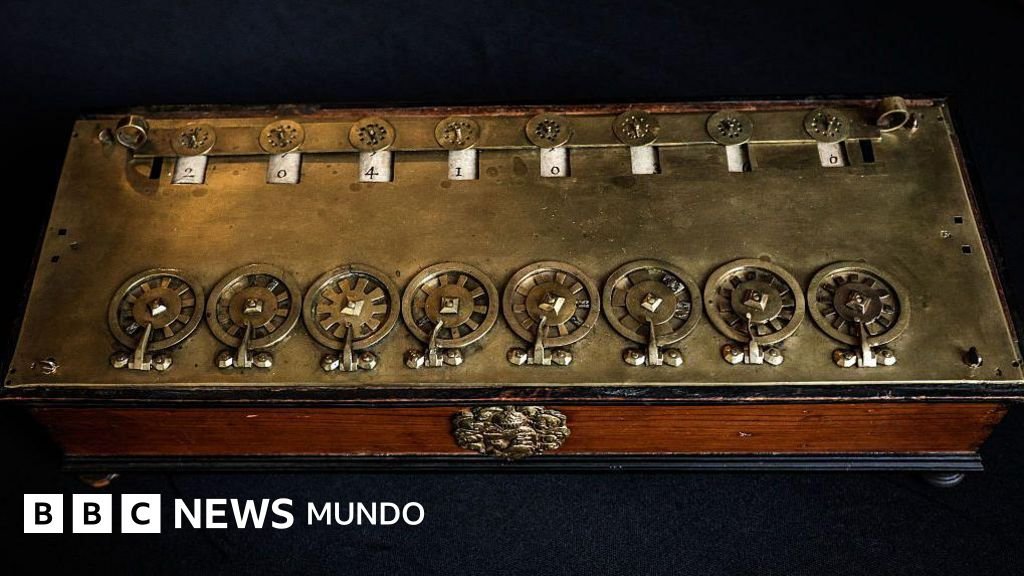
The Pascaline: A Treasure of Scientific Heritage
The Pascaline, crafted by the brilliant Blaise Pascal in the 17th century, is not just a simple calculating machine; it’s a monumental piece of scientific history facing potential loss. This article discusses the recent outcry surrounding its sale, the legacy of Pascal, and the cultural implications of this device in modern computation.
A Shocking Announcement
Recently, members of the Institute of France, which represents the nation’s cultural and scientific heart, expressed their dismay regarding the imminent sale of a Pascaline. Known for its ability to perform additions, subtractions, multiplications, and divisions, this machine measures 36 x 12.5 x 6.5 cm. Their statements echoed a profound concern: “What an astonishing error! How tragic is the realization of neglect for our scientific heritage!” This sentiment, captured in a piece published by Le Monde, emphasized the Pascaline as a precursor to modern computing, placing France at the forefront of this incredible intellectual revolution.
A Call to Action
Experts urged the French government to reconsider the export license granted to Christie’s auction house, emphasizing that the state had thus overlooked the classification of the Pascaline as a ‘national treasure.’ The machine was part of a unique collection belonging to Léon Parcé, a Frenchman of Catalan descent, whose private library housed nearly a hundred bibliographic treasures, including rare manuscripts and significant scientific treaties.
The Legend of Blaise Pascal
Blaise Pascal, a giant of intellectual thought born in 1623, has left an indelible mark across various fields: mathematics, physics, philosophy, and religious thought. Today, the unit of pressure, the Pascal, commemorates his vital contributions to our understanding of gases. He’s also renowned for creating the Pascal’s Triangle and for formulating Pascal’s Wager—an argument that rationalizes belief in God. His work laid the foundation for modern probability theory and he distinctly proved the existence of vacuum.
A Multifaceted Scholar
Pascal was not just an abstract thinker; he also engaged in practical inventions. His famous Law of Pascal led to devices that predated contemporary syringes, demonstrating his prowess in practical physics. He also pioneered urban transport concepts in Paris with the establishment of fixed-route carriages, laying groundwork for modern public transport.
The Birth of the Pascaline
Pascal’s journey to creating the Pascaline began at age 19 when he sought an efficient solution to assist his father—a royal tax collector—in his accounting duties. After years of refinement, he unveiled the machine in 1645, excitedly introducing it alongside a necessary advisory for those eager to learn about this remarkable invention. He praised its effectiveness in minimizing human error during calculations.
Historical Significance
Although the Pascaline was a marvel of engineering, its complex design ultimately hindered widespread adoption. Nevertheless, it captivated the minds of renowned scholars, including Gilles de Roberval. The invention even became the first machine documented in the Diderot and d’Alembert Encyclopedia and paved the way for later calculating devices.
The Auction and Its Implications
During the successful auction of Léon Parcé’s collection, numerous seminal scientific works exchanged hands. However, notably absent was the Pascaline itself. Prior to the auction, legal challenges were raised to prevent its public sale, highlighting its unique significance as the only surviving device of its kind design for topographical calculations. An administrative court in Paris temporarily blocked its export after deeming it a potential ‘national treasure.’
As the dust settles, the fate of the Pascaline remains uncertain, but for now, it rests safely at home. It represents not just a piece of machinery, but a critical element of France’s intellectual and technological legacy.
Key Takeaways
- The Pascaline, created by Blaise Pascal, is a crucial artifact of scientific history.
- Concerns over its sale have prompted legal actions to classify it as a national treasure.
- Pascal was a significant figure whose influence spans multiple disciplines, including mathematics and public transportation.
- The Pascaline is regarded as a forerunner of modern calculating machines.