
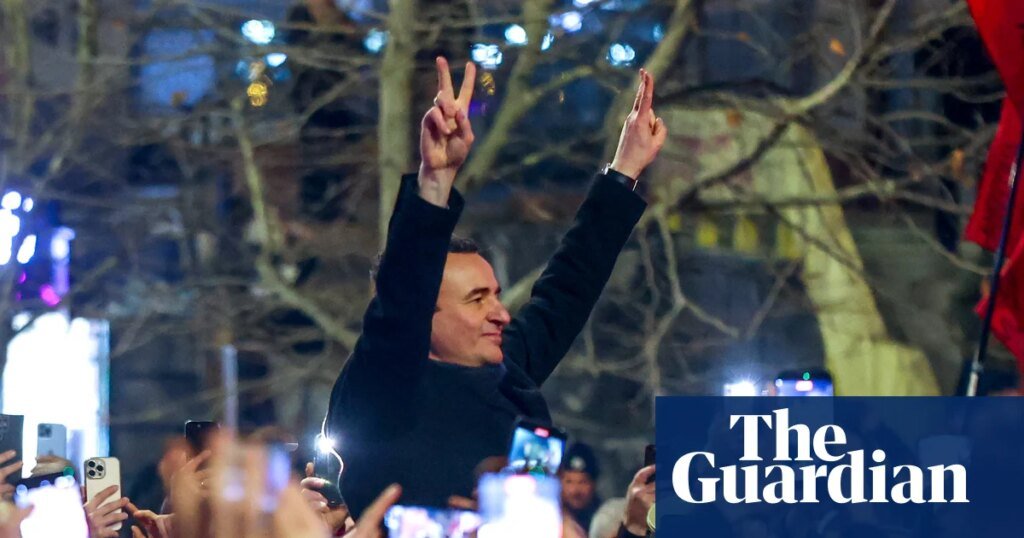
Kosovo’s Prime Minister Albin Kurti Secures Major Election Victory
In a decisive turn of events, Kosovo’s Prime Minister Albin Kurti has emerged victorious in the latest election, putting an end to a political stalemate in Europe’s youngest nation. This win not only reinforces Kurti’s mandate but also paves the way for crucial domestic reforms, including enhancing welfare and increasing salaries for public sector workers. Nevertheless, he faces significant challenges, such as ongoing tensions with Serbia and underdeveloped health and education systems compared to other Balkan nations.
Election Results and Reinvigoration of Leadership
With nearly complete vote counts, Kurti’s Self-determination Party garnered over 49% of the votes in Sunday’s snap election. This outcome means he will require only a few minor coalition partners to secure a governing majority. This victory signifies a remarkable comeback for Kurti, who struggled to form a coalition with larger opposition parties in previous elections, resulting in a non-functioning parliament for much of 2025. This deadlock delayed approximately €1 billion in vital international funding for one of Europe’s most impoverished states.
Focus on International Relations and Domestic Reform
In Kurti’s new term, he will be focusing on improving Kosovo’s relationships with its international allies, particularly the U.S., as well as working towards joining the European Union, a goal he fervently supports. Political commentator Ilir Deda remarked, “It’s a political earthquake that has shattered the opposition parties, and we are going to feel the consequences of this result for the next decade. Kosovo has opted for a strong government model with a weak opposition, akin to other Western Balkan nations.”
The Impact of the Diaspora Vote
The recent poll coincided with a holiday season that typically sees a surge of participation from the Kosovo diaspora, which likely contributed to Kurti’s success. He previously served as prime minister for a brief stint in 2020 and has held the position since March 2021. According to an exit poll by Ubo Consulting, a substantial 61.7% of the diaspora cast their votes for Kurti’s party.
Public Sentiment and Expectations
Tahir Shabani, a 58-year-old Kosovo native living in Germany, returned to Pristina to vote and expressed relief over the election result, stating: “We are tired of this nine-month blockade that has cost us our nerves, cost Kosovo millions of euros, and set back our development. With this result, there is a solution, and that is why we are happy.”
Conversely, some citizens are eager for immediate improvements post-impasse, particularly in living standards, healthcare, and education. Skender Halimi, 52, a voter in Pristina, emphasized the need for institutions to be operational: “We have much work ahead, just as the prime minister said. The budget must be approved, international agreements must follow, and progress is essential.”
Historical Context and Ongoing Challenges
Kosovo declared its independence from Serbia in 2008, supported by the U.S., following a war that included a NATO intervention to halt Serbian forces from suppressing an uprising by the ethnic Albanian majority. Despite receiving recognition from over 100 countries, Kosovo, home to 1.6 million people, continues to grapple with poverty, instability, and organized crime. Key nations like Serbia, Greece, Spain, and Russia do not acknowledge Kosovo’s statehood.
The year 2023 saw escalated tensions with Serbia, leading to EU-imposed sanctions against Kosovo, partly in response to Kurti’s policies affecting the Serbian minority in northern Kosovo. These sanctions are estimated to have cost the country hundreds of millions of euros. However, as the election campaign commenced, the EU indicated it would lift these sanctions, which Deda interpreted as a positive sign for Kurti’s government’s relationship with the West.
Conclusion
Albin Kurti’s election victory not only reinstates his leadership but also opens up avenues for essential reforms in Kosovo. As he embarks on this new term, the expectations from the public are high, particularly concerning the economic and social spheres. The path ahead is fraught with challenges, yet it also offers a chance for transformative growth and strengthened international ties.
- Albin Kurti won over 49% of the votes in the recent election, allowing him to push for key reforms.
- The election result reflects a shift towards strong government and weak opposition in Kosovo.
- Public expectations are geared towards immediate improvements in healthcare, education, and overall quality of life.
- Kosovo continues to face significant challenges, including international recognition and relationship tensions with Serbia.