
Myanmar’s Military-Backed Party Claims Victory in General Election Amid Ongoing Turmoil
Myanmar’s military-supported political party has announced a decisive win in the country’s recent three-phase general election, as reported by state media. This outcome solidifies predictions made following a tightly managed political landscape set against the backdrop of civil conflict and extensive repression.
Election Results
The Union and Solidarity Party (USDP) triumphed in all stages of the election, securing a significant majority in both chambers of Myanmar’s legislature. Results reveal that the USDP won 232 out of 263 available seats in the lower house, the Pyithu Hluttaw, and 109 out of 157 declared seats in the upper house, the Amyotha Hluttaw, according to announcements made on Thursday and Friday.
As per a report from pro-military media outlet Eleven Media Group, Myanmar’s parliament is set to convene in March to select a new president, with a new government anticipated to step into power by April.
Background of the Election
The final voting round concluded in late January, wrapping up an election that commenced on December 28—over four years after the military coup that toppled the elected government led by Nobel Peace Prize laureate Aung San Suu Kyi.
Ever since the coup, Myanmar has been engulfed in political crisis, with severe crackdowns on pro-democracy protests igniting a nationwide rebellion. The United Nations estimates that approximately 3.6 million people have been displaced due to the ongoing conflict.
International Reactions and Criticism
The 11-member Association of Southeast Asian Nations (ASEAN) has stated it cannot endorse the election process, while human rights organizations and several Western nations have also condemned the elections, labeling them as a façade.
Despite criticism, Myanmar’s military government insists that the elections were conducted fairly and that they enjoyed public support. The National League for Democracy, led by Aung San Suu Kyi, has been dissolved along with numerous other political parties, with some choosing to boycott the election altogether. Critics argue that the electoral framework is designed to reinforce military dominance.
Political Landscape and Military Influence
In Myanmar’s political framework, the military is entitled to a guaranteed 25% of the parliamentary seats, ensuring ongoing influence even as power is nominally transferred to a civilian-led government.
Founded in 2010 after decades of military governance, the USDP aims to serve as a proxy for the armed forces. The party is led by a retired brigadier general and includes numerous former high-ranking military officials. In this election, the USDP ran with 1,018 candidates, representing a fifth of the total number registered.
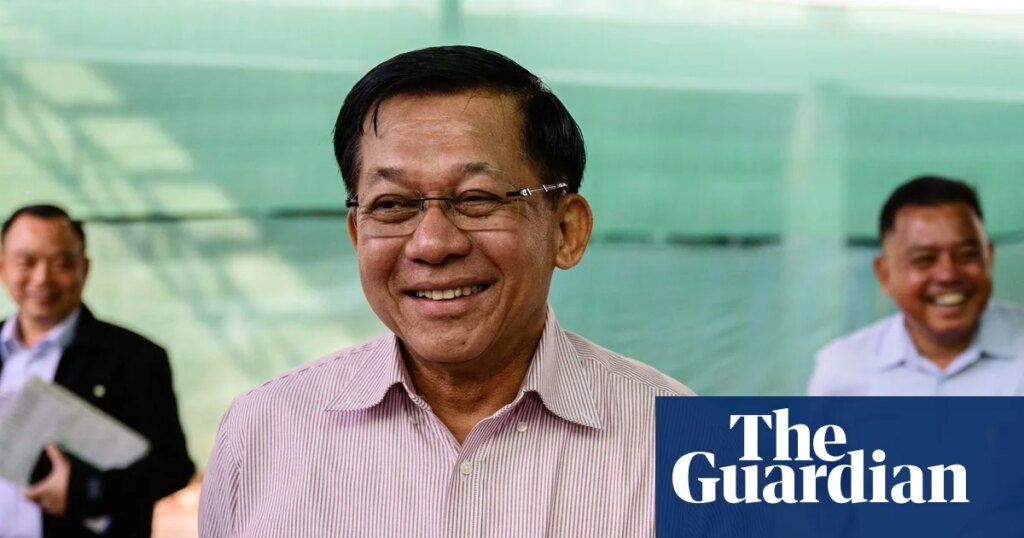
Junta chief Min Aung Hlaing is expected to remain a significant player in the new government. He has characterized the elections as a step towards stability, dismissing criticism from opponents and foreign entities while affirming that governmental responsibilities will be transitioned to the newly elected administration.
Voter Turnout and Challenges
The overall voter turnout was about 55% across all three phases, a decline compared to approximately 70% in previous elections. This lower turnout stands in stark contrast to the 2015 election that brought Aung San Suu Kyi to power and the 2020 election, whose results were invalidated by the junta prior to the coup.
Voting occurred in 263 of Myanmar’s 330 townships, with many areas unable to participate due to intense military conflicts and ongoing resistance from ethnic armed groups and local factions that have arisen since the 2021 coup.
- The USDP achieved a sweeping victory in Myanmar’s general election amid ongoing political unrest.
- The military junta asserts that the elections were fair despite widespread international criticism.
- Voter turnout was reported at 55%, down from previous elections.
- The elections proceed despite significant civil instability and displacement of millions.