
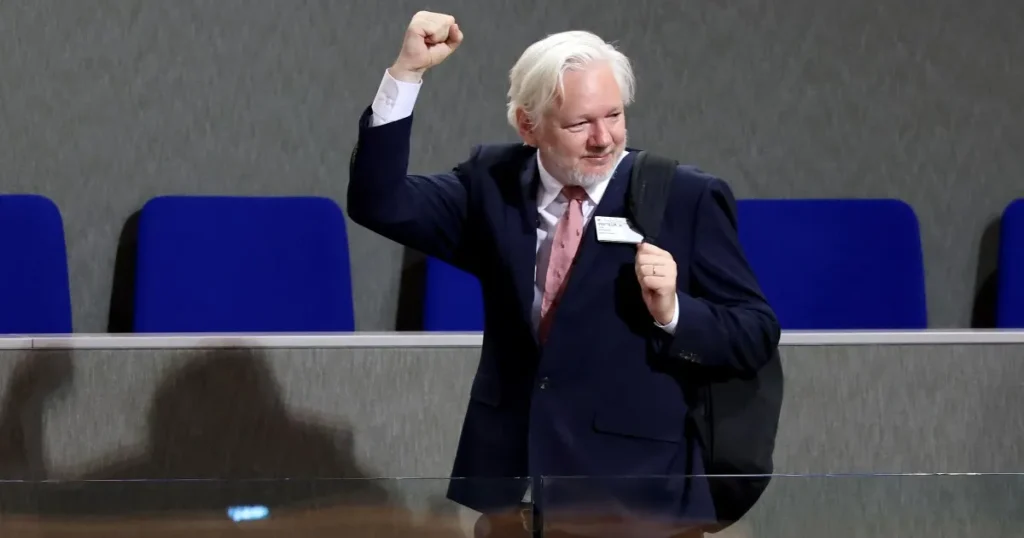
Nobel Prize Controversy: Assange Challenges Decision to Honor Venezuelan Opposition Leader
WikiLeaks founder Julian Assange has recently sparked a heated debate by filing a criminal complaint in Sweden against the Nobel Foundation. His complaint specifically targets the organization’s decision to award this year’s Nobel Peace Prize to María Corina Machado, a leader in Venezuela’s opposition movement. Assange argues that granting Machado this prestigious honor constitutes a “gross misappropriation” of funds and risks enabling war crimes under Swedish law.
Details of the Complaint
In his complaint, submitted on Wednesday, Assange seeks to prevent the transfer of 11 million Swedish kronor (approximately $1.18 million) designated as prize money to Machado. He claims that the award transforms a symbol of peace into one of conflict, stating that it facilitates actions that contravene international humanitarian laws.
Accusations of Misappropriation
Assange’s filing implicates 30 individuals associated with the Nobel Foundation, including top leadership. He accuses them of misappropriating funds, enabling war crimes, and perpetrating crimes against humanity. According to Assange, Machado has incited international crimes, particularly through her alignment with U.S. military efforts aimed at ousting Venezuela’s President Nicolás Maduro.
Controversies Surrounding Machado
Machado’s nomination has not been without backlash, especially concerning her outspoken support for Israel amid its ongoing military actions in Gaza. Her connections with Israeli Prime Minister Benjamin Netanyahu in the aftermath of her Nobel accolade have drawn significant criticism. Additionally, she has advocated for relocating Venezuela’s embassy in Israel to Jerusalem if she assumes power.
Support for U.S. Intervention
Furthermore, Machado has openly supported U.S. President Donald Trump’s aggressive campaign against Maduro, aligning herself with the administration’s hawkish stance. Trump and his officials claim that Maduro has connections to drug trafficking organizations posing a threat to U.S. national security, although this assertion has raised skepticism within U.S. intelligence circles. The Trump administration has also carried out numerous military operations against perceived drug traffickers in the region, resulting in significant casualties.
Assange’s Principles and Concerns
Assange contends that Machado’s endorsement of military action categorically disqualifies her from receiving the Nobel Peace Prize. He references Alfred Nobel’s 1895 will, which explicitly states that the prize should be awarded to those who have made significant contributions to promoting fraternity between nations. Assange warns of the potential misuse of the award funds, arguing that they could facilitate acts of aggression and crimes against humanity, contradicting the award’s charitable intent.
Nobel Foundation’s Responsibility
While the Nobel Peace Prize is awarded by a committee in Oslo, Assange stresses that the Nobel Foundation, based in Stockholm, bears financial responsibility. Reportedly, Swedish police have acknowledged receipt of Assange’s complaint.
A Brief Background on Julian Assange
Julian Assange founded WikiLeaks in 2006, gaining international attention in 2010 following the release of classified military documents by former U.S. Army intelligence analyst Chelsea Manning. To evade extradition to Sweden for sexual assault allegations—later dropped—Assange sought asylum in Ecuador’s embassy in London, where he remained for seven years. From 2019 to 2024, he was incarcerated in London’s high-security Belmarsh prison while the U.S. pursued extradition on espionage charges. Assange was ultimately released in 2024 as part of a plea deal, returning to Australia afterward.
Conclusion
The controversy surrounding the Nobel Prize awarded to Maria Corina Machado continues to unfold, raising questions about the implications of such recognition amidst geopolitical tensions. Assange’s actions highlight the complexities of honoring individuals in a worldwide context where peace and conflict often intersect.
Key Takeaways
- Julian Assange has filed a criminal complaint against the Nobel Foundation over its decision to award the Peace Prize to María Corina Machado.
- Assange argues that the award misappropriates funds and could facilitate war crimes.
- Machado’s controversial support for U.S. military action against Venezuela is a focal point in Assange’s claims.
- Assange emphasizes that the prize should honor contributions to peace, per Alfred Nobel’s original intent.