
Protest Erupts in Brussels as Farmers Oppose Controversial Trade Pact
Published On 18 Dec 2025
Brussels saw a massive influx of farmers whose protests filled the streets with hundreds of tractors, as they rallied against the contentious trade agreement between the European Union and South American nations. This deal, known as the Mercosur agreement, is perceived by many as a looming threat to the livelihood of local farmers.
The protests erupted on Thursday just as EU leaders convened for a crucial summit to discuss the agreement’s future. According to the farm lobby Copa-Cogeca, more than 150 tractors converged on central Brussels, with estimates suggesting that upwards of 10,000 protesters gathered in the city’s European quarter.
Intensifying Tensions Amid EU Summit
This day was heightened with palpable tension both inside the summit and on the streets of Brussels. While leaders focused on a pivotal vote regarding the use of nearly $200 billion in frozen Russian assets to support Ukraine for the next two years, farmers took to the streets with a passionate show of discontent.
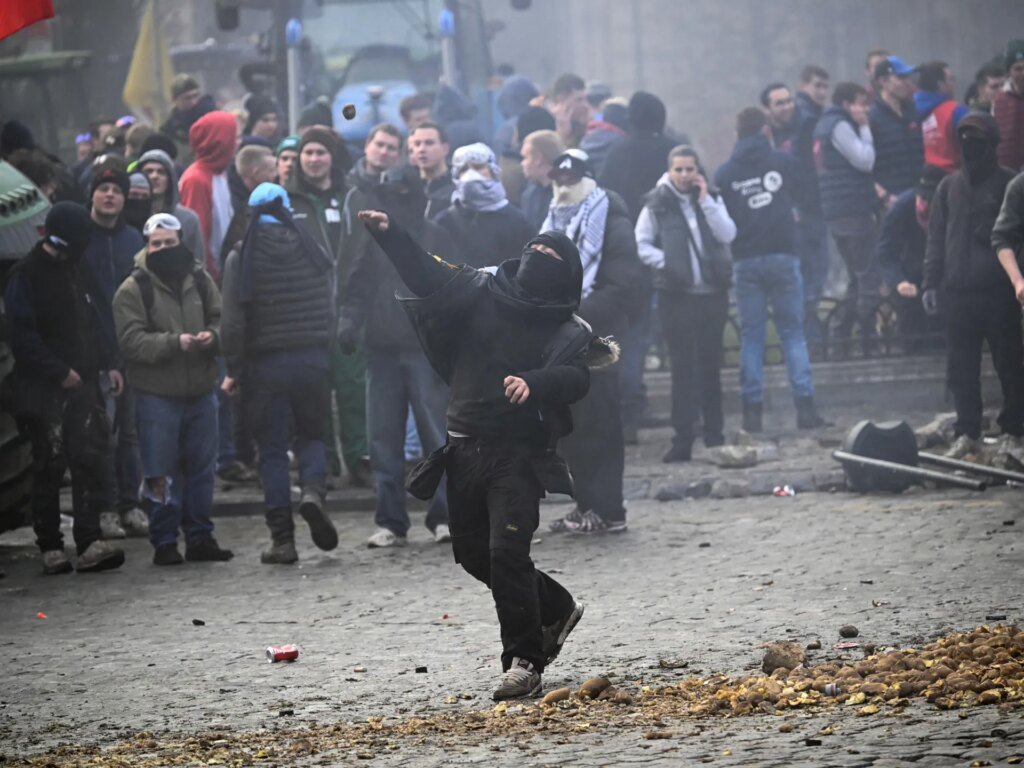
Outside the summit venue, protesters made their voices heard by throwing potatoes and eggs at police, igniting fireworks, and bringing traffic to a halt. In response, authorities deployed tear gas and water cannon, setting up barriers and closing several tunnels across the city. One tractor bore a poignant sign that questioned, “Why import sugar from the other side of the world when we produce the best right here?”
Belgian dairy farmer Maxime Mabille expressed disdain for the EU’s approach, accusing European Commission President Ursula von der Leyen of attempting to push the deal through forcefully, likening the EU’s actions to those of a dictatorship.
Fears Over Cheaper Imports
Farmers are particularly concerned that an influx of less expensive agricultural products from Brazil and neighboring countries will undermine European producers. Their worries focus on commodities such as beef, sugar, rice, honey, and soybeans, particularly since these products are subjected to less stringent safety regulations, especially concerning pesticides banned in the EU.
Florian Poncelet from the Belgian farm union FJA pointed out that protests have been ongoing since 2024 across multiple countries, expressing a desire for their voices to finally be acknowledged.
France and Italy have emerged as leading opponents of the trade pact, with President Emmanuel Macron asserting that the agreement is not ready to be signed in its current form. Teaming up with Poland, Belgium, Austria, and Ireland, France has successfully delayed the negotiations, gathering enough support within the European Council to potentially block the entire deal.
However, Germany and Spain are advocating strongly for its approval. German Chancellor Friedrich Merz emphasized the urgency of making decisions for the EU to maintain credibility in global trade policies, while Spanish Prime Minister Pedro Sanchez contended that the deal would empower Europe economically and geopolitically against global adversaries.
Future of the Agreement at Stake
The Mercosur agreement, which has been under negotiation for a quarter-century, aims to create the world’s largest free-trade area, encompassing 780 million people and accounting for a quarter of the global GDP. Proponents argue it aims to counterbalance China’s influence and enhance European exports of vehicles, machinery, and wines amidst rising tariffs from the U.S.
Even with provisional safeguards established to limit sensitive imports, resistance continues to grow. Von der Leyen is determined to travel to Brazil this weekend to finalize the pact, but she requires backing from at least two-thirds of EU member states.
The stakes have been heightened by a recent ultimatum from Brazil’s President Luiz Inacio Lula da Silva, indicating that this upcoming Saturday may represent a “now or never” situation. Lula made it clear that Brazil would not entertain further agreements during his presidency if this deal fails.
Conclusion
The protests in Brussels underscore the deep concerns among farmers regarding the potential repercussions of the Mercosur trade agreement. As tensions surrounding the deal escalate, the EU is at a crossroads that could significantly impact its agricultural sector and trade relationships.
- Farmers protested in Brussels against the EU-Mercosur trade agreement.
- The deal is feared to flood Europe with cheaper South American agricultural products.
- France and Italy lead the opposition, calling for further negotiations and safeguards.
- The outcome of the agreement remains uncertain as EU leaders grapple with internal divisions.