
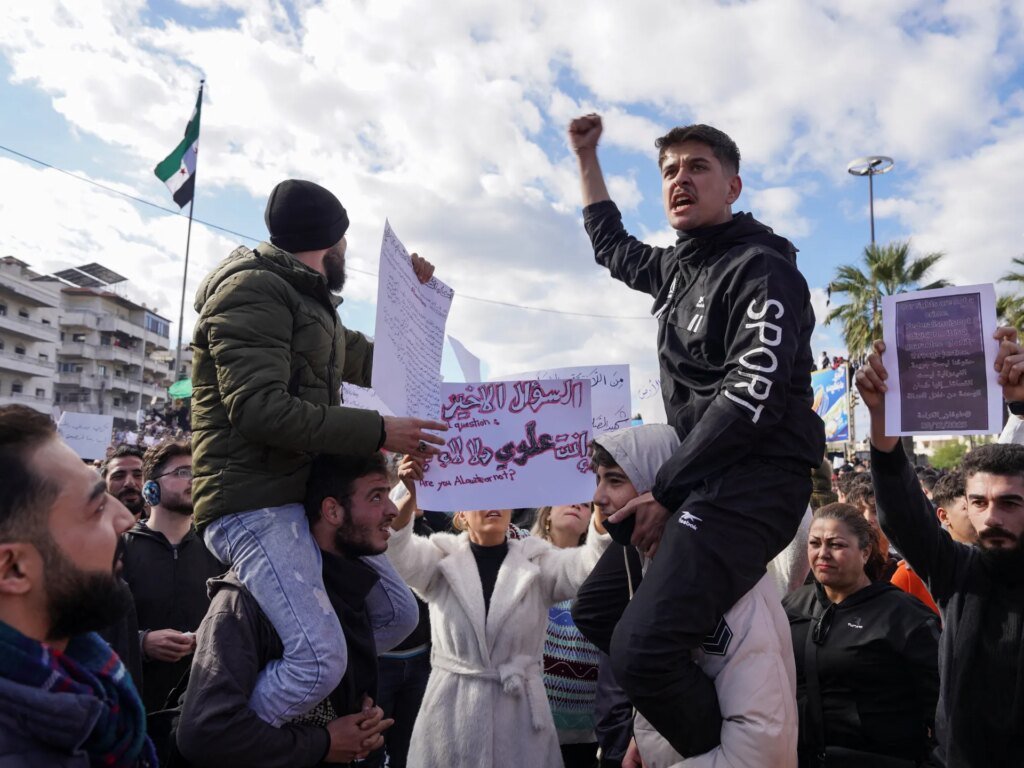
Sectarian Protests Erupt Across Syria’s Coastal Regions
In a significant escalation of sectarian tensions, protests have erupted across Syria’s coastal areas, marking the latest chapter in the nation’s ongoing conflict since the fall of Bashar al-Assad’s regime last year. The demonstrations began following a deadly bombing at an Alawite mosque, prompting community members to demand security and political reforms amid fears of escalating violence.
What Initiated the Protests?
The recent unrest was ignited by a bombing at the Imam Ali bin Abi Talib Mosque in the Wadi al-Dahab neighborhood of Homs during Friday prayers. A lesser-known group, Saraya Ansar al-Sunna, took responsibility for the attack, claiming it specifically targeted the Alawite sect. This incident comes against the backdrop of a year filled with sectarian violence, raising doubts about the interim government’s capacity to maintain national unity after years of civil war.
Reactions to the Mosque Attack
The Syrian government condemned the mosque bombing, labelling it a futile attempt to disturb peace and create chaos among the people. Since al-Assad’s regime fell in December 2024, the security landscape in Syria has been fragmented, leading to escalating tensions among various sectarian groups.
Who is Organizing the Protests?
The recent protests saw leadership primarily from Ghazal Ghazal, an Alawite religious figure residing abroad. He heads the Supreme Alawite Islamic Council in Syria and Abroad and issued a plea for political federalism, emphasizing the need for self-determination for the Alawite community. Protesters have been calling for accountability for violence against civilians and an increased sense of security.
Clashes and Security Response
In response to these protests, clashes erupted between Alawite demonstrators and counterprotesters supporting the interim government. Reports from a local correspondent noted that violence ensued, with counterprotesters hurling rocks and confrontations escalating rapidly. The Ministry of Defence stated that army units were deployed to restore order after violent outbreaks from alleged “outlaw groups.”
The Human Toll
Official reports indicate that the protests have led to significant casualties, with at least four fatalities and over a hundred injuries reported in Latakia. Injuries range from stabbings to injuries caused by stones and gunfire targeting both civilians and security personnel. Tensions remain high as security forces face mounting challenges on the ground.
Understanding the Alawite Community
The Alawites comprise a religious minority in Syria, making up roughly 10 percent of the population. Historically, this group has held considerable political power under al-Assad, who relied heavily on Alawites for positions within the military and security forces. However, since the fall of the regime, sectarian violence has gripped the nation, with numerous incidents reported over the past year affecting Alawite civilians.
Historical Context of Violence
Earlier this year, violence erupted in coastal cities, with government-aligned factions accused of executing Alawite civilians summarily. A government investigation concluded that approximately 1,400 individuals were killed during these violent outbreaks, signaling a deepening crisis influenced by historical tensions and ongoing disputes over land and sectarian identities.
Challenges to Government Stability
Amid rising tensions, Syria’s interim president, Ahmed al-Sharaa, has reiterated the importance of unity and peace within the nation. However, experts have pointed out that the central government’s limited reach and enduring sectarian divides hinder attempts at establishing equality among minority groups, including the Alawites and Druze. Concerns over representation and potential discrimination in public sector opportunities remain prevalent.
Future Scenarios
Looking ahead, there are two primary possibilities: one where the Syrian government successfully negotiates with the Kurdish-led Syrian Democratic Forces (SDF), potentially leading to a roadmap for integration and reduction of tensions, and another where ongoing violence exacerbates sectarian divides further. As the situation unfolds, Syria stands at a critical junction, with many uncertain about how events will transpire.
Conclusion
The current wave of protests in Syria signifies a crucial moment for the nation as communities voice their concerns amid a backdrop of ongoing sectarian violence. The capacity of the interim government to foster unity and address the grievances of minority groups will be vital in determining the future stability of the country.
- Protests have erupted in Syria’s coastal regions, sparked by the bombing of an Alawite mosque.
- Demonstrators are demanding political reforms and security assurances, led by Alawite religious figures.
- Clashes have resulted in casualties as tensions rise between various sectarian factions.
- The future of Syria’s governance hinges on the ability to address minority concerns and maintain national unity.