
EU Delays Mercosur Trade Deal Amid Farmers’ Protests
The European Union has postponed a significant free-trade agreement with South American nations due to widespread protests from farmers and last-minute objections from France and Italy. This decision pushes back the signing of the EU-Mercosur deal, which has been in the works for roughly 25 years, until January.
Background of the Delay
On Thursday, Paula Pinho, spokesperson for the European Commission, confirmed that the anticipated signing of the pact would not occur as planned. EU Commission President Ursula von der Leyen was initially slated to travel to Brazil for the signing ceremony, but she required support from a substantial majority of EU member states.
Key Players Involved
Reports from the Associated Press indicate that an agreement to postpone the signing was established between von der Leyen, European Council President Antonio Costa, and Italian Prime Minister Giorgia Meloni during an EU summit. Italy’s backing is crucial for moving forward in January.
French Opposition
Meanwhile, French President Emmanuel Macron expressed his concerns upon arriving at the summit in Brussels, advocating for further discussions and concessions before the signing. Macron highlighted the myriad challenges faced by farmers in the EU, reflecting the sentiments of the French agricultural sector.
Concerns About the Agreement
The trade deal, which includes Argentina, Brazil, Bolivia, Paraguay, and Uruguay, is expected to yield the EU’s largest tariff reductions to date. However, French and Italian officials have voiced fears that an influx of cheaper commodities from these countries could harm local farmers, particularly in sectors like poultry and beef. Conversely, Germany, Spain, and Nordic nations argue that the agreement would enhance exports hampered by U.S. tariffs and decrease dependence on Chinese goods.
Protests Erupt in Brussels
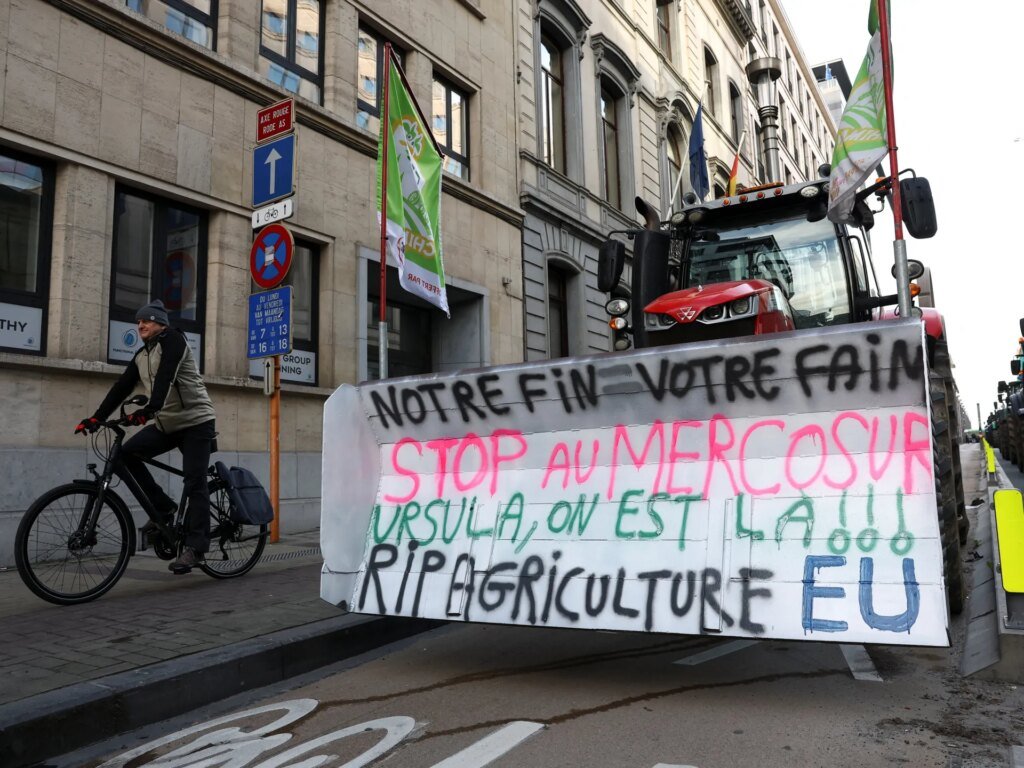
In a display of opposition, farmers took to the streets of Brussels, employing tractors to block roads and staging protests that attracted national attention. Some demonstrators traveled from as far away as Spain and Poland, throwing potatoes and eggs while clashing with police, who used tear gas and water cannons to control the situation. The protests escalated to the point where portions of the European Parliament had to be evacuated due to damages.
Response from Mercosur Nations
Following the announcement of the delay, Mercosur nations were informed of the situation. Initially, Brazil’s government reacted with urgency, suggesting that timelines should remain strict. However, Brazilian President Luiz Inacio Lula da Silva mentioned that Prime Minister Meloni requested “patience,” implying that Italy might eventually support the agreement.
Looking Ahead
The decision to delay raises questions about the dynamics between now and mid-January. It remains to be seen how the shifting political landscape and pressures from both sides will influence the outcome of this substantial trade deal.
Conclusion
The EU’s decision to postpone the Mercosur trade agreement underscores the complex interplay between international trade and local agricultural interests. With protests emphasizing the fears of farmers and varying positions among EU member states, the situation continues to evolve as stakeholders weigh their options.
Key Takeaways
- The EU-Mercosur trade deal signing is delayed until January due to farmer protests and opposition from France and Italy.
- Concerns over the impact of cheap imports on European agriculture are central to the debate.
- Protests in Brussels highlighted the frustrations of farmers regarding the proposed agreement.
- The future of the deal remains uncertain as negotiations continue among EU member states.