
The Enigmatic World of Mercury: Unlocking Its Secrets
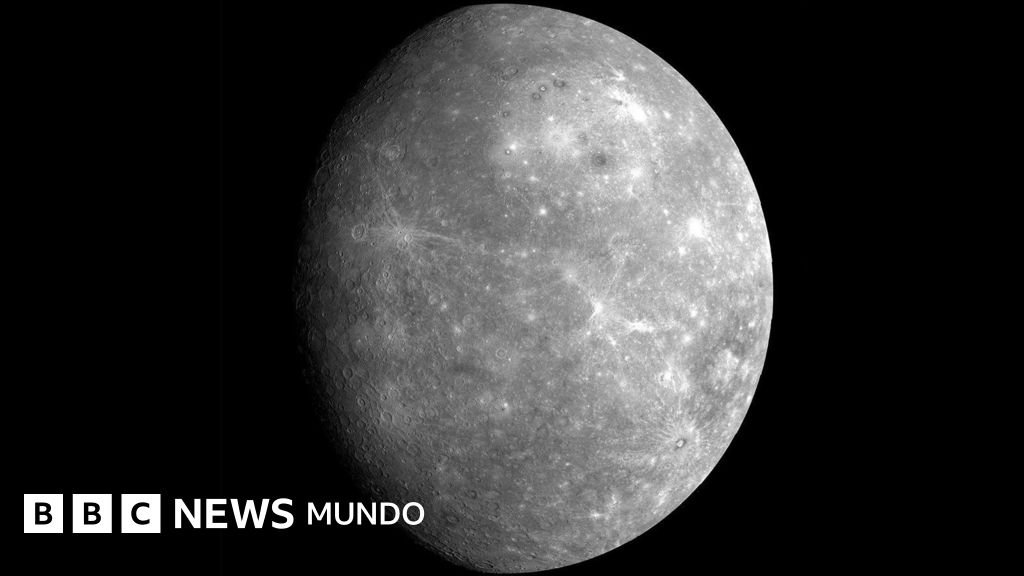
At first glance, Mercury may seem like the most boring planet in our Solar System. Its barren surface lacks significant features, there’s no trace of water from its past, and its thin atmosphere barely qualifies as one. The prospects of discovering life among its scarred craters appear nonexistent. However, taking a closer look reveals that Mercury is a fascinating and improbable world shrouded in mystery.
The Unlikely Existence of Mercury
Planetary scientists find themselves puzzled by the very existence of Mercury, the closest planet to our Sun. It’s incredibly small, with only one-twentieth the mass of Earth and a width not much broader than Australia. Yet, it’s the second densest planet in our Solar System, second only to Earth, due to a large metallic core that comprises most of its mass. Moreover, Mercury’s orbit, which hovers close to the Sun, is situated in a peculiar position that astronomers haven’t fully explained. This raises a crucial question: how did Mercury even form? By all accounts, it seems as if this planet shouldn’t exist at all.
Upcoming Exploration
The quest to decode Mercury’s origin may soon find answers with the arrival of the BepiColombo mission—an international collaboration between Europe and Japan launched in 2018. This will mark the first visit to Mercury in over a decade. Upon reaching its orbit, anticipated in November 2026 after a delay caused by a propulsion issue, one of the primary objectives will be to shed light on Mercury’s origins.
Mysteries Beneath the Surface
The surface of Mercury is marked by craters and lava flows, but beneath lies a massive metallic core. Understanding Mercury’s formation is crucial not only for insights into our Solar System’s origins but also for studying planets orbiting other stars, known as exoplanets. “Mercury is likely the closest thing we have to an exoplanet,” states Saverio Cambioni, a planetary scientist at the Massachusetts Institute of Technology. “It’s a truly fascinating world.”
The Discovery Journey
The first hint that something was amiss with Mercury came from NASA’s Mariner 10 spacecraft, which flew by the planet three times in 1974 and 1975—the first human encounters with this distant celestial body. Those flybys yielded initial gravity measurements and offered a rare glimpse into Mercury’s interior, revealing its unusual composition.
Understanding Mercury’s Core
While Earth, Venus, and Mars possess iron-rich cores that make up about half their radius, Mercury’s core forms nearly 85% of its radius. It sports only a thin rocky mantle and crust on top. This unique structure contributes to the planet’s remarkable density, but why it developed in this manner remains a mystery. “The formation of Mercury is a major puzzle,” notes Nicola Tosi, a planetary scientist at the German Aerospace Center in Berlin. “We still don’t understand why Mercury is the way it is.”
New Insights from Missions
The subsequent NASA mission, MESSENGER—which orbited Mercury from 2011 to 2015—left us with even more questions. Orbiting the Sun at a mere 60 million kilometers away, daytime temperatures on Mercury can soar to 430°C, while nighttime can plunge to -180°C. Despite such extreme conditions, MESSENGER discovered volatile elements like potassium and radioactive thorium on the surface, which should have long evaporated due to solar radiation. Additionally, complex molecules such as chlorine and even trapped water ice found in shadowy polar craters raised further questions about Mercury’s existence.
The Challenges of Formation Theories
The positioning of Mercury has posed a long-standing challenge for astronomers trying to explain its formation. Existing solar systems form from a disk of dust and gas around stars, slowly accumulating material to grow planets. However, Mercury’s distance from Venus complicates this model, leading researchers to search for alternate explanations.
Possible Scenarios
- **Giant Impact Theory:** One of the leading ideas suggests that Mercury may have once been much larger, potentially double its current size. It is theorized that an enormous impact—possibly from another planet the size of Mars—stripped away Mercury’s outer layers, leaving behind its dense iron core.
- **Ferrous Formation Theory:** Another possibility is that Mercury was formed from material closer to the Sun, enriched in iron. This theory argues that the early solar system’s heat caused lighter materials to evaporate, leading to the formation of a iron-rich Mercury.
Despite these theories, questions remain, particularly regarding why debris from such an impact did not settle back on the planet or create moons, especially since Mercury has none. Other postulations involve the possibility of a collision mechanism termed “collision pulverization,” where the debris was ground into fine powder carried off by solar wind.
New Discoveries from BepiColombo
As the BepiColombo mission approaches, scientists hope to clarify many aspects of Mercury’s origin. The two spacecraft involved, operated jointly by the European Space Agency (ESA) and the Japan Aerospace Exploration Agency (JAXA), will separate to employ their instruments for detailed studies of the planet’s surface composition, gravity, and weak magnetic field.
Unlocking Mercury’s Mysteries
According to Tosi, BepiColombo will obtain crucial data that could illuminate Mercury’s origin. If the planet had once been larger, evidence of a molten mantle may still exist today. Initial images of Mercury from the spacecraft have shown its surface marked by impact craters and ancient lava flows, with signs of a vast lava flood from around 3.7 billion years ago.
Ultimately, understanding how Mercury formed could lead us to broader insights about planetary formation and our cosmic neighborhood. “What we truly want is a sample from Mercury,” Rothery states, as scientists aspire to unlock the planet’s secrets through further study.
Conclusion
Mercury, while appearing bleak and metallic from afar, holds vast mysteries about its formation and existence. As BepiColombo continues its journey, the enigmatic planet challenges our understanding of how celestial bodies come into being and operate within their star systems. Whether Mercury is an anomaly or a common entity among the stars remains to be seen.
Key Takeaways
- Mercury’s existence is puzzling due to its peculiar dense core and barren surface.
- The BepiColombo mission aims to uncover secrets regarding Mercury’s origin and structure.
- Understanding Mercury may provide broader insights into planetary formation in our Solar System and beyond.
- Theories about its formation range from giant impacts to unusual solar material conditions.