
The Astonishing Discovery of a Supermassive Black Hole’s Outburst
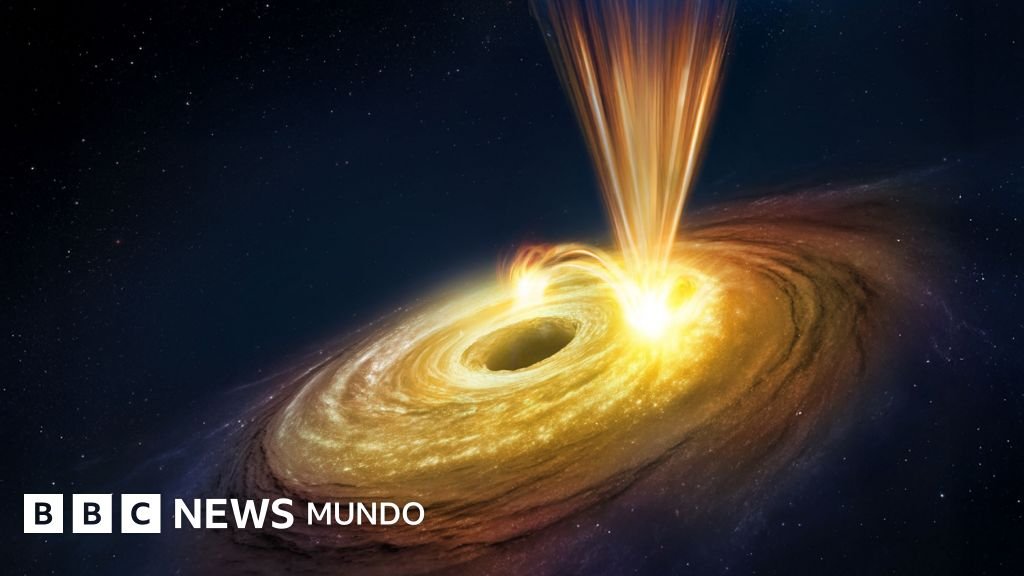
In an unprecedented observation, astronomers have captured a spectacular outburst from a supermassive black hole, which is estimated to be thirty million times the mass of our sun. This extraordinary event was marked by a brilliant flare of X-ray radiation that emerged and then faded away rapidly. As it dwindled, this gravitational giant expelled material into space at an astonishing speed of 60,000 kilometers per second. A study published in Astronomy & Astrophysics highlights that the winds triggered by this flare mirror those formed by the Sun, potentially offering broader insights into our universe.
Understanding Black Holes
Despite their ominous name, black holes are not actually holes in space; rather, they are enormous concentrations of matter squeezed into a tiny area, according to NASA. Their incredible density means that nothing can escape their gravitational pull—not even light—which is what makes them one of the most enigmatic objects in the cosmos. Supermassive black holes harbor masses many times greater than that of the Sun; in fact, they can possess billions of times more mass. These colossal entities are typically found at the centers of most large galaxies, surrounded by rotating disks of gas and dust that they can absorb due to their intense gravity.
As these black holes “devour” surrounding material, the disks become extremely hot, emitting bright light across various wavelengths, including X-rays. Additionally, these black holes eject jets and streams of gas, known as winds, which contain ionized atoms that may even influence the birth of new stars within their galaxy.
“We have never observed a black hole generating winds at such rapid speeds before,” says Liyi Gu, lead researcher at the Netherlands Institute for Space Research (SRON).
A Closer Look at the Event
The supermassive black hole under study is located in a spiral galaxy approximately 130 million light-years away from Earth. To witness this unique phenomenon, researchers utilized two telescopes that worked in tandem. One of these is the XMM-Newton telescope operated by the European Space Agency (ESA), dedicated to studying X-ray sources throughout the universe. The other is the X-Ray Imaging and Spectroscopy Mission (XRISM), part of a collaborative effort led by the Japan Aerospace Exploration Agency (JAXA), with contributions from both ESA and NASA.
The radiant region fueled by this supermassive black hole is referred to as an active galactic nucleus (AGN). According to Matteo Guainazzi, a project scientist for XRISM at ESA, “The winds surrounding this black hole seem to arise when the AGN’s intricate magnetic field suddenly ‘unravels,’ much like solar eruptions, but on an almost unimaginable scale.” Camille Diez, a team member and ESA researcher, emphasizes that AGNs with strong winds “play a crucial role” in shaping their galaxies over time.
Unlocking the Secrets of the Universe
This study indicated that the winds emanating from the black hole resemble significant eruptions found on the Sun, known as coronal mass ejections. These massive expulsions of charged particles from the Sun’s outer layer can have effects on Earth as well.

Coronal mass ejections often occur simultaneously with solar flares, which are bursts of radiation from the release of stored energy in twisted magnetic fields. “By focusing on an active supermassive black hole, the two telescopes have uncovered something we’ve never seen before: fast and ultrafast winds triggered by eruptions, similar to those formed on the Sun,” remarks Erik Kuulkers, a scientist involved with the XMM-Newton project at ESA. “This discovery is thrilling, suggesting that solar physics and high-energy physics could operate in remarkably similar ways across the universe.”
Conclusion
The recent findings surrounding the explosive outburst of a supermassive black hole offer fascinating implications for our understanding of cosmic events. By connecting the behavior of black holes with phenomena observed in our own solar system, researchers uncover intricate relationships that span the universe.
- Astronomers have recorded a unique outburst from a supermassive black hole.
- The event released material into space at speeds of 60,000 km/s.
- Similarities between black hole winds and solar eruptions could reveal new cosmic insights.
- The study highlights the collaborative efforts of international space agencies in uncovering the mysteries of the universe.