
María Corina Machado’s Nobel Peace Prize Journey
María Corina Machado, a prominent Venezuelan opposition leader, recently made headlines upon arriving in Oslo, Norway, to receive her Nobel Peace Prize. Despite having spent months in hiding due to government threats, Machado’s courage to travel underscores her commitment to her cause. In this article, we delve into her emotional journey, her thoughts on the Venezuelan regime, and the challenges she faces as she advocates for democracy in her homeland.
A Bold Appearance in Oslo
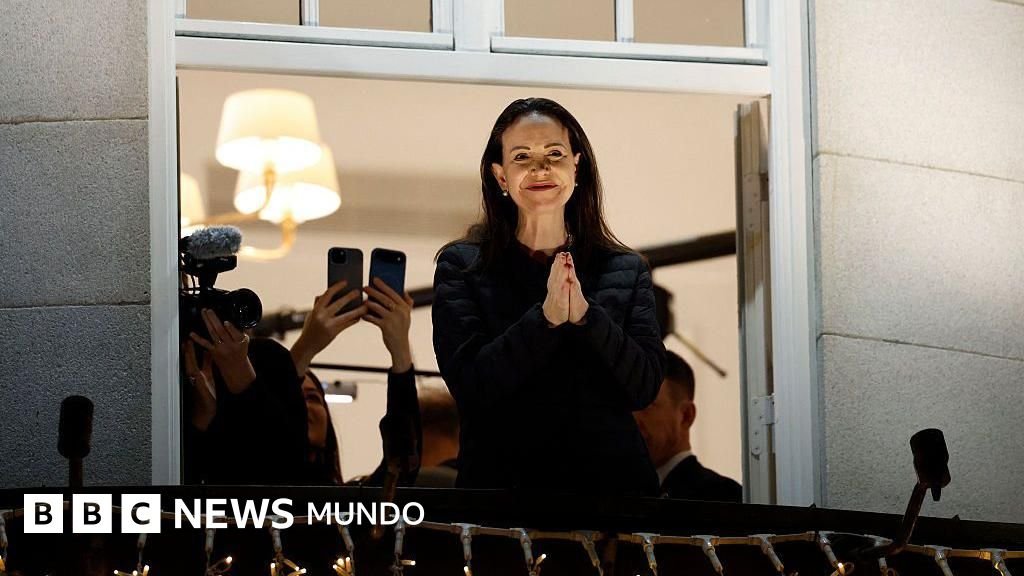
In a surprising and heartfelt moment, María Corina Machado graced her supporters with a balcony wave from her hotel in Oslo. This was her first public appearance since January, and she traveled discreetly despite being barred from leaving Venezuela. The government warned that she would be labeled a fugitive if she attempted this journey.
Emotional Connections
Machado greeted her supporters with affection, blowing kisses and singing along with them outside the Grand Hotel. After climbing over a security barrier to reach them, she was met with cheers of “¡María! ¡María!” as fans captured this historic moment on their phones.
Earlier, her daughter, Ana Corina Sosa, accepted the Nobel Prize on Machado’s behalf. The Nobel Institute awarded Machado the prize this year for her relentless fight for a “fair and peaceful transition from dictatorship to democracy” in Venezuela. It had been nearly two years since she last saw her children, whom she sent abroad for safety reasons.
A Heartfelt Interview
In her first interview following the award ceremony, Machado recounted the emotional toll of being away from her family. “For over 16 months, I haven’t been able to embrace or touch anyone,” she revealed. “Suddenly, in just a few hours, I’ve been able to see those I love, touch them, cry, and pray together.”
Denouncing the Regime
As a respected voice of the Venezuelan opposition, Machado has long condemned President Nicolás Maduro’s government as “criminal” and urged citizens to unite for its overthrow. Her candidacy in the previous presidential elections was barred, which Masduro subsequently won amid widespread allegations of fraud.
Addressing Military Intervention
Machado stressed the need to view Maduro’s regime not as a conventional dictatorship but as a criminal organization. She accused the government of financing itself through activities like drug trafficking and human trafficking, appealing to the international community for help in curtailing these illicit activities.
The Debate on Military Action
When questioned about supporting a potential U.S. military intervention, Machado refrained from a direct answer but criticized Maduro’s surrender of sovereignty to criminal organizations. “We never wanted war; it was Maduro who declared war on the Venezuelan people,” she stated.
A Risky Journey to Acceptance
Machado faced numerous threats and was warned of her potential arrest by Maduro’s government if she traveled to Norway. The Attorney General labeled her a fugitive, citing alleged conspiratorial actions against the state. This made her journey to accept the Nobel Prize particularly dangerous and complex.
The details surrounding her escape were highly confidential. Reports suggest that Machado disguised herself to evade capture, navigating through military checkpoints undetected and boarding a small fishing boat to leave Venezuela. This elaborate plan took two months to execute, assisted by a network of supporters in Venezuela.
Will She Return to Venezuela?
As speculation swirls about her safe return to Venezuela, Machado expressed her determination to go back. “I know exactly the risks I’m taking,” she stated. “I will be where I’m most useful for our cause.” While acknowledging that her previous thoughts about being in Venezuela may have changed, she emphasizes that her current presence in Oslo aligns with her mission.
Following her Nobel acceptance, many noted Machado’s public praise for U.S. President Donald Trump, especially as tensions with Venezuela escalate. Recently, Trump announced the seizure of a Venezuelan oil tanker, further intensifying international pressure on Maduro’s administration, which accused the U.S. of robbery and piracy.
Conclusion
María Corina Machado’s journey to accept the Nobel Peace Prize is emblematic of her unwavering resolve to fight for democracy in Venezuela despite overwhelming risks. Her story highlights the ongoing struggle against oppressive regimes and the enduring hope for change among the Venezuelan people.
- Machado received the Nobel Peace Prize for advocating a peaceful transition to democracy in Venezuela.
- Despite threats from the Venezuelan government, she successfully traveled to Norway to accept the award.
- Machado aims to unite the Venezuelan people against a regime she deems criminal.
- Her experiences reflect the sacrifices made by those fighting for freedom and democracy.