
Air Travel Disruptions in Indonesia Due to Anak Krakatoa Eruptions
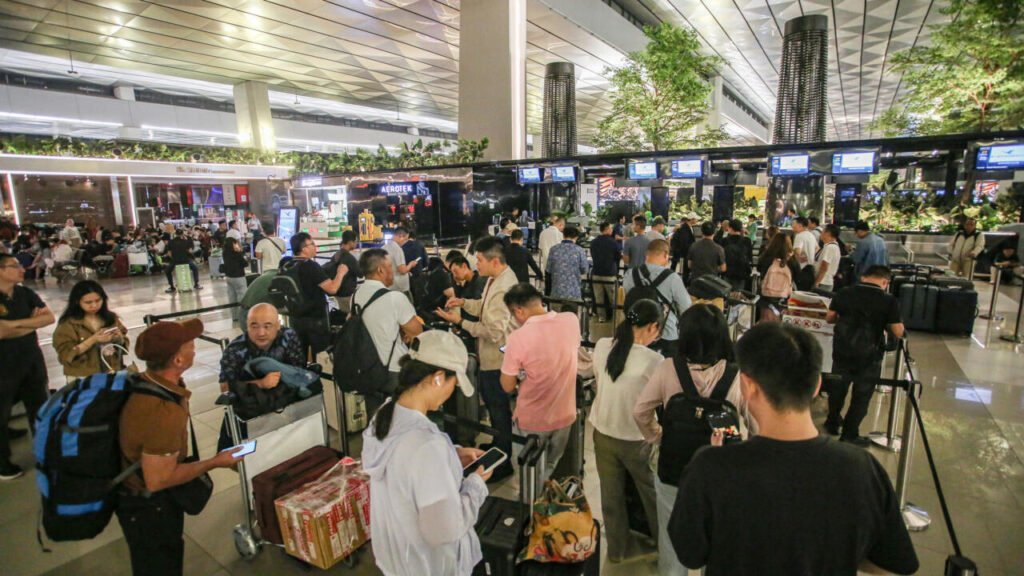
Operations at Indonesia’s main international airport, Soekarno-Hatta, came to a standstill on Sunday as ash clouds from the Anak Krakatoa volcano, located over 150 kilometers away, disrupted air traffic and affected thousands of travelers. The situation has escalated as eruptions continue to pose risks to aviation safety.
Eruption Details and Impact
Mount Anak Krakatoa erupted on Saturday, creating a spectacular display of lava and producing loud noises audible from hundreds of kilometers away, according to the geological agency. Two additional eruptions were reported on Sunday, prompting warnings from the volcanology agency.
As ash spread into the airspace around Soekarno-Hatta International Airport, authorities initially suspended airport operations from 1:30 AM Sunday (Saturday 18:30 GMT) until 5:30 AM. This suspension was subsequently extended three times, with the latest extension lasting until 5:30 PM due to heightened volcanic activity, as announced by the airport on social media.
Additionally, seven other airports, including Husein Sastranegara Airport in Bandung and Radin Inten II Airport near Bandar Lampung, also paused operations. Alternative landing options were prepared at several other airports, including those in Semarang and Surabaya.
Passengers in Distress
The disruption has left many passengers in a scramble for alternative flights. Henny Yensan, 44, expressed her disappointment, stating that she hoped to return to her hometown but was left with no options. “Everybody was disappointed,” she noted.
No one flew into a rage, because after all, this is due to natural disaster.
– Henny Yensan
Samuel Guiberteau, a Danone executive stuck in Lombok due to the cancellations, shared his frustration, explaining that he had found another flight on Citilink, but it was also canceled. “Nothing is certain for the moment,” he said.
More than 22,000 travelers have been affected, with 209 flights canceled, primarily those heading to and from Singapore, as well as other international destinations like Doha, Sydney, and Kuala Lumpur. At least 16 domestic flights to and from Bali have also been canceled.
The disaster mitigation agency, BNPB, announced plans for weather modification operations, including potential cloud-seeding, to encourage rain and help wash away the disruptive ash. BNPB chief Suharyanto remarked, “If it rains heavily enough, the volcanic ash that has been disrupting our daily lives since yesterday and continuing today will be washed away quickly.”
Safety Precautions and Warnings
Anak Krakatoa, or “Child of Krakatoa,” is situated in the strait between Java and Sumatra. Authorities have urged ships in the area to exercise caution due to the potential threats posed by volcanic activity.
More than 22,000 passengers have been impacted by the suspension.
Local port authorities have prohibited vessels from entering a three-kilometer exclusion zone around the volcano. Since its emergence in the early 20th century, Anak Krakatoa has shown sporadic activity, and this latest eruption series highlights the continuing risks associated with the region, which is part of the Pacific Ring of Fire.
Geological agency head, Lana Saria, explained that seismic activity indicates movements of volcanic fluids beneath the surface, though she cautioned that the timing and scale of future eruptions remain unpredictable. While there is no immediate tsunami risk, she reminded the public that hazardous materials could still pose dangers within the exclusion zone.
Past eruptions of Krakatoa’s predecessor claimed over 36,000 lives in a catastrophic series of tsunamis, underscoring the importance of monitoring and safety precautions in the volcanic region.
Conclusion
As Indonesia grapples with the effects of Anak Krakatoa’s eruptions, thousands of travelers find themselves stranded and searching for alternative options. Authorities are implementing safety measures while managing the challenges posed by volcanic activity in this dynamic region.
- Ash from Anak Krakatoa has disrupted air travel, affecting over 22,000 passengers.
- Multiple airports were temporarily closed as safety measures were put in place.
- Local authorities are considering weather modification to mitigate the ash fallout.
- Precautions are being taken to ensure navigation safety near the volcanic area.