
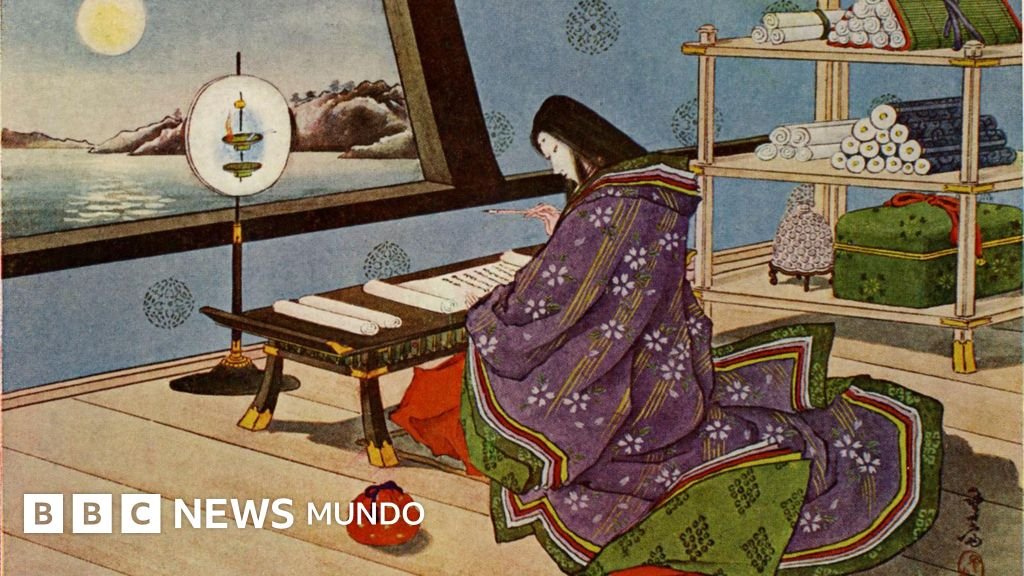
The Timeless Tale of Murasaki Shikibu and “The Tale of Genji”
Once upon a time, in a world far removed from ours, a story blossomed that would become a cornerstone of literature. This narrative takes us back around a thousand years to Japan, a nation that chose to seal itself off from the world in 894 AD. During this era, cultures across the globe exchanged goods, ideas, and beliefs freely. Japan, however, decided to halt its engagement with the outside world, resulting in a self-contained culture that thrived in its isolation. Within this bubble lay the refined court of Kyoto during the Heian period (794 to 1185), where the pursuit of beauty and sophistication shaped everyday life.
Beauty and Communication in Heian Society
The medieval Japanese culture was marked by an extreme aestheticism that transformed beauty into a revered principle governing daily life. Ian Buruma, a novelist and expert on Japanese culture, describes the Heian court as a place where ritual governed existence. “Communication often took the form of poetry contests and incense scenting games,” he explains. The court’s women played a pivotal cultural role, becoming pioneers in writing Japanese using a phonetic syllabary known as hiragana, or ‘onnade’—meaning ‘woman’s hand.’ By expressing themselves in everyday vernacular, these women produced literary diaries and works that would enchant future generations.
The Creation of “The Tale of Genji”
Through their writings, we glimpse the intricacies of life within the cloistered Heian court. Among these women was a courtier who penned a literary masterpiece: “Genji Monogatari,” or “The Tale of Genji,” composed in the early 11th century. This narrative chronicles the adventures of Hikaru Genji, a prince renowned for his extraordinary beauty and charm. Murasaki Shikibu, as she is now known, wrote her work under circumstances that remain shrouded in mystery, as it was considered inappropriate to address individuals by their names in her era.
The Life of Murasaki Shikibu
Born around 973 AD in Kyoto to a cultured but minor aristocratic family, Murasaki lacked formal education due to her gender. However, she absorbed knowledge as her brother studied literature and history for a career in the imperial court. When her husband’s untimely death left her seeking purpose, Murasaki began chronicling the life and loves of the captivating Genji—a process that spanned a decade. The early drafts circulated among her peers, capturing the interest of the elite, prompting her eventual appointment as a lady-in-waiting to Empress Fujiwara no Shōshi.
An Insight into Court Life
Her position enabled Murasaki to observe closely the nuances of aristocratic life, amplifying her ability to comment on the intricacies of court society. Her vivid accounts reveal a blend of sophistication and humanity, giving readers a chance to appreciate not only the court’s grandeur but also its vulnerabilities. Murasaki’s reflection toward the end of her diary encapsulates this duality: “Each of us is distinctly different… What others see is merely a façade.”
The Narrative Unfolds
“The Tale of Genji” opens with a poignant tale of love unfulfilled. It begins with a low-ranking lady favored by the Emperor, who, despite her status, faces jealousy and scorn from the higher-ranking women in the court. This envy ultimately leads to her demise after giving birth to the radiant Genji. The plot then unfolds, showcasing Genji’s quest for love and happiness, traversing a variety of romantic encounters, wielding power, suffering loss, and ultimately meeting an untimely death. The narrative spans nearly a century, cramming over 400 characters into 54 chapters or episodes.
A Classic for the Ages
Despite being written over a millennium ago, “The Tale of Genji” remains a celebrated classic in Japan. Murasaki defied conventions by choosing to write in Japanese prose rather than the classical Chinese, the language typically regarded as scholarly. This groundbreaking approach helped elevate her work above others, as embedded within the narrative are 795 waka poems—short verses that add depth and emotional resonance.
The Journey to the West
It took a millennium for Genji to reach Western shores, but upon its arrival, it captivated audiences immediately. The initial English translation by Arthur Waley, published in 1925, enchanted writers like Virginia Woolf, who was struck by the contrast between Western literature of the time and the lyrical beauty of Murasaki’s prose. Woolf’s observations reveal a fascination with Genji’s elegance, yet she noted certain limitations compared to other great authors of the Western canon.
Over the years, “The Tale of Genji” has inspired paintings, films, theatrical productions, and even manga, solidifying its place in both Japanese and global culture. While initially overlooked in the narrative of novelistic history, it’s gradually been recognized as one of the first psychological novels, encapsulating complex themes of love, betrayal, and societal structures.
Conclusion
The influence of “The Tale of Genji” endures, proving that even in a time of isolation, art can connect us across centuries and cultures. Murasaki Shikibu’s legacy as a pioneering novelist continues to shine brightly, reminding us of the timeless human experiences that bind us all.
- Japan isolated itself from the world around 894 AD, allowing its culture to flourish in seclusion.
- Murasaki Shikibu, the author of “The Tale of Genji,” became a significant cultural figure in Heian society.
- The novel features intricate themes of love, power, and societal norms, establishing itself as a pioneering work in literature.
- “The Tale of Genji” is often recognized as the first psychological novel in history, inspiring countless adaptations worldwide.