
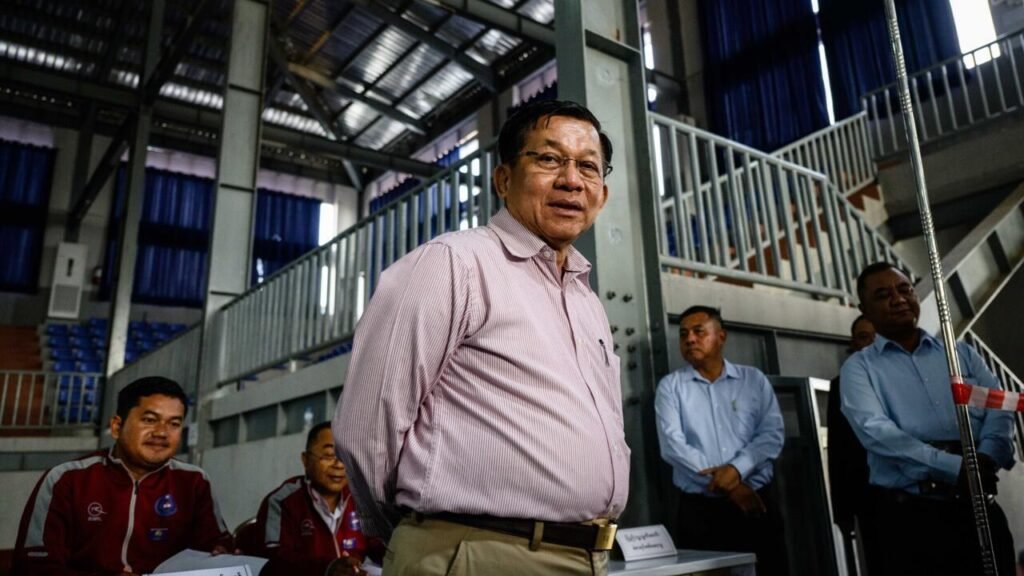
Myanmar’s Junta Chief Takes Office as President
In a significant political development, Myanmar’s parliament elected junta leader Min Aung Hlaing as president on Friday. This marks a transition for the former military commander, who previously seized power five years ago through a coup, as he prepares to lead the country in a civilian capacity.
Min Aung Hlaing, who played a pivotal role in dismantling the country’s democratic governance in 2021 by detaining the democratically elected Aung San Suu Kyi and dissolving her party, received his new title from pro-military members of parliament. They were selected in a recent election conducted under the supervision of the ruling junta.
During the parliamentary session in the capital city of Naypyidaw, Min Aung Hlaing secured a resounding victory in a three-person race, garnering 429 out of 584 votes cast. Parliament Speaker Aung Lin Dwe made the announcement, officially confirming him as the new president.
While the junta has promoted the reopening of parliament as a restoration of civilian rule, critics argue that this move is merely a facade designed to obscure the military’s ongoing dominance. Political analysts suggest that this development is part of an effort to legitimize the military’s grip on power.
The Election Landscape
The election held in late January saw the pro-military Union Solidarity and Development Party (USDP) claim over 80 percent of the contested parliamentary seats. Additionally, members of the military occupy a quarter of the available seats by virtue of their position, further solidifying the junta’s power in the legislature.
Aung San Suu Kyi, who enjoys widespread popularity, has remained in detention since the coup in February 2021, while dissent against the election process is heavily suppressed. Voting was also obstructed in regions controlled by armed rebel groups that continue to challenge military authority amid a prolonged civil conflict.
Conflict Continues
With opposition factions remaining resilient following the elections, the conflict and humanitarian crisis in Myanmar show little sign of resolution. The ongoing violence has resulted in tens of thousands of casualties across various factions since the military took control.
Upcoming Leadership Changes
Min Aung Hlaing is set to officially assume the presidency this month, with his two competitors—current Prime Minister Nyo Saw and Nan Ni Ni Aye from Karen state—taking on the roles of vice-presidents. To solidify his position as president, Min Aung Hlaing must step down from military leadership, a task he completed recently by appointing loyalist and former intelligence chief Ye Win Oo as the new commander-in-chief.
Myanmar’s military has dominated the nation for much of its history post-independence, positioning itself as the protector against potential chaos within the country. It momentarily relaxed its authoritarian grip for about a decade starting in 2011, allowing Suu Kyi to lead a democratic government and initiate crucial reforms.
Following a sweeping victory by Suu Kyi’s party in the 2020 elections, Min Aung Hlaing executed the coup under claims of widespread electoral fraud, which many analysts dispute as unsubstantiated fears regarding the military’s declining influence.
With the USDP firmly established in parliament and military representatives maintaining their unelected seats, experts predict that the new government will closely align with the military’s objectives.
- Min Aung Hlaing has been elected as president by Myanmar’s pro-military parliament.
- The election process has been criticized as a means to legitimize military rule.
- The ongoing civil conflict continues to escalate, with significant casualties reported.
- Min Aung Hlaing must now transition from military leadership to his new presidential role.