
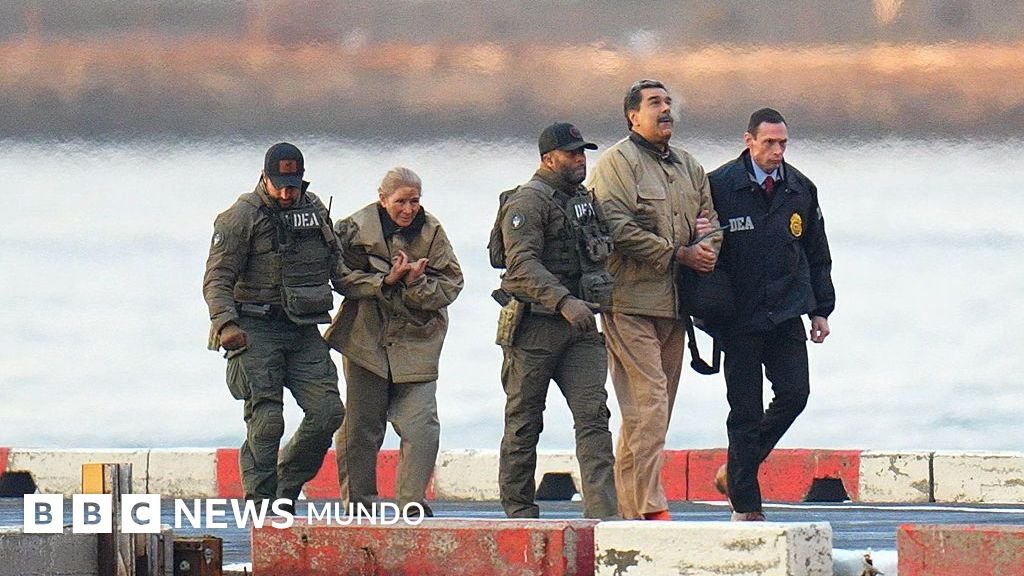
Defending Nicolás Maduro: An Examination of Legal Financial Responsibilities
Nicolás Maduro, the former president of Venezuela, finds himself embroiled in a legal battle in the United States, raising an essential question: Who will foot the bill for his defense during his upcoming court appearance in New York? This pivotal issue will be addressed in a federal court within the next few days, as Maduro confronts serious drug trafficking charges that he vehemently denies.
A Clash Over Defense Costs
Maduro and his spouse, Cilia Flores, who is also facing similar allegations and is detained in New York, argue that the Venezuelan state should cover their legal expenses. In contrast, the U.S. government maintains that sanctions imposed against Venezuela prohibit the use of state funds for this purpose, asserting that defendants must rely on personal resources.
The legal fees for cases of this magnitude can reach millions, and both Maduro and Flores claim they lack personal assets to finance their defense. Their legal team argues that their rights have been violated and has petitioned Judge Alvin Hellerstein for a dismissal of the charges.
Legal Experts Weigh In
Legal experts express skepticism about the likelihood of Hellerstein dismissing the case, which has garnered international attention since Maduro and Flores were apprehended in a military operation in Caracas on January 3rd. Ronald Allen, a law professor at Northwestern University, remarked, “The motion to dismiss the charges is absurd.” Yet, the dispute regarding who pays for the legal representation highlights the significant challenges within this unprecedented legal context.
Seeking Permission for State Funded Defense
Shortly after their arrest, legal representatives for Maduro and Flores sought approval to use Venezuelan government funds for their legal fees. On January 7th, they filed a request with the U.S. Treasury Department’s Office of Foreign Assets Control (OFAC), which is responsible for enforcing international economic sanctions. The approval date was crucial, as both Maduro and the government he led until his arrest are under sanctions due to allegations of corruption, human rights abuses, drug trafficking, and other crimes.
Back and Forth with OFAC
On January 9th, the OFAC granted permission for Maduro and Flores, only to revoke it hours later and further amend their decision weeks after. Barry Pollack, Maduro’s attorney, sought to dismiss the case in February, arguing that the U.S. government interjected into the defendants’ constitutional right to choose their legal representation. “According to Venezuelan law, the government is obligated to cover Maduro’s defense costs,” Pollack stated.
Political and Legal Tensions
Delcy Rodríguez, acting president of Venezuela, maintains that Maduro is the “legitimate president” of the country and insists on their innocence. Nevertheless, diplomatic relations between Caracas and Washington were reestablished following Maduro’s capture amid various pressures from the Trump administration on Rodríguez.
Legal Representation Challenges
Pollack, who has an extensive track record in high-profile cases and was instrumental in Julian Assange’s release, mentioned his intention to withdraw from representing Maduro if the Treasury’s restrictions remain in place.
A Claim of Administrative Errors
Prosecutors contended that the initial authorizations for Maduro and Flores to use Venezuelan funds for their defense resulted from an “administrative error,” which was promptly corrected. Their document, submitted to the court on March 13th, emphasized that U.S. regulations prohibit utilizing funds from a sanctioned entity for the legal fees of another sanctioned individual. Despite this, they insisted that both Maduro and Flores could utilize personal funds to secure their legal representation.
Comparative Cases and Challenges Ahead
Though there have been other cases involving former foreign presidents in the U.S., such as Manuel Noriega of Panama, the current situation involving Maduro is unique. Noriega, captured during the U.S. invasion in 1990 and tried for drug trafficking, initially faced similar barriers. His legal team resolved the funding issue through negotiations with federal prosecutors, allowing access to frozen assets for defense costs.
Chimène Keitner, an international law professor at UC Davis, points out that no accused president has previously been recognized as such by their country while facing U.S. legal proceedings, adding further complications to Maduro’s case. “Legally reimbursing Maduro for his legal expenses outside of U.S. jurisdiction is possible, but ensuring U.S. compliance with sanctions while doing so presents challenges,” she stated.
Conclusion
The legal saga involving Nicolás Maduro highlights the intricate relationship between international law, political tensions, and individual rights. As the courtroom battles unfold, the resolution of who bears the financial responsibilities for his defense remains a pivotal issue, one that could redefine the legal landscape for similar cases in the future.
- Maduro insists the Venezuelan state should fund his legal defense.
- The U.S. government argues that sanctions prevent such funding.
- Legal fees for high-profile cases like these can reach millions of dollars.
- This case has the potential to set a precedent for similar legal matters globally.