
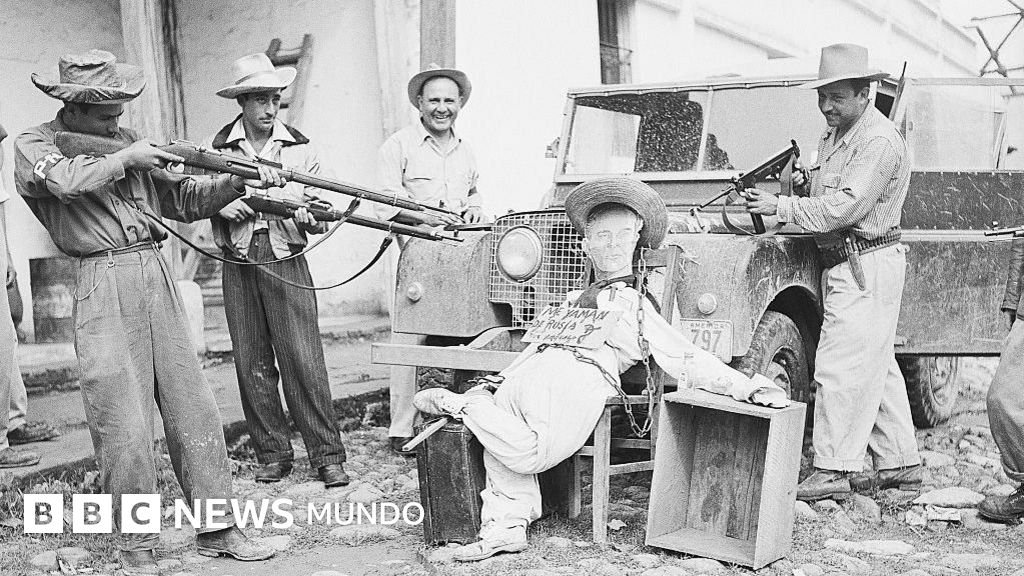
The Legacy of U.S. Intervention in Guatemala: Lessons from 1954
In 1954, the United Fruit Company persuaded President Dwight D. Eisenhower to overthrow Guatemala’s democratically elected leader, Jacobo Arbenz. This event had profound repercussions throughout Latin America for decades. Today, experts are examining the origins of what has been termed the “Donroe doctrine”—a concept revived by U.S. President Donald Trump in his campaign against Venezuelan President Nicolás Maduro. This article delves into the critical aspects of this historical intervention, offering insights into its lasting impact.
The Role of United Fruit Company
United Fruit Company held immense power in Guatemala and its neighboring countries, earning the nickname “The Octopus” due to its extensive reach. Grace Livingstone, an expert from Cambridge University, explains that although the company was American, it had no formal ties to Eisenhower’s administration. However, when Arbenz proposed land reforms to alleviate the country’s chronic poverty, United Fruit sought government support, framing Guatemala as susceptible to Soviet influence amid the Cold War.
Arbenz’s Proposed Reforms
Arbenz promised generous compensation for the lands he aimed to expropriate, offering more than double what United Fruit had originally paid. Despite this, the company remained dissatisfied, and Eisenhower ultimately decided to intervene.
Understanding the Donroe Doctrine
Eisenhower’s justification for his intervention stemmed from the Monroe Doctrine, established in the early 19th century by President James Monroe. This doctrine asserted that the Western Hemisphere should be free from European influence, serving as a defense mechanism for U.S. interests in the region.
The Roosevelt Addition
President Theodore Roosevelt later expanded this policy in 1904 to explicitly justify U.S. military involvement in Latin America. Livingstone notes that Trump’s “Donroe doctrine”—a play on Monroe’s name—echoes this historical stance, clarifying a rationale behind military posturing regarding Venezuela, Greenland, and Iran.
Echoes of Historical Tactics
The tactics used in Guatemala mirror modern military strategies. As Livingstone describes, Eisenhower’s administration implemented a military build-up with submarines and bombers positioned close to Guatemala. This intensified pressure mirrored recent actions in Venezuela.
Psychological Warfare
The CIA disseminated pamphlets threatening an invasion, employing graphic imagery to connect with a largely illiterate population. The agency even claimed that opposition forces were rallying, although no such uprising occurred when they crossed the border. Bombing campaigns targeted key strategic sites, including the capital, designed to demoralize both the populace and military.
Consequences and Reflections
After Arbenz resigned under mounting pressure, he was exiled and humiliatingly escorted onto a plane. Decades later, Maduro experienced a similar fate, illustrating a continuous pattern of U.S. interventions. Analysts highlight that Trump’s approach to Greenland relies heavily on visual politics, aiming to assert dominance over smaller nations.
Long-Term Risks
Supporters of U.S. interventions often argue that only dictators suffer from U.S. actions, yet many experts disagree. Livingstone emphasizes that the overthrow of a democratically elected government led to long-lasting violence and instability, paving the way for authoritarian regimes and drug cartels that have fueled migration and illegal trade, presenting a far greater threat to U.S. interests today than the initial justifications of land reform and communist influence.
Conclusion
The historic U.S. intervention in Guatemala serves as a cautionary tale about foreign involvement in sovereign nations. The repercussions of such actions can resonate for generations, influencing political landscapes and national stability long after the immediate effects have faded.
- The 1954 coup in Guatemala, driven by United Fruit Company interests, reshaped U.S.-Latin America relations.
- The “Donroe doctrine” reflects a continuation of historical interventionist policies under the guise of safeguarding U.S. interests.
- The methods used in Guatemala resonate with contemporary strategies in regions like Venezuela and Iran.
- Long-term impacts of U.S. interventions often result in instability that challenges U.S. security interests more than the original issues intended to be resolved.