
Key Developments in Russia’s War on Ukraine – Day 1,418
As we delve into the ongoing conflict in Ukraine, significant events marked Day 1,418 of Russia’s war. From air attacks to military aid announcements, a complex picture unfolds, highlighting both the ongoing challenges and international responses.
Fighting on Multiple Fronts
Early on Monday, Russia executed an air strike on Kyiv, causing a fire in one of the city’s districts. The Ukrainian military reported that air defense units were in action to counter this attack, as noted by Tymur Tkachenko, the head of Kyiv’s military administration.
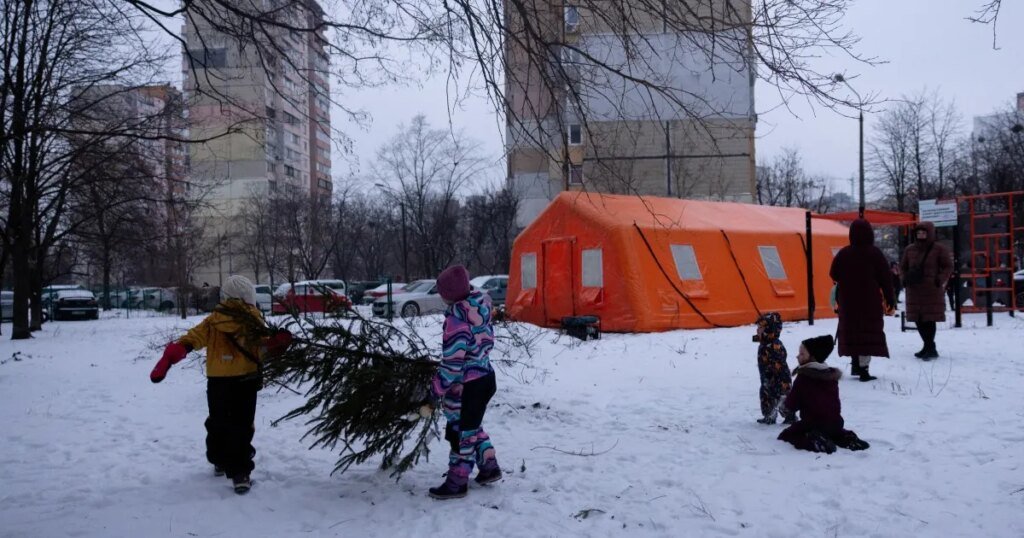
In Kyiv, over 1,000 apartment buildings have been left without heating three days after a significant Russian assault, according to local authorities. Ukrainian Prime Minister Yulia Svyrydenko emphasized, via Telegram, that every day this week has seen Russian strikes on energy facilities and critical infrastructure, totaling at least 44 attacks.
On a different front, a Ukrainian drone action in the Russian city of Voronezh resulted in one woman’s death and injuries to three others, as reported by regional governor Alexander Gusev. The drone strike also damaged more than ten apartment buildings, several private homes, a secondary school, and multiple administrative structures.
Ukrainian forces claimed they achieved “direct hits” on three oil drilling platforms owned by Russia’s Lukoil in the Caspian Sea. The attacked platforms included the V Filanovsky, Yuri Korchagin, and Valery Grayfer sites.
Additionally, Russia’s Ministry of Defence asserted that they have gained control over the village of Bilohirya in Ukraine’s southeastern Zaporizhia region. Meanwhile, Ukraine’s military intelligence indicated that Russia began deploying the new jet-powered “Geran-5” strike drone—an adaptation of the Iranian-designed Shahed—capable of carrying a 90kg (200-pound) warhead with a range of nearly 1,000km (620 miles).
Military Support and Aid
The United Kingdom made headlines by announcing plans to develop a new long-range ballistic missile for Ukraine, dubbed ‘Nightfall.’ This initiative aims to create missiles that can carry a 200kg (440 lbs) warhead over a distance exceeding 500km (310 miles).
Meanwhile, Sweden is committing 15 billion Swedish crowns (approximately $1.6 billion) toward enhancing its air defense capabilities. This funding primarily aims to safeguard civilians and critical infrastructure as the nation bolsters its military in response to the Russian invasion of Ukraine.
On a broader scale, European Union defense commissioner Andrius Kubilus proposed the establishment of a unified military force that could eventually succeed U.S. troops stationed in Europe. This force could comprise up to 100,000 personnel to improve Europe’s security posture.
Political and Diplomatic Movements
In a significant diplomatic announcement, Ursula von der Leyen, head of the European Commission, stated that it is now Russia’s responsibility to demonstrate a genuine interest in peace. This statement follows an agreement by Kyiv and its allies to adopt a 20-point peace plan and related security guarantees that would come into effect with a ceasefire.
Von der Leyen elaborated on the plan, noting that Ukraine will initially depend on its own well-trained and battle-experienced armed forces, while emphasizing the necessity for European nations to ensure adequate military equipment support. Additionally, she mentioned a “Coalition of the Willing”—encompassing 35 nations, including most EU member states and allies like Canada, the UK, Australia, New Zealand, and Turkiye—as a second line of defense.
Conclusion
Day 1,418 of the Russia-Ukraine conflict reveals a landscape rife with military actions, international response initiatives, and ongoing diplomacy efforts. The situation remains fluid as both sides navigate the complexities of war and peace.
Key Takeaways
- Russia’s air strikes continue to impact civilian areas in Ukraine, causing widespread damage.
- The UK and Sweden are increasing military support to bolster Ukraine’s defense efforts.
- European leaders are exploring the establishment of a military force to enhance regional security.
- Diplomatic efforts are underway, with a peace plan introduced for Russia to consider.