
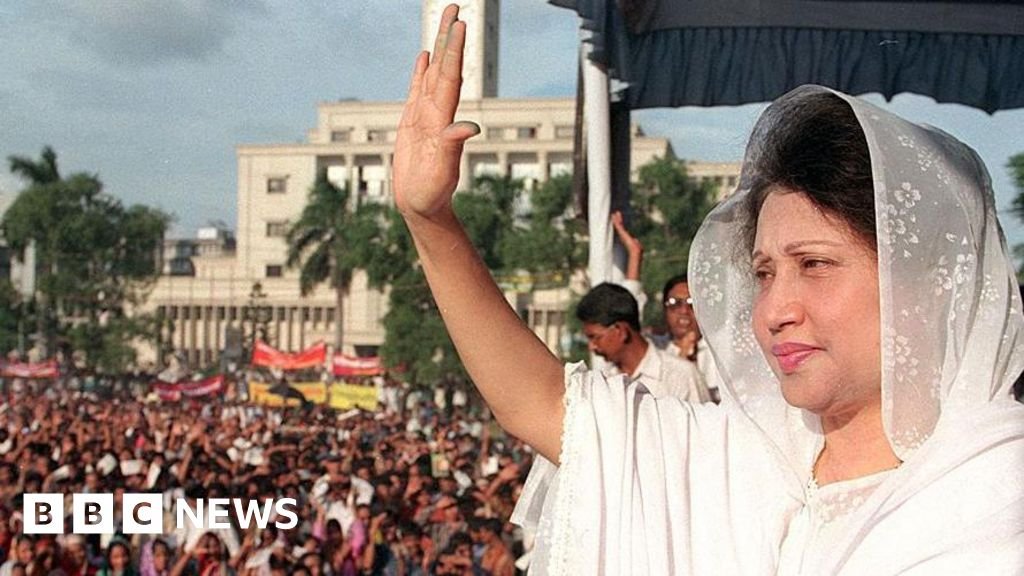
Khaleda Zia, Bangladesh’s First Female Prime Minister, Passes Away at 80
Khaleda Zia, a significant figure in Bangladesh’s political landscape and the nation’s first female prime minister, has passed away at the age of 80. Her remarkable journey from a reserved housewife to a prominent leader illustrates the complexities of her public life and the political turmoil in Bangladesh.
A Transformative Political Journey
Khaleda Zia was born in 1945 in Dinajpur, then part of British India. She was known as a “shy housewife” before stepping into the spotlight after the assassination of her husband, Ziaur Rahman, in 1981. Rahman was a key leader in Bangladesh’s fight for independence and later became president in 1977. Following his death, Zia took charge of his political party, the Bangladesh Nationalist Party (BNP), and eventually served two terms as prime minister—first from 1991 to 1996 and again from 2001 to 2006.
Her vibrant political career was marked by significant challenges, including her later conviction for corruption, which resulted in a period of imprisonment. However, she was acquitted after her rival, Sheikh Hasina, was ousted from power during widespread unrest in 2024.
Early Life and Political Activism
After her marriage to Ziaur Rahman at just 15, Khaleda’s life took a pivotal turn. Ziaur played a vital role in the 1971 independence of Bangladesh, after which he reintroduced political parties and media freedom during his presidency. However, his term was marred by political violence and military coups, eventually leading to his assassination in 1981.
Widowed at 36 and initially keeping a low profile, Khaleda became a prominent political figure by joining the BNP in 1982, following a military coup that plunged the country into dictatorship. Zia emerged as a fierce opponent of military rule, often facing arrests for her protests but gaining a reputation as an “uncompromising leader.” After the military regime ended in 1990, she led the BNP to victory and became Bangladesh’s first female prime minister in 1991, marking a significant milestone in the country’s history.
Champions of Change
During her first term, Khaleda implemented vital reforms, including making primary education free and compulsory. However, she lost her re-election bid in 1996 to Sheikh Hasina’s Awami League.
In 2001, a strategic alliance with Islamist parties allowed Khaleda to return to power, winning a significant parliamentary majority. During her second term, she actively promoted women’s rights, establishing quotas for female MPs and supporting educational initiatives for young women, whose literacy rates were alarmingly low.
The Path of Opposition and Controversy
Following her second term, political unrest led to her arrest on corruption charges, paralleling similar accusations against her political rival, Sheikh Hasina. As both women clashed in the political arena, Khaleda Zia’s role transitioned to that of opposition leader, particularly after the BNP boycotted the 2014 elections, resulting in a complete loss of representation in parliament.
In 2018, she received a five-year prison sentence for embezzling funds intended for an orphanage trust—a charge she disputed as politically motivated. Due to health issues, including arthritis and diabetes, she was later moved to house arrest.
A Return to the Spotlight
In a dramatic shift, the political landscape in 2024 led to Hasina’s government being replaced under a wave of public dissatisfaction. Khaleda was released from prison, but by this time, she faced serious health challenges, including liver cirrhosis. She was acquitted of many previous convictions and traveled to London for medical treatment in early 2025.
Khaleda Zia passed away on the morning of December 30 in Dhaka, surviving by her elder son, Tarique Rahman, who is now seen as a potential successor for leadership in Bangladesh. Her younger son, Arafat Rahman, sadly passed away in 2015.
- Khaleda Zia died at the age of 80, leaving behind a legacy as Bangladesh’s first female prime minister.
- She transitioned from a shy housewife to a formidable political leader after her husband’s assassination.
- Zia’s political career was marked by significant reforms and notable challenges, including corruption charges.
- Her passing comes amid ongoing shifts in Bangladesh’s political landscape, with her son poised as a future leader.