
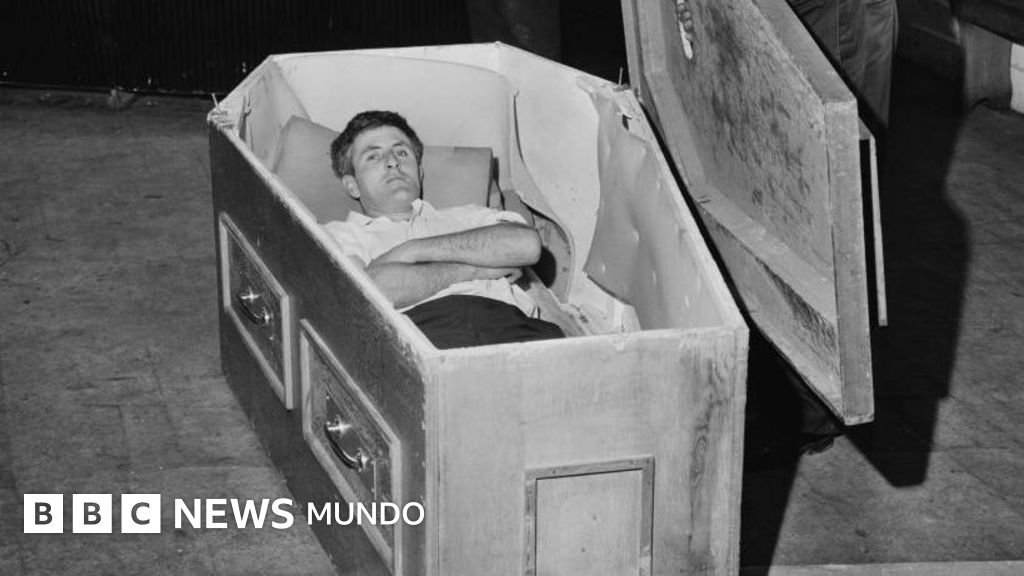
The Unusual Tale of Mick Meany
Mick Meany’s story is as captivating as it is bizarre, recapturing a moment in history where a man chose to be buried alive — not once but twice. This article explores the extraordinary life of a man who went from aspiring boxer to a record-breaking stunt artist, all in the pursuit of fame and fortune.
A Unique Farewell
According to his daughter Mary, the priest who officiated Mick Meany’s funeral remarked, “This is the first time I’m burying someone who has already been buried before.” In her 2015 book, “You Can’t Eat Roses, Mary!” she recalls that during this second burial, only a local journalist was present. This contrasted sharply with his first burial, which drew a massive crowd and global media attention when he was actually alive.
Mick’s initial burial was not a mishap from earlier centuries, but a carefully orchestrated event designed to captivate the public and media both in the UK and as far away as the United States and Australia.
A Dream Born in Adversity
The tale begins in a pub that served as a meeting point for many Irish expatriates, well away from Ireland itself. Meany, born to a farmer in Tipperary, had moved to England post-World War II in search of work to support his family. Despite his dreams of becoming a world boxing champion, a workplace accident left him unable to box, and he took on construction work instead.
After a serious incident where a tunnel he was digging collapsed on him, he conceived an unusual new aspiration — to break the record for the longest time spent buried alive in a coffin. This idea, albeit morbid, had become a trend since the 1920s in the U.S. and inspired by previous records, including one set by an American sailor who spent ten days underground, led Meany to challenge the notable feat of Digger O’Dell, who had endured 45 days beneath the earth.
Motivation Behind the Madness
Many may wonder why someone would choose to undertake such a terrifying endeavor. It turns out that there were multiple motivations for these so-called funeral artists: breaking records, earning money, and drawing attention to various issues.
For example, Digger O’Dell volunteered to bury himself 158 times in his lifetime, often promoting specific products or places. Meany, however, was driven by a mixture of desperation and ambition. At 33, lacking any qualifications and realistic career prospects, he saw this challenge as a way to secure his place in history and perhaps earn enough to return to Ireland and build a home.
“I had no future in real life. That’s why I wanted to go under and prove my worth,” he stated, revealing his determination to achieve fame, albeit via a grim path.
The Big Reveal
Eventually, thanks to the encouragement of pub owner Michael “Butty” Sugrue, the plans were set in motion. Sugrue had envisioned making this challenge a public spectacle, starting with a last supper in the pub amidst the press. On February 21, 1968, dressed in pajama-style clothing, Mick climbed into a custom-made coffin lined with foam.
With a crucifix and a rosary in hand, he declared he was doing this for his family and for the honor of Ireland before being sealed away. The funeral procession led Meany through Kilburn, where he would be buried for what he hoped would be at least six weeks plus a day.
Buried two and a half meters deep, he had access to air through two tubes and was provided with books, food, and even beer — all consumed from a side position in the coffin. A specially designed trapdoor acted as his restroom, and he humorously alluded to the underground setting as anything but luxurious.
From Fame to Forgotten
As the challenge gained traction, donations poured in, and fans came to visit him from across London. He even spoke with people via a phone installed within the coffin, connecting him to the outside world through The Admiral Nelson pub, where Sugrue charged for calls. Despite the media frenzy, world events like the Vietnam War and the assassination of Martin Luther King overshadowed the spectacle.
On April 22, 1968, after 61 days beneath the earth, Sugrue ensured that Meany’s return was grand. With a parade and a crowd of journalists, the coffin was unearthed, and a slightly disheveled but triumphant Meany emerged, stating, “I would like to last a hundred more days!”
However, the following months held disillusionment. Promised a worldwide tour and a cash prize for breaking the record, he returned to Ireland without a penny to his name, and Guinness World Records never validated his claim. His legacy was soon overshadowed when a former nun set a new record of 101 days buried alive just months later.
A Lasting Impact
Even though Mick Meany’s story faded into the backdrop of history, his incredible tale was revived over two decades later in a documentary titled “Buried Alive/Beo Faoin bhFód,” garnering acclaim in film festivals. This unique narrative of ambition, absurdity, and the quest for recognition continues to inspire conversations about the lengths one might go for fame.
Key Takeaways
- Mick Meany’s unique life journey involved a quest for fame through an unusual death-defying challenge.
- His initial burial, a spectacle designed for media attention, drew crowds and curiosity worldwide.
- Despite breaking a record for time spent buried alive, he returned to a life devoid of financial success and official recognition.
- The revival of his story in a documentary highlights the timeless fascination with the extraordinary lengths people go for notoriety.