
Myanmar’s First General Election After Military Coup: A Complex Picture
Polling has commenced in Myanmar’s first general election since the military ousted Nobel Peace Prize laureate Aung San Suu Kyi’s elected government in a coup in 2021. This election, heavily restricted and contested amid ongoing civil strife, is taking place across approximately one-third of the country’s 330 townships, with significant regions remaining cut off from participation due to conflict.
The Election Process and Accessibility
The election unfolds in phases, with additional rounds scheduled for January 11 and January 25. However, voting has been entirely canceled in 65 townships, rendering approximately 20% of the population disenfranchised at this stage. Tony Cheng from Al Jazeera, reporting from Yangon, highlights the crucial question of voter turnout in urban areas.
Voter Demographics and Concerns
Polling stations opened at 6 AM on Sunday (23:30 GMT, Saturday), and as daylight broke, a steady stream of voters emerged. Despite this, the demographic skewed older, with fewer younger voters participating. Cheng notes, “When you look at the ballot, there are only a few choices, and most are military-affiliated parties.”
Critics, including various human rights organizations and the United Nations, have condemned the election as lacking freedom and credibility, particularly due to the absence of participation from anti-military political factions.
The Political Landscape
Aung San Suu Kyi remains in detention following her party’s significant victory in the last general election, which took place in 2020. Her party, the National League for Democracy (NLD), has since been dissolved, paving the way for the pro-military Union Solidarity and Development Party (USDP) to dominate the election.
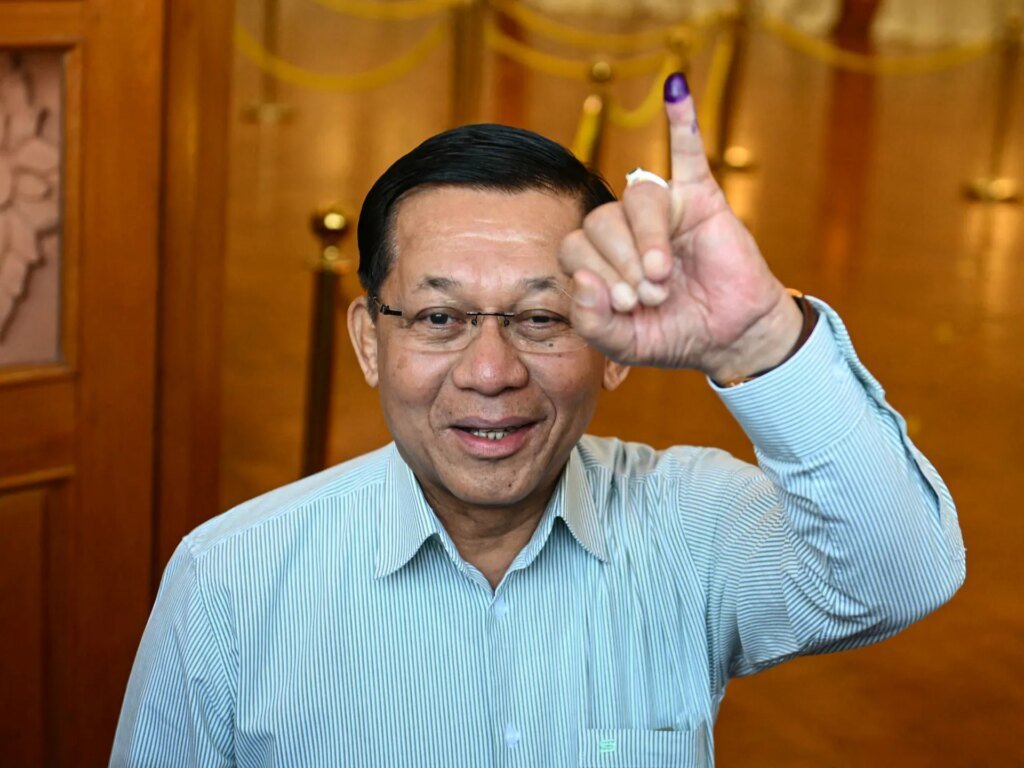
The military, in power since the 2021 coup, frames the upcoming vote as an opportunity for political and economic renewal for the 55 million citizens of Myanmar. Senior General Min Aung Hlaing emphasized this sentiment by casting his vote shortly after the polls opened.
A New Chapter or Continued Conflict?
A state-run opinion piece claimed that the elections could signify a shift from a country plagued by conflict to one filled with promise. However, with violent clashes persisting, UN human rights chief Volker Turk asserted that the current environment does not support the democratic processes necessary for genuine citizen engagement.
The Human Cost of Conflict
The civil war, ignited by the military’s coup, has resulted in the loss of nearly 90,000 lives, displacing about 3.5 million, and leaving around 22 million people reliant on humanitarian aid. The Assistance Association for Political Prisoners reports over 22,000 individuals currently detained for political reasons.
Security Measures and Voting Procedures
In downtown Yangon, stations were secured with armed personnel patrolling the area. Various electronic voting machines are being utilized for the first time, though they preclude write-in candidates and spoiled ballots.
Among the early voters was 45-year-old Swe Maw, who downplayed international criticism of the election, stating, “It’s not an important matter. There are always people who like and dislike.” Conversely, 40-year-old Moe Moe Myint expressed skepticism regarding the election’s integrity, questioning how one could support a military-led election amidst widespread suffering. “We are homeless, hiding in jungles, and living between life and death,” she lamented.
Looking Ahead
The subsequent voting rounds will take place on January 11 and January 25, although the dates for tallying votes and revealing results remain unannounced. Analysts caution that the military’s efforts to establish a stable governance structure amidst extensive conflict is fraught with challenges, suggesting that any military-led administration is unlikely to gain significant international legitimacy, regardless of any civilian influences.
Conclusion
The unfolding situation in Myanmar, marked by civil unrest and political turmoil, poses serious questions about the legitimacy and future of governance in the country. As the elections progress, the international community watches closely, awaiting developments that could redefine Myanmar’s political landscape.
- This is Myanmar’s first general election since the military coup in 2021.
- About 20% of the population is disenfranchised due to voting cancellations.
- The election is criticized as lacking fairness and credibility.
- The ongoing civil war has severe humanitarian consequences for millions.