
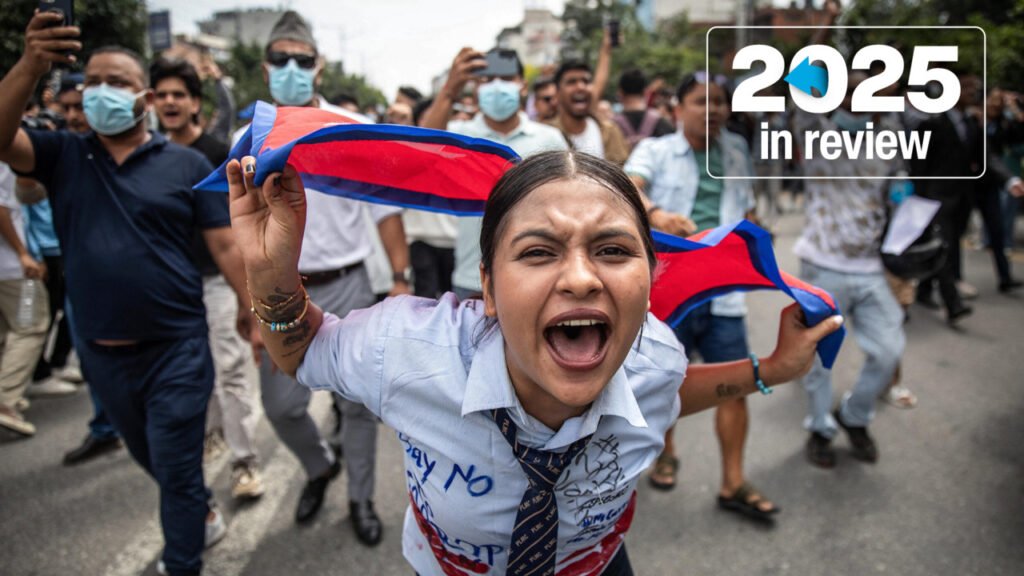
Youth-Led Protests: A Global Movement of Generation Z
In an unprecedented wave of discontent, young people around the globe rallied together in 2025, united by their frustrations with political elites and their desire for change. From the streets of Lima to the protests in Antananarivo, Generation Z, born between the late 1990s and early 2010s, expressed their frustrations and aspirations through protests, showcasing a collective demand for a better future.
A Shared Experience of Protest
Despite the vast distances separating them, strikingly similar scenes emerged in various countries, with young crowds wielding hand-painted signs, viral slogans birthed on platforms like TikTok and Discord, and straightforward but powerful messages. Sociologist Michel Wieviorka from the School for Advanced Studies in the Social Sciences remarked, “This is a generation that is not acting only for itself, but so that everyone has access to education, healthcare, and housing, and to put an end to corruption in power. It is a protest driven by universal values.”
A Contagion Effect
The movement ignited in Indonesia at the end of summer, with students in Jakarta taking to the streets after a controversial announcement regarding housing allowances for members of parliament, which exceeded ten times the country’s minimum wage. The protest sparked the use of a symbol from the popular manga “One Piece”, the pirate flag, representing the youth’s revolt.
By September, the momentum surged in Nepal. Viral content on social media unveiled the opulent lifestyles of the so-called “nepo-kids”, leading to a government-imposed block on numerous digital platforms. As anger reached a boiling point in Kathmandu, protests escalated to the point of violence, culminating in the parliament being set ablaze.
The unrest soon spread to Madagascar, where protests initially aimed at denouncing water and power shortages evolved into calls for the president’s resignation. Demonstrators chanted, “We are not asking for luxury, just the means to live with dignity,” highlighting the voices of students and precarious workers alike. Meanwhile, in Morocco, a group known as Gen Z 212 organized mobilizations through Discord, promoting calls for educational reform, improved healthcare, and social justice.
On the American front, youths in Peru coordinated demonstrations from Lima to Cusco, demanding action against political instability and corruption. While the specific demands varied, the atmosphere of dissatisfaction reflected a broader struggle against weakened democracies and prevalent authoritarian regimes.
Wieviorka noted, “These are countries where democracy, if it exists, remains illiberal or weakly liberal. They are also more or less authoritarian regimes, where power responds with repression, fueling a spiral of violence.” Tragically, this unrest came with a heavy price, claiming lives across the globe.
Victories and Disappointments
Despite facing repression, Generation Z achieved significant milestones. In Nepal, the protest movement led to a change in government. An interim prime minister, Sushila Karki, a former Supreme Court chief justice, was appointed as a result of a vote conducted via Discord, signifying a new political transition birthed from both online and offline mobilization.
However, the aftermath in Madagascar left many disheartened. A military coup removed President Andry Rajoelina, leading to continued dominance by the military over the country’s political landscape. “The military hijacked a protest that had failed to constitute itself as a political force,” Wieviorka remarked.
In Morocco, while the monarchy remained intact, the protests prompted authorities to acknowledge youth demands, leading to commitments for investments in education and healthcare. Yet, the government’s repressive actions persisted, resulting in the detention of numerous young demonstrators.
Lasting Momentum or Fleeting Wave?
In Nepal, the momentum has not waned; legislative elections are set for March 2026, with activists focusing on voter registration and combating corruption. “We are in the second phase of the movement,” protester Yujan Rajbhandari stated. “We won’t stop.”
Meanwhile, the future remains uncertain in other regions. Wieviorka expressed a duality of possibility: “This movement can endure and produce lasting effects, or on the contrary, fade away completely. There are no rules.”
History serves as a cautionary tale; previous social movements like the Arab Spring and Occupy Wall Street have emerged, lost steam, or left enduring legacies. “Social movements are not eternal,” Wieviorka concluded, but the unique feature defining Generation Z is their collaborative spirit. “They do not have a fully formed political platform,” he noted, “but they possess a clear vision: that of profound change.”
- Generation Z united globally in 2025, protesting against political elites.
- Movements originated in Indonesia and spread rapidly to Nepal, Madagascar, and beyond.
- Despite gains in some regions, many protests faced violent repression and disappointing outcomes.
- The future of these movements remains uncertain, balancing between lasting impact and potential decline.