
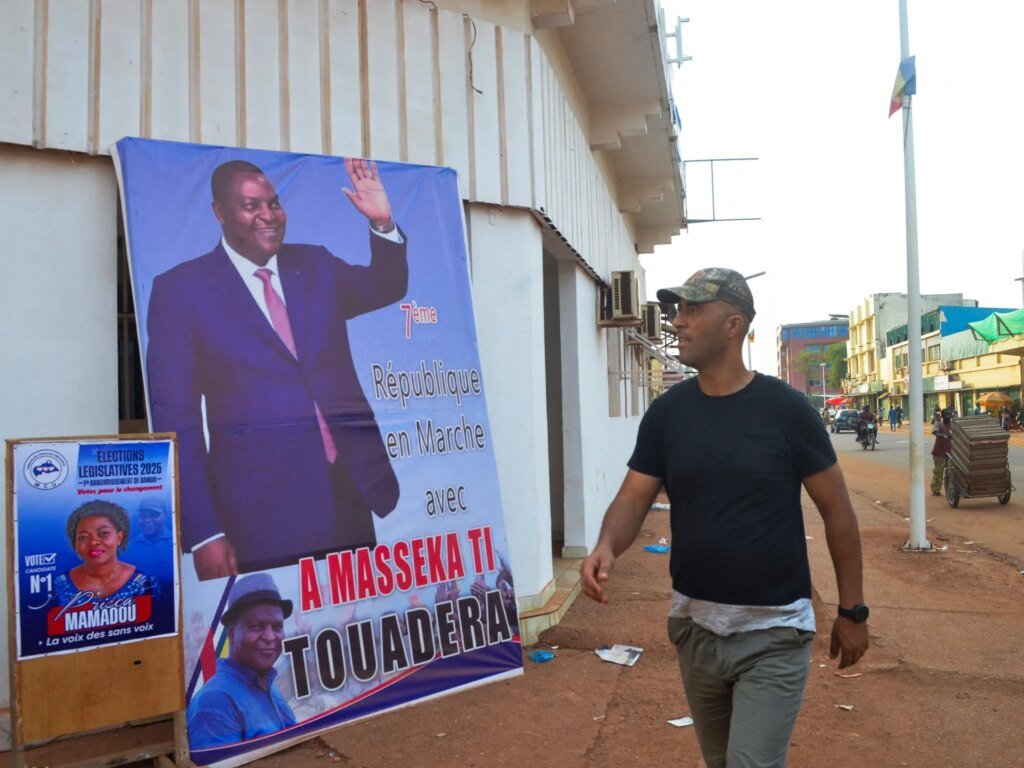
Controversial Elections in the Central African Republic
This Sunday, the Central African Republic (CAR) will hold presidential and legislative elections that are stirring up significant controversy. These elections could mark the first time in the nation’s history that President Faustin-Archange Touadera extends his tenure beyond two terms. Having made headlines in 2022 for adopting Bitcoin as one of its legal tenders, Touadera previously pushed through a referendum that eliminated presidential term limits. As a result of delays affecting the participation of key challengers, several opposition groups are calling the elections a “sham” and are boycotting the process.
Local Elections and Ongoing Conflict
Alongside the presidential and legislative votes, CAR will also conduct local elections for the first time in four decades. This development comes after years of political turmoil, including a civil war primarily involving the Seleka rebel movement and the Anti-balaka armed groups, which has displaced approximately one million citizens. There are concerns regarding the electoral body’s capacity to manage such a large-scale election effectively.
Country Overview
CAR, a landlocked nation bordered by Chad to the north and the Democratic Republic of the Congo (DRC) to the south, is home to around 5.5 million people. French and Sango are the national languages. Although the country is rich in natural resources like oil, gold, and uranium, it remains one of Africa’s poorest due to chronic political instability since gaining independence from France in 1960, compounded by ongoing conflict.
Citizens of CAR are known as Central Africans, and the capital, Bangui, derives its name from the Ubangi River, which serves as a natural boundary with the DRC. The nation primarily exports diamonds, timber, and gold, but many individuals rely on subsistence farming, resulting in limited economic activity.
Details About the Upcoming Election
Voting Process
Approximately 2.3 million Central Africans aged over 18 are registered to vote. Among these, about 749,000 are new registrations since the last election in 2020. Voters will select a new president, national lawmakers, and, after many years, municipal administrators. Historically, the voter turnout has hovered around 62 percent, according to reliable sources. There are roughly 6,700 polling stations nationwide.
Initially scheduled for late August, the municipal elections have been postponed to December due to funding issues and technical hurdles, raising eyebrows among election observers and opposition figures about the electoral body’s preparedness.
Candidates for the Presidency
The constitutional court has approved the candidacy of President Touadera, along with notable opposition leader Anicet-Georges Dologuele, ex-Prime Minister Henri-Marie Dondra, and several others. However, opposition coalition the Republican Bloc for the Defence of the Constitution (BRDC) has opted to boycott the elections, opting not to field a candidate.
Faustin-Archange Touadera
At 68 years old, Touadera is a mathematician and former vice chancellor of the University of Bangui. He previously served as Prime Minister from 2013 to 2015 and has been president since 2016. Campaigning on promises of security, peace, and infrastructure development, he is viewed as the frontrunner. However, his legacy is marred by allegations of election rigging and opposition suppression.
Henri-Marie Dondra
Dondra, 59, with a background in banking and finance, is standing for the Republican Unity party (UNIR). Despite serving under Touadera as prime minister, he was dismissed, likely due to his pro-France stance as the government pivoted toward Russia. His candidacy faced uncertainty until recently due to accusations regarding his citizenship, which he denied.
Anicet-Georges Dologuele
A prominent opposition figure, Dologuele has broken from the boycotting coalition to contest in the elections. At 68, he has previously run for president in 2015 and was the runner-up in 2020. His earlier citizenship struggles have fueled heated discussions surrounding his eligibility, with mixed views regarding his experience.
Key Issues Impacting the Elections
Armed Groups and Security Concerns
The deep-rooted conflict in CAR extends over a decade, with many residents desiring leadership that can establish peace. The situation escalated after the 2013 coup by Seleka rebels, who faced opposition from Christian groups. Despite recent agreements aimed at peace, violence and human rights violations persist, raising security concerns during the elections.
Poverty Profiles
CAR remains one of the world’s poorest nations, with a significant percentage of the population living in poverty. The economy is largely dependent on subsistence agriculture, and many lack basic services like electricity and internet access. Fuel shortages further complicate everyday life.
Political Divisions
The country’s political landscape is marked by division, hindering the establishment of a unified opposition to challenge Touadera. Concerns persist that he may seek to prolong his rule following the controversial referendum in 2023, prompting calls for constitutional reforms.
Conclusion
The upcoming elections in the Central African Republic are fraught with controversy, from allegations of manipulation and suppression to critical socioeconomic challenges. As the nation prepares to cast its ballots, many are hoping for leadership that can bring about much-needed change and stability.
Key Takeaways
- Elections in CAR may extend President Touadera’s term beyond two terms for the first time.
- Controversy surrounds the process, leading some opposition groups to boycott.
- Security issues remain a significant concern for voters in conflict-affected areas.
- Poverty and political division continue to challenge the country’s growth and stability.