
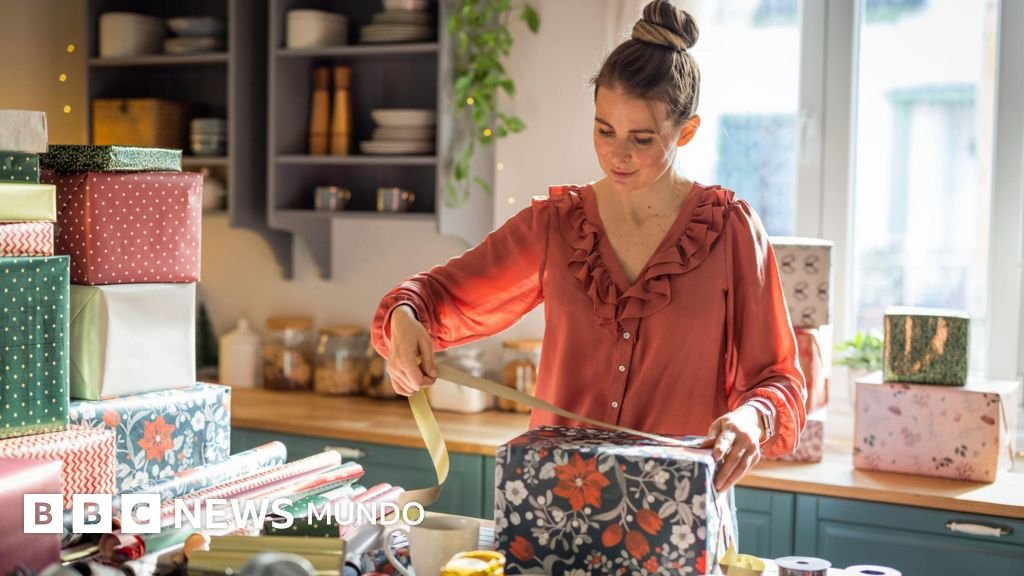
Mastering the Art of Gift Wrapping This Christmas
The holiday season is upon us, and while choosing gifts often brings joy, wrapping them can sometimes feel like a chaotic ordeal. With scissors, tape, and festive wrapping paper in hand, how can we ensure our gifts look as good as they should? Enter the world of mathematics—this year, let’s consider how some simple calculations can make our gift-wrapping experience not just easier, but more enjoyable.
Innovative Approaches to Wrapping
Cubic boxes are typically the easiest items to wrap, yet many struggle to cut the right amount of paper. Often, we either end up with excess paper folded clumsily at the ends, or we cut too little and must patch it with extra pieces. Thankfully, mathematician Sara Santos from King’s College London has developed a clever formula to streamline this process.
Calculating the Perfect Wrapper
First, measure the height of your box and multiply this figure by 1.5. Next, measure the diagonal of the larger face of the box from corner to corner. Simply add these two numbers together, and you will have the dimensions of the square of wrapping paper needed. For instance, to wrap a cube measuring 4.5 cm diagonally and 3 cm tall, you would cut a 9 cm x 9 cm square of paper.
The trick is to position the gift diagonally in the center of the paper, then carefully fold each corner towards the center, tucking in the edges beneath the bulkier folds. Securing everything with just three small pieces of tape ensures a neat finish—and if you’re using striped paper, you might even get the patterns to match up at the seams!
Alternative Shapes and Sizes
This method can also work with rectangular boxes, though it’s worth noting that if you’re working with a square piece of paper, a diagonal wrap isn’t always the best choice. For example, a box measuring 2 x 4 x 8 cm requires a 14 x 14 cm square of paper for diagonal wrapping, but a standard 12 cm square would suffice for traditional wrapping.
Advanced Wrapping Techniques
When it comes to triangular prisms, measure the height of the triangle at the packaging’s end, double it, and then add the total length of the box to determine the perfect size of paper needed to achieve a flawless finish.
Wrapping Cylinders
For cylindrical gifts, like candy tubes, first measure the diameter of one end, multiply it by Pi (approximately 3.14), and this will yield the amount of paper needed to wrap the item. After that, take the length of the cylinder and add the diameter to find the minimum length of paper required. Ideally, the paper should overlap perfectly at each circular end with minimal tape used. A little extra paper is advisable to ensure complete coverage and maintain the element of surprise.
Challenges with Spheres
Unfortunately, if your gift is a ball, you’re in for a challenge! Wrapping a sphere is one of the most difficult tasks due to the unique properties of paper and a concept known as the “hairy ball theorem.” This theorem states that it’s impossible to comb the hair of a sphere flat without resulting in at least one tuft or bump.
Creative solutions can come into play for spherical gifts; for instance, tying a bow around it or twisting the paper to resemble a candy shape can add a whimsical touch. If you aim for efficiency with something like a soccer ball, using triangular pieces of wrapping paper can be beneficial.
Research indicates that reducing the perimeter of the wrapping improves material usage, suggesting that a square shape is often more efficient than a rectangle when wrapping spherical items. The secret lies in utilizing a technique that minimizes material waste while maximizing coverage.
Dealing with Irregular Shapes
Wrapping oddly shaped gifts like mugs, which have handles protruding, presents yet another layer of complication. There isn’t a strict mathematical solution for every potential gift shape, making experimentation a valuable alternative in these situations. One potential workaround is to combine the irregular item with another gift to create a more manageable shape.
Efficiency in Group Wrapping
When it comes to efficiency, wrapping two gifts of similar size together can save paper compared to wrapping them separately. However, if the items vary significantly in size or shape, this could lead to increased waste.
Final Thoughts
The art of wrapping gifts isn’t as straightforward as it may seem—sometimes, a little math can go a long way. Whether you’re using Santos’ method for efficiency or opting for creative solutions to tackle challenging shapes, the goal remains the same: to wrap gifts beautifully without unnecessary waste.
Key Takeaways
- Calculating dimensions accurately can significantly reduce wrapping paper waste.
- Positioning gifts diagonally can often lead to better coverage.
- Be creative when wrapping spherical or irregular shapes—think outside the box!
- Experimentation is key to mastering the art of gift wrapping.