
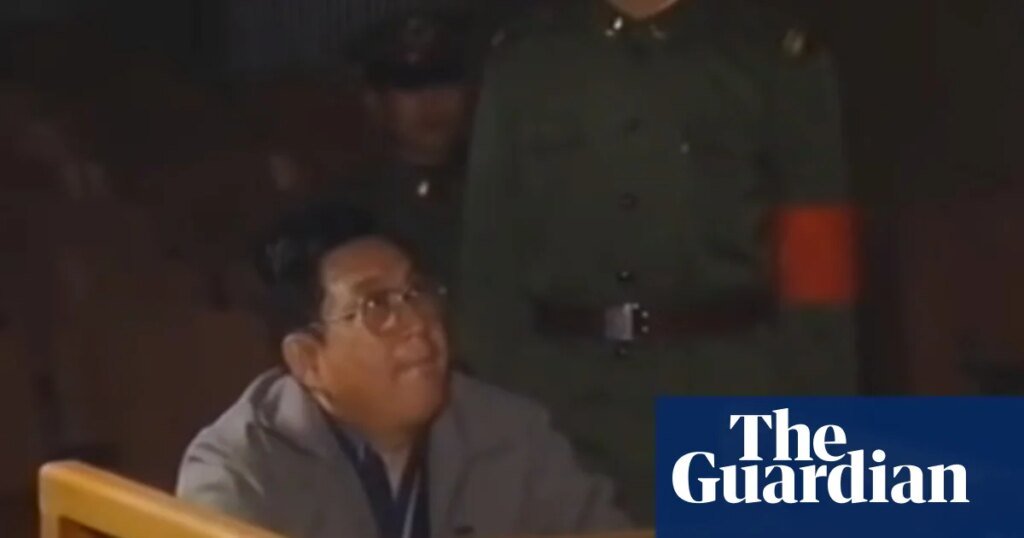
Unearthed Footage Reveals PLA General’s Defiance During Tiananmen Square Protests
In a rare revelation from a tumultuous chapter in modern Chinese history, recently leaked footage showcases General Xu Qinxian of the People’s Liberation Army (PLA) openly defying superior orders during the 1989 Tiananmen Square protests. This unprecedented material provides valuable insight into the military’s internal dynamics during one of China’s most impactful events.
The Courageous Stand of General Xu Qinxian
General Xu Qinxian’s decision to refuse deployment orders to quell the student-led protests has been woven into the history of Tiananmen for over three decades. The six-hour recording of his court martial hearing, which surfaced online last month, documents this brave act, with Xu articulating his fears of becoming “a sinner in history” should he follow through with his orders.
Zhou Fengsuo, a prominent figure in the student demonstrations and now residing in the US, expressed that this footage confirms the long-held beliefs surrounding Xu’s resistance. “This is the first time that we have a clear first-person view of this period,” he noted, highlighting the significance of such a direct account.
Although the origins of the video remain unclear, it has garnered significant attention, amassing over 1.2 million views on various online platforms. Wu Renhua, a historian connected to the Tiananmen movement and one of the first to distribute the footage, emphasized its importance, describing it as “perhaps the most important piece of data that I have gathered in my three decades of research.” He remains convinced of its authenticity based on corroborated details from his investigations.
The Events of 1989
The demonstrations, which captivated Beijing during the spring of 1989, culminated in tragic violence on June 4, when PLA forces brutally dispersed civilians around Tiananmen Square. The resulting massacre likely claimed hundreds or even thousands of lives, marking a deeply sensitive chapter in the governance of the Chinese Communist Party (CCP). Discussions regarding this incident remain heavily censored, and the party has yet to address it openly or officially.
Amidst rising unrest, there were prevalent rumors of military dissent. Historical accounts reveal that many soldiers expressed solidarity with the demonstrators prior to June 4.
General Xu’s Hesitation and Insights
At the time protests erupted, General Xu was hospitalized, recovering from kidney stones. However, on May 18, he received orders to mobilize his 15,000 troops to enforce martial law. During his court martial, Xu articulated his reservations about the situation. With a candid demeanor, he stated, “I had a different opinion on this matter. This was a mass political incident, and it should primarily be resolved through political means.”
Ultimately, he declined to carry out the order but relayed his opinions to higher-ups. He warned that failure to enforce martial law could label the executing commander as a “sinner in history.”
Joseph Torigian, an associate professor specializing in Chinese politics, noted that the footage illustrates the complexities faced by senior military officials in an ambiguous political landscape. Xu’s testimony candidly reflects his internal struggle regarding loyalty to both the military and the ruling party. He expressed concerns about the potential for escalating violence.
Debate Over Martial Law
One of the critical points raised by Xu was his skepticism about whether the Central Military Commission had the authority to impose martial law without a formal discussion in China’s National People’s Congress. This assertion showcases his quest for legitimacy in a heated political climate.
Since the fallouts of the Tiananmen Square protests, the CCP has consolidated its power over the PLA, mandating absolute loyalty to the party rather than any external authority. This loyalty remains a crucial concern for the ruling party, as evidenced by recent purges of military leaders under accusations of corruption.
General Xu faced severe consequences for his defiance, resulting in his expulsion from the CCP and a five-year prison sentence. He ultimately lived in exile from Beijing until his passing in 2021 at the age of 85.
- General Xu Qinxian’s leaked court martial footage highlights his refusal to suppress the Tiananmen protests.
- The video serves as a significant first-person insight into military dynamics during the events of 1989.
- Xu voiced concerns about the legitimacy of martial law and the implications of violent confrontation.
- The fallout from the 1989 protests continues to shape the relationship between the CCP and the PLA today.