
The Enduring Craft of the Kobyz and Yurt
On a brisk morning in Chimbay, a quaint town in the Karakalpakstan region of northwestern Uzbekistan, a seasoned craftsman meticulously shapes a half-finished wooden frame. Though his movements are slow, they resonate with confidence as he constructs a yurt much like his father and grandfather did before him. Meanwhile, not far away, a young apprentice struggles to extract a sound from a two-stringed instrument, guided by a teacher who describes its music as ancient as the vast steppe itself. These moments are emblematic of a broader cultural awakening across Central Asia.
At the recent 20th session of the UNESCO Intergovernmental Committee in New Delhi, two significant elements—the Kobyz, a traditional bowed instrument, and the yurt—were jointly nominated by Uzbekistan, Kazakhstan, and Kyrgyzstan and inscribed on UNESCO’s Lists of Intangible Cultural Heritage. However, UNESCO cautions that numerous aspects of this heritage face serious threats due to the diminishing number of skilled craftsmen.
The Kobyz: A Voice from Centuries Past
The Kobyz stands as one of the oldest bowed instruments in the Turkic world, with origins traced back to the 5th-8th centuries CE. Its unique design features a scoop-shaped body, an arched neck, and a camel-skin membrane, all contributing to a resonant sound deeply rooted in shamanic traditions. Historically, the term “qobuz” among Turkic tribes signified “musical instrument,” emphasizing its cultural importance.
In Kazakhstan, regions like Kyzylorda and Mangystau are particularly rich in Kobyz traditions, where generations of storytellers and musicians, recognized as baky and kyuishe, have preserved its repertoire. In Kyrgyzstan, the enduring elements of this tradition are alive in the musical practices of the Issyk-Kul and Naryn regions, where related bowed instruments accompany epic storytelling.
Crafting a Kobyz necessitates specialized knowledge, from selecting the right type of wood to expertly carving the body from a single block, along with preparing horsehair for the strings and bow. Traditionally, this expertise has been passed down through families. Today, in Karakalpakstan, the Kobyz lives on primarily through zhyrau, epic storytellers who skillfully accompany their tales with the instrument. Unfortunately, this tradition is waning rapidly.
Ermek Bayniyazov, a zhyrau from a village near Nukus, expresses concern over the swift decline of this craft. “In my youth, you could find someone who knew how to tune or repair a Kobyz in every village. Now, there are hardly any true masters left. If one of them stops, those skills vanish,” he laments.
“A Kobyz isn’t like a guitar you can buy in a shop. The body must be carved from a single block, and the horsehair needs to be washed, dried, and twisted precisely. Even the selection of the wood was once considered an art. Today, many players lack knowledge of its construction, which is a troubling sign for the future.”
The Yurt: Architectural Heart of Nomadic Life
While the Kobyz serves as the voice of the steppe, the yurt is its architectural counterpart. For the nomadic and semi-nomadic peoples of Central Asia, including Karakalpaks, Kazakhs, and Kyrgyz, the yurt represented the primary living structure until the late 19th century. By the 1930s and 1940s, its presence was largely restricted to shepherds during seasonal migrations.
The yurt historically held significant social implications. Young men preparing for marriage were expected to acquire one, and among the Karluk and Kipchak groups, parental approval for marriage often hinged on yurt ownership. Wedding yurts, draped in white felt, contrasted with everyday yurts—known as kara ui—made from darker materials.
Throughout the region, the yurt symbolizes continuity and a deep connection to the land. For many communities, its interior embodies a microcosm of order, while the world outside its felt walls represents the broader universe.
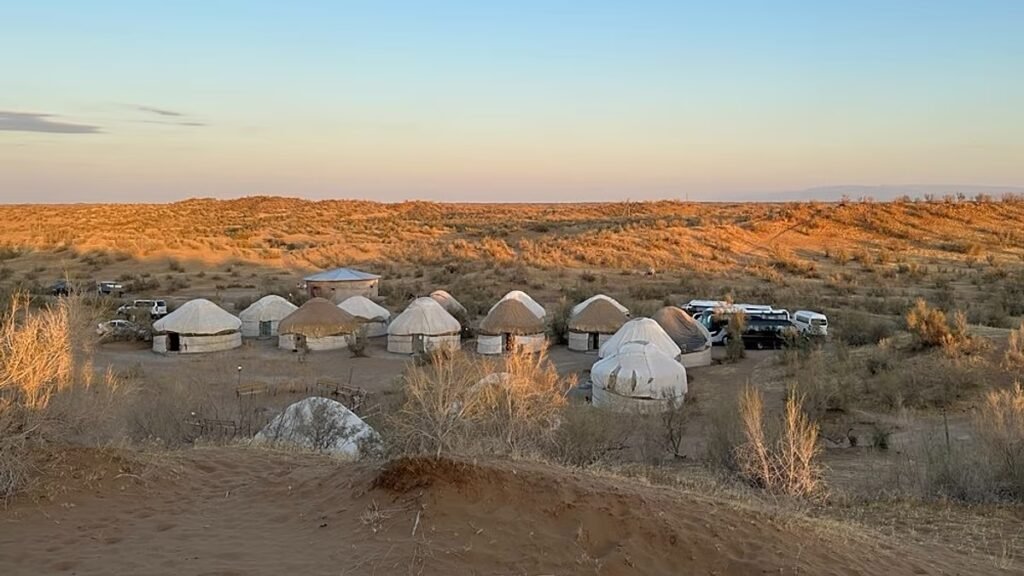
In Uzbekistan, yurts remain integral to cultural life in regions like Karakalpakstan, Surkhandarya, and Navoi, especially during summer gatherings near water or trees, where felt panels are lifted for ventilation. Chimbay is one of the few remaining centers for traditional craftsmanship, where artisans master yurt-making alongside embroidery for suzani and other textiles. Although artisans may not always use the term “heritage,” their skills are fundamental to the practices UNESCO aims to protect.
Presently, yurts are less often seen as daily homes and more frequently serve as cultural spaces where visitors can immerse themselves in nomadic traditions. Vohid Pirmatov, who runs the “Kyzylkum Safari” yurts in Navoi, shares that these authentic felt structures create a crucial link to the past. “Our yurts are crafted from natural felt, maintaining the same material traditionally used in nomadic homes. They allow for breathability, keeping the interior cool,” he explains. He notes that there is growing interest from tourists, particularly from Germany, France, and Italy, who wish to experience the culture firsthand rather than merely read about it.
Why UNESCO’s Recognition is Timely
The inscription serves to highlight not only the cultural richness of these practices but also the urgent need for their safeguarding. Skilled Kobyz artisans are becoming increasingly rare, while environmental challenges limit access to suitable wood for yurt frames. Additionally, younger generations are often drawn towards modern music and digital tools, overshadowing traditional crafts.
Gulbakhar Izentaeva, Director of the Savitsky State Museum of Art in Nukus, notes that this is a landmark moment, as it marks the first instance of an element from Karakalpakstan being added to the UNESCO Intangible Heritage Lists and the first from Uzbekistan to be listed under the Urgent Safeguarding List. She cautions that “young people rarely listen to traditional music or show interest in learning how to make the Kobyz.”
According to Izentaeva, knowledge that has persisted through centuries now relies on an increasingly narrow pool of masters within a fast-evolving social landscape. Saida Mirziyoyeva, Head of the Presidential Administration, emphasized on social media that this inscription strengthens the connection between generations, reflecting the depth of traditions and spiritual heritage.
Throughout Central Asia, this recognition is celebrated as an acknowledgment of a living heritage chain. Despite the shifting currents of modern life, the Kobyz and the yurt remain vital anchors of cultural identity, upheld by the communities that continue to cherish and transmit them.
Conclusion
The Kobyz and yurt are more than just instruments and structures; they are vital components of Central Asia’s rich cultural fabric. The UNESCO recognition not only sheds light on their importance but emphasizes the urgency to protect these traditions before they fade away.
Key Takeaways
- The Kobyz and yurt are integral to the cultural heritage of Central Asia.
- These traditions face significant threats due to declining skills among craftsmen.
- UNESCO’s recognition highlights the need for urgent preservation efforts.
- Strong cultural ties continue to unite communities around these time-honored practices.