
Resilience in Education: Students Return to the Islamic University of Gaza
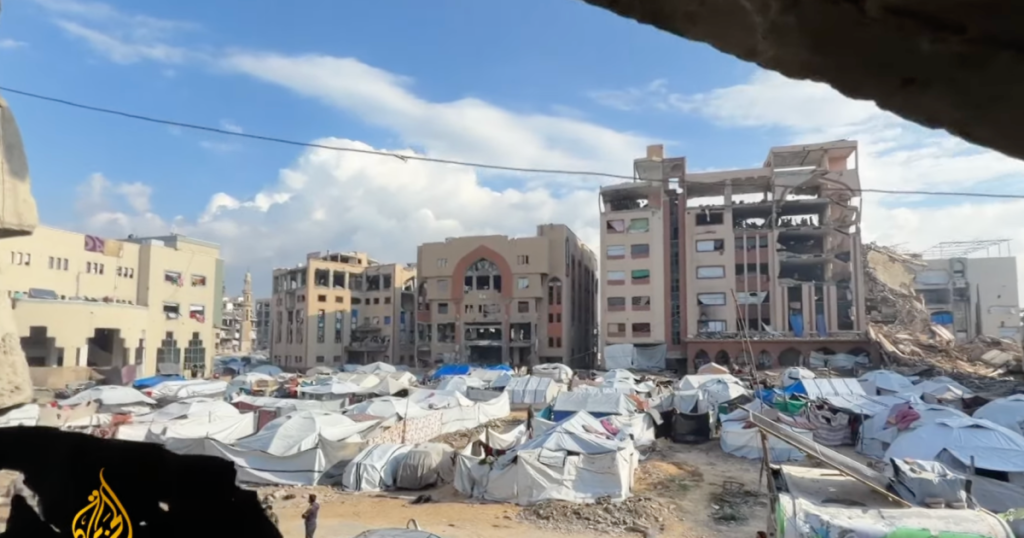
For the first time in two years, students at the Islamic University of Gaza are stepping back into in-person classes. This return is both a significant milestone and a daunting challenge for those navigating a campus that has transformed into a refuge amidst the devastation caused by ongoing conflict. The university now serves as a shelter for nearly 500 displaced families, who have sought safety among buildings left in ruins as a result of relentless bombardments.
A Campus in Crisis
Once a place of learning, the campus has been altered dramatically, with tents replacing lecture halls, symbolizing the dual crises of homelessness and educational erosion in Gaza. Atta Siam, who was displaced from Jabalia, expressed his concerns: “We came here because we had nowhere else to go, but this place is meant for education, not for shelter. It should be a space for our children to learn.”
The Hope for Education
The partial reopening of classes has sparked renewed hope among the students, even though the environment bears little resemblance to what a functional university should look like. According to UNESCO, over 95% of higher education institutions in Gaza have suffered severe damage or destruction since the escalation of violence in October 2023.
Youmna Albaba, a first-year medical student, shared her challenges: “I dreamed of studying in a well-equipped university. I need a place that fully supports my education, but I haven’t found what I envisioned here. Yet, I remain hopeful because we are learning to rebuild from nothing.”
The Reality of Scholasticide
What human rights organizations and UN experts describe as “scholasticide” has left over 750,000 Palestinian students without education for two consecutive years, according to the Al Mezan Center for Human Rights. Recent reports reveal a disturbing reality—with 494 schools and universities either partially or completely destroyed, including 137 that are now rubble. The conflict has resulted in the loss of 12,800 students, along with 760 educators and 150 academics.
Notably, the last remaining functioning university in Gaza, Isra University, was reduced to ruins in January 2024. Meanwhile, professors at the Islamic University are making the best of what limited resources they have, often improvising under dire circumstances. Dr. Adel Awadallah explained the situation: “We’re trying to cover the exposed walls with plastic sheets to fit in as many students as we can. We’ve even borrowed generators to keep the university’s equipment running.” Despite only four classrooms being usable, thousands rely on these makeshift setups to continue their education.
The Broader Implications
UN experts highlighted in April 2024 that the extensive destruction may indicate an intentional strategy to dismantle the foundations of Palestinian society. “When schools are destroyed, so too are hopes and dreams,” they stated, emphasizing that the systematic destruction of educational infrastructure is a violation of fundamental human rights.
The challenges faced by families go beyond infrastructure. Many struggle to access basic necessities like food, water, and medicine, making it nearly impossible to support their children’s education. Remote learning efforts from the Ministry of Education and UNRWA have faltered due to persistent electricity outages, internet disruptions, and mass displacements.
Nevertheless, students persevere. Despite the trauma and loss endured over more than two years, returning to education remains a top priority—a glimmer of hope for recapturing normalcy and their futures. As Youmna Albaba articulated, “Despite everything, I feel grateful to attend lectures in person. We are building everything from scratch.”
Conclusion
The journey back to education at the Islamic University of Gaza is emblematic of resilience in the face of immense challenges. Even as ruins surround them, the spirit of learning and hope persists in the hearts of these students.
Key Takeaways
- Students return to the Islamic University of Gaza for in-person classes for the first time in two years.
- The campus is now a shelter for displaced families amid significant destruction from conflict.
- Over 750,000 Palestinian students remain without education due to ongoing violence.
- Despite immense challenges, students continue to prioritize their education and hope for a better future.