
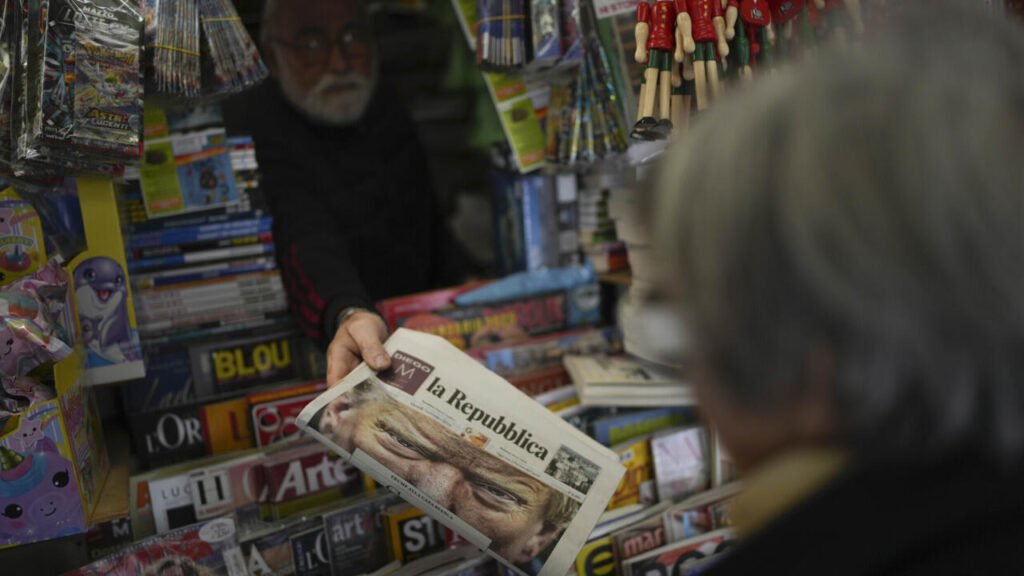
Italy’s Political Landscape Shakes with Proposed Newspaper Sale
Italy’s parliament has summoned executives from GEDI, the publisher behind La Repubblica and La Stampa, to provide insights regarding the proposed sale of the two prominent newspapers to Greece’s Antenna Group. This inquiry, announced by the chairman of the parliamentary media committee, Federico Mollicone, follows a series of strikes and rises in anxiety within newsrooms as negotiations continue between GEDI—owned by the Agnelli family’s Exor holding—and the Greek bidder, Theodore Kyriakou.
The Buyer Under Scrutiny
The potential sale has garnered substantial public attention, primarily due to the buyer’s controversial background. Kyriakou, a significant figure in the media and shipping sectors, is the son of Minos Kyriakou, who established Antenna, the company operating ANT1 TV, a major Greek television network. His reputation has been described as that of an “ultra-conservative Berlusconi of the Balkans” by the independent Greek outlet Blitz Quotidiano. Notably, Kyriakou has acknowledged close connections with U.S. President Donald Trump and retains commercial ties in both Qatar and Saudi Arabia. In the spring of 2025, he was present at a dinner in Doha hosted by Qatar’s Emir, which was an occasion for private discussions surrounding international commerce and politics.
Furthermore, according to reports, Kyriakou may have sought informal consent from Italy’s Prime Minister, Giorgia Meloni, before progressing with the acquisition of the Italian papers.
Financial Details and Prospective Goals
Last week, John Elkann, chairman of the Gedi Group, confirmed the ongoing exclusive discussions with Antenna to staff members. GEDI, under the control of the Agnelli family’s holding company, Exor, which also owns substantial stakes in Stellantis, Ferrari, and Philips, indicated the transaction could be around €140 million. A source close to Antenna revealed ambitions for “expansion goals,” particularly aiming for the internationalization of the newspapers’ brands, which might create additional job opportunities in the medium term. However, specifics regarding the implementation of this strategy and measures to maintain editorial independence have not been disclosed.
Concerns Over Editorial Integrity
La Repubblica, established in Rome in 1976, is known for its center-left perspectives and intellectual coverage, while La Stampa, founded in Turin in 1867, reflects the liberal traditions of northern Italy. Together, they rank among the nation’s top five newspapers, with La Repubblica selling approximately 96,000 copies daily and La Stampa around 59,000, as reported by ADS.
Both publications have a history of criticizing Prime Minister Giorgia Meloni’s government as well as figures like Donald Trump and Vladimir Putin, leading to heightened fears that foreign ownership may compromise their editorial independence. Concerns are further amplified due to Antenna’s financial and political links abroad—particularly following a 2022 investment by Saudi Arabia’s Public Investment Fund (PIF), which acquired a 30% stake in the group. Although Antenna asserts that this investment does not extend to the GEDI acquisition, human rights groups have long criticized PIF for using its funds to enhance Saudi Arabia’s global image amidst serious human rights concerns.
International Scrutiny and Local Reactions
The sale has drawn attention from international observers. The Russian embassy in Rome expressed hopes that the new ownership would reduce what they termed the newspapers’ “anti-Russian propaganda.” In response, La Repubblica’s editorial team condemned this statement as “a serious act of interference,” vowing to uphold their commitment to challenge misinformation spread by authoritarian figures. Opposition politicians in Italy criticized the Russian comments, with Green Party’s Angelo Bonelli labeling them “unacceptable interference.”
So far, the Italian government has refrained from exercising its “golden power,” which allows it to block foreign acquisitions in strategic sectors. Foreign Minister Antonio Tajani indicated that market forces should dictate the matter, although he acknowledged that local ownership of national newspapers would better serve Italy’s interests.
Emotional Responses from Local Communities
The potential sale has stirred emotions in Turin, where La Stampa is deeply rooted in the community. Readers have expressed their anger and dismay, while the city’s Archbishop, Roberto Repole, underscored the necessity of independent journalism in today’s delicate democratic environment. Journalists from both newspapers have initiated strike action, seeking assurances regarding employment stability and editorial independence. Reports suggest that Kyriakou does not intend to retain La Stampa, planning to seek a different buyer before finalizing the deal early next year.
Conclusion
The proposed sale of La Repubblica and La Stampa represents more than just a financial transaction; it raises critical questions about media independence, political influence, and journalistic integrity in Italy. As negotiations proceed, the outcomes could significantly impact the landscape of Italian journalism.
- Italy’s parliament is investigating the proposed sale of La Repubblica and La Stampa to Greece’s Antenna Group.
- The potential buyer, Theodore Kyriakou, has stirred controversy due to his political ties and intentions for the newspapers.
- Editorial independence is a significant concern, as both papers have critiqued Italian leadership and global political figures.
- Public and political responses include strikes and significant emotional opposition from local communities.