
Innovative Medical Solutions by Palestinian Doctors in Gaza
In the face of overwhelming adversity, Palestinian doctors in Gaza are showcasing incredible resilience and ingenuity as they work to save lives amidst devastation. With the enclave’s medical infrastructure severely compromised due to ongoing conflict, these dedicated professionals have turned to innovative solutions, leveraging technology to address urgent medical needs.
Harnessing Solar Power for 3D Printing
Hospitals in Gaza are struggling to maintain operations due to frequent power outages, but resourceful medical staff are utilizing solar energy to operate 3D printers. This technology allows them to create essential medical devices that address the complicated fractures resulting from relentless bombardment.
Creative Solutions to Complex Problems
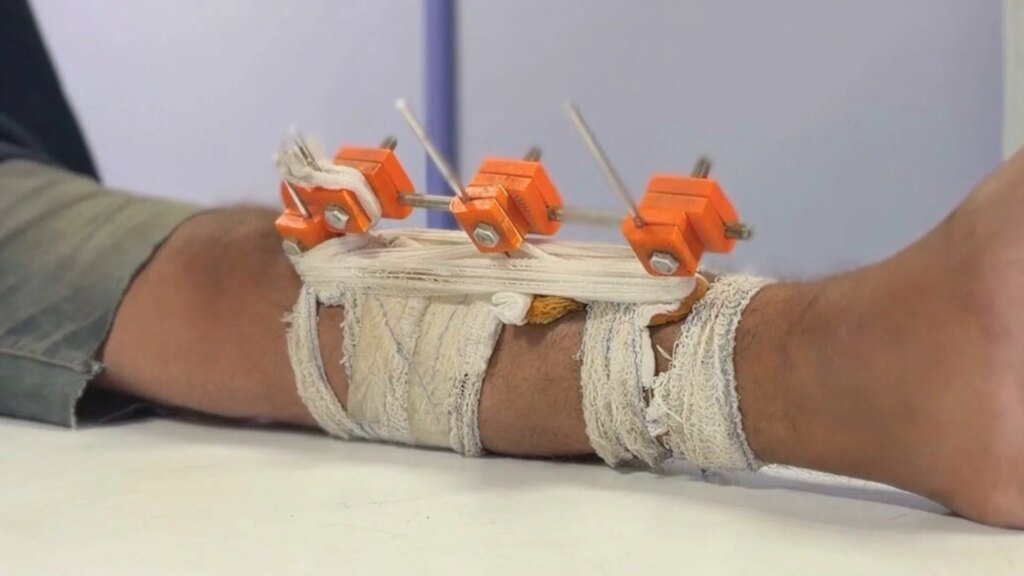
Dr. Fadel Naim, a consultant orthopedic surgeon and acting director of al-Ahli Arab Hospital in Gaza City, shared that medics are crafting external fixators, which are crucial for supporting severely injured limbs. These devices, made from affordable 3D-printed parts and recycled materials, provide a cost-effective solution for the increasing number of complex fractures caused by the conflict.
“The types of fractures we’re seeing during this war are incredibly complicated,” Dr. Naim explains. “External fixators are the optimal treatment method.” He demonstrated how these devices can be assembled with minimal financial resources by combining 3D-printed components with standard metal rods, nuts, and bolts.
Real-Life Impact on Patients
Working alongside the medical solidarity organization Glia, Dr. Naim has spearheaded this initiative to produce fixators that would typically cost over $500 each. By utilizing open-source designs and solar energy for manufacturing, they can produce these life-saving devices without limitations.
One patient, Zakaria, who was displaced from the Jabalia refugee camp to Deir el-Balah, is a testament to this innovation. After sustaining a severe leg injury from shrapnel, he was treated with a locally produced external fixator. “I was taken to the hospital with no immediate care, but two weeks later, I was given this new device to fix my leg,” Zakaria recounted. “I was surprised to learn it was made by Palestinians.”
Dr. Naim added, “He’s pain-free and has full range of motion; he can walk now,” highlighting the profound difference this local technology has made in Zakaria’s life.
A Beacon of Hope Amidst Despair
Journalist Hind Khoudary remarked that this pioneering technology is effectively a lifeline for Gaza, a region that has lost its electricity and where the healthcare system is on the brink of collapse. “In a place where everything is being destroyed, Palestinian doctors are still creating, still resisting, still saving lives — one printed piece at a time,” she stated.
The Need for Continued Innovation
Glia recently announced that there are 12 more patients awaiting similar treatment, underscoring the critical demand for these devices and the transformative impact of local manufacturing under siege conditions. The organization emphasized the global significance of this Gaza-led project, showcasing how such technology can thrive in extreme situations and serve as a model for other regions facing conflict, disaster, or environmental challenges.
Consequences of Ongoing Conflict
The situation in Gaza has reached dire levels, with Israeli military operations leaving approximately 63% of hospitals non-functional as of December 9. According to the United Nations agency for Palestinian refugees (UNRWA), around 282,000 housing units have been destroyed, resulting in around 1.5 million displaced Palestinians. Since the large-scale assault began following the October 7 attack, more than 70,000 lives have been lost.
Conclusion
Despite the harsh realities of war, Palestinian doctors continue to persevere, using innovation and technology to provide vital medical care. Their persistence and creativity are examples of resilience and hope in the face of unimaginable challenges.
Key Takeaways
- Palestinian doctors are innovatively using solar-powered 3D printers to create medical devices.
- External fixators made from 3D-printed components are addressing complex injuries sustained during conflict.
- Local production of medical devices is proving crucial in a collapsing healthcare system.
- The ongoing conflict has resulted in significant civilian casualties and destruction of infrastructure.