
The Rich Influence of Arabic Language on Global Communication
Arabic stands as one of the most widely spoken languages in the world, boasting around 400 million speakers, including 200 million who speak it as their first language. This article dives into the significance of Modern Standard Arabic (MSA), its diverse dialects, and its impact on various languages through history. Every year, on December 18, the international community acknowledges World Arabic Language Day, honoring Arabic as a vital aspect of cultural diversity. This date commemorates the moment in 1973 when the United Nations General Assembly recognized Arabic as one of its six official languages.
Understanding Modern Standard Arabic and Its Dialects
MSA serves as the formal language utilized in government, education, and legal contexts, while over 25 dialects flourish across the Middle East and North Africa. This diversity in dialects showcases the depth and vibrancy of Arabic as a language throughout various regions.
The Path of Arabic Words into Global Languages
As the most prevalent of the Semitic languages, Arabic has significantly influenced various cultures and languages for centuries. The borrowing of Arabic words into other languages highlights a long history of trade, scholarship, and cultural interaction. Languages like English, Spanish, and French, among many others, have incorporated a vast array of Arabic vocabulary into everyday use.
The Natural Course of Linguistic Borrowing
Muntasir Al Hamad, a linguist and Arabic professor at Qatar University, emphasizes that the adoption of words across languages is a common and natural process. This exchange of vocabulary extends to various fields including science and technology, demonstrating that Arabic, like many languages, has contributed to the broader tapestry of global communication.
Examining the Arabic Alphabet
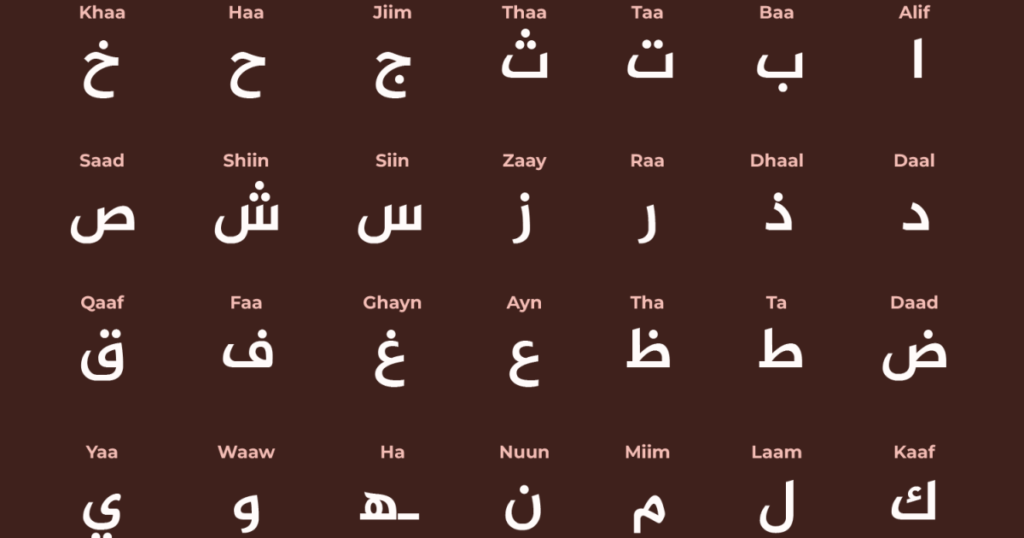
The Arabic alphabet consists of 28 letters and is uniquely written from right to left. Its cursive nature means letters change shapes based on their placement in a word, and typically, short vowels are not indicated in casual writing. These characteristics often foster the belief that Arabic is an extremely difficult language to master for non-native speakers.
A Misunderstood Language
However, Al Hamad argues that this belief is not entirely accurate. He points out, “One of the biggest misconceptions about Arabic is that it is among the most difficult languages in the world. In reality, it is simply a language with systems that diverge from those in English and many European languages.” He also mentions that speakers of languages like Urdu and Farsi may find Arabic relatively easier to navigate due to their similarities.
Arabic’s Contributions to Science and Mathematics
Among its many contributions, Arabic has significantly impacted the fields of mathematics and science. Over time, many Arabic terms became so frequently used that their origins are rarely recognized. For example, the word “algebra” comes from the Arabic term al-jabr, which translates to “restoration” or “reunion,” emerging from a notable 9th-century work focused on solving equations.
Transformations Across Languages
The journey of some Arabic words illustrates how they have been adapted into various languages. The term “carat,” used for measuring gemstones, is derived from the Arabic word qirat. Linguistically, Arabic words often undergo transformations to fit the phonetic preferences of other languages. For instance, the initial Arabic sound for qirat is reshaped with more familiar sounds like C, G, or K, leading to the English “carat.”
Everyday Vocabulary with Arabic Roots
Arabic influence is also present in daily vocabulary. The word “giraffe,” for instance, stems from the Arabic zarafa, similarly undergoing phonetic adjustments to blend into English. Words like “tariff,” originating from the Arabic ta’rif, entered English mainly through interactions with Romance languages, reflecting the intricate web of linguistic exchanges shaped by trade and cultural exchanges across the globe.
Conclusion
Arabic is far more than just a mode of communication; it has profoundly influenced world languages and cultures. As we celebrate its unique contributions, we also acknowledge the rich tapestry of words and ideas that connect us all. Understanding Arabic and its transformative role can foster greater appreciation for this remarkable language and its place within global discourse.
Key Takeaways
- Arabic, spoken by approximately 400 million people, plays a crucial role in global communication.
- Modern Standard Arabic serves as the formal language for various professional and educational contexts.
- Linguistic borrowing from Arabic has significantly blended with other languages over the centuries.
- The misconceptions surrounding the difficulty of Arabic often overlook its shared characteristics with other languages.