
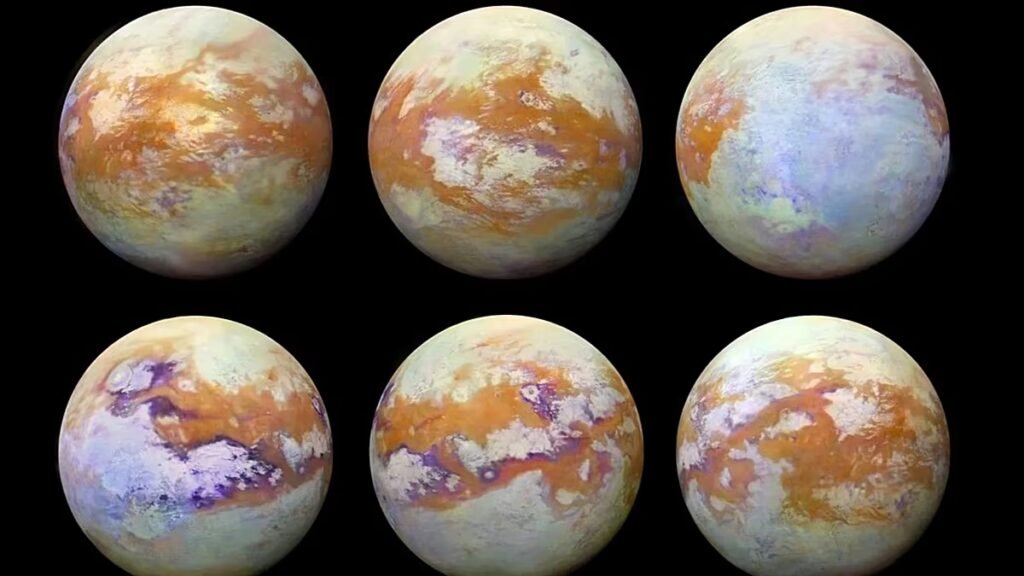
New Insights into Titan’s Frozen Landscape
Recent research presents intriguing findings about Titan, Saturn’s largest moon, suggesting it may harbor slushy ice layers rather than the previously theorized vast ocean beneath its surface. This revelation challenges a decade-old belief regarding Titan’s potential for supporting life.
A Surprising Discovery
A study published in Nature indicates that rather than a broad underground ocean, Titan may consist of deep layers of ice and slush, similar to the formations found in Earth’s Arctic regions or aquifers. This could imply the existence of small pockets of liquid water within these icy layers—potentially conducive environments for life.
Baptiste Journaux, an assistant professor at the University of Washington and a co-author of the study, explains, “Instead of an open ocean like we have here on Earth, we’re probably looking at something more like Arctic sea ice or aquifers. This has implications not only for potential life forms but also for the availability of nutrients and energy.”
While no signs of life have yet been detected on Titan, which spans 3,200 miles as the solar system’s second-largest moon, its hazy atmosphere and unique surface conditions raise fascinating questions. Titan is the only known celestial body besides Earth with liquid on its surface—but unlike water, Titan’s liquid is methane, existing at temperatures as frigid as -297 degrees Fahrenheit.
Expanding the Search for Life
Despite the absence of a full ocean possibly seeming like a hindrance in the quest for life, researchers believe this finding actually broadens the spectrum of environments deemed habitable. Ula Jones, a UW graduate student involved in the study, states, “It expands the range of environments we might consider habitable.”
Furthermore, it’s suggested that pockets of freshwater on Titan could reach temperatures as high as 21 degrees Celsius, making conditions potentially richer for life compared to a diluted ocean. If life does exist, it might resemble the polar ecosystems we find on Earth.
The Dynamic Nature of Titan’s Interior
Flavio Petricca, a postdoctoral fellow at JPL and the study’s lead author, denotes that Titan’s subsurface water may have undergone freezing in the past and could now be melting, or conversely, the moon’s hydrosphere might be gradually congealing. Computer models indicate the presence of ice, slush, and water layers extending over 340 miles deep, with an outer layer of ice approximately 100 miles thick covering slush and water pools.
The breakthrough arose from enhanced analysis of how Saturn’s gravity impacts Titan. Since Titan is tidally locked to Saturn—always facing the planet—Saturn’s gravitational pull creates deformations on Titan’s surface, leading to bulges reaching up to 30 feet high. In 2008, scientists theorized that a vast ocean was necessary to facilitate such deformations. The new study introduces a critical timing aspect, revealing a 15-hour delay between the peak gravitational force and the resultant surface rise.
“Like stirring honey, it takes more energy to move a thick substance than liquid water. A liquid ocean would respond instantly, but the delay signals a slushy ice interior with liquid water pockets,” Petricca elaborates.
A Call for Skepticism
Luciano Iess from Sapienza University of Rome, who previously supported the ocean theory using Cassini data, expresses skepticism regarding these new findings. He comments, “While certainly intriguing and stimulating for renewed discussion, the current evidence doesn’t convincingly exclude Titan from the family of ocean worlds.”
Future Missions and Exploration
The upcoming Dragonfly mission, featuring a helicopter-like craft set to launch to Titan later this decade, aims to shed light on the moon’s inner workings. With an expected arrival in 2034, Dragonfly will become the second flying vehicle on a celestial body besides Earth.
Alongside Titan, other moons such as Jupiter’s Ganymede and Enceladus, as well as Europa, also present possibilities of subsurface water, furthering the prospects of extraterrestrial life in our solar system. Saturn, with its 274 known moons, offers an exciting frontier for exploration.
Conclusion
The latest research offers a fresh perspective on Titan, suggesting a landscape rich in slushy ice layers rather than a vast ocean. As researchers continue to delve deeper into the moon’s characteristics, the possibilities for life on Titan grow more nuanced and complex.
- Research indicates Titan may contain slushy ice layers instead of a vast underground ocean.
- Pockets of liquid water within these layers could provide potential habitats for life.
- The upcoming Dragonfly mission aims to explore Titan’s surface and its interiors.
- Other moons in the solar system also suggest the presence of subsurface water.