
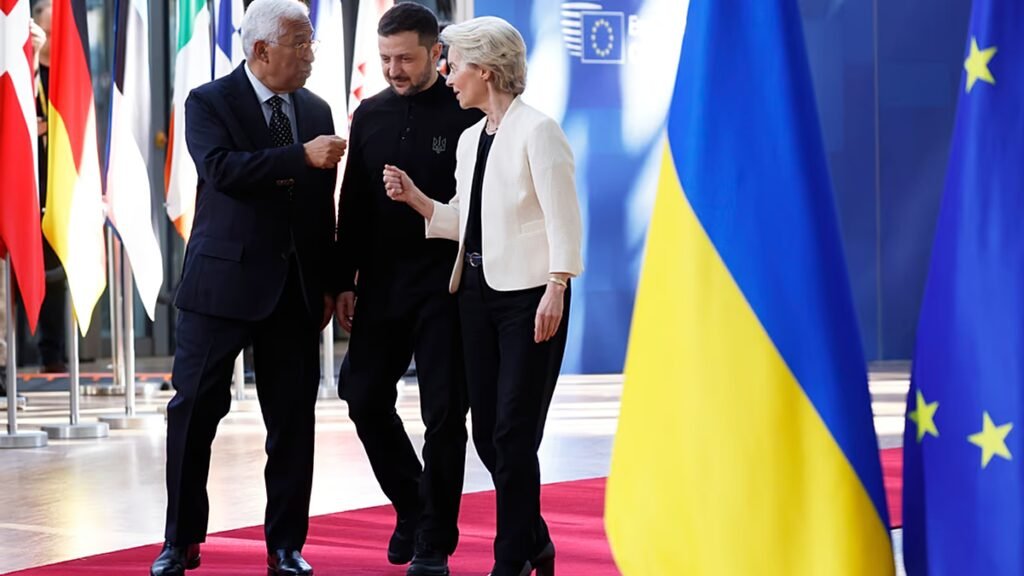
Ukraine’s EU Membership: A Path to Security Amidst Ongoing Challenges
Securing Ukraine’s future goes beyond merely achieving European Union (EU) membership, although this aspiration is indeed a vital component of the broader peace negotiations, as highlighted by Danish European Affairs Minister Marie Bjerre in a recent interview with Euronews. While the prospect of Ukraine joining the EU as soon as January 2027 seems promising, skepticism surrounds this timeline, particularly regarding the stringent requirements necessary for membership.
The EU Membership Perspective
Bjerre affirmed that EU membership should be an integral part of discussions related to establishing peace in Ukraine, linking it to long-term stability and security. “I think it is fair that EU accession is a part of the talks when we’re talking about peace with Ukraine,” she stated. However, she stressed that just becoming a member of the EU is insufficient to ensure Ukraine’s security. Achieving accession requires the implementation of numerous reforms aimed at combating corruption and fortifying the rule of law.
Despite the ambitions set forth in discussions with the United States regarding Ukraine’s timeline for EU integration, the proposal has raised questions about its practicality. “We have never put a timeline on either Ukraine or Moldova or on the countries in the Western Balkans because it is a merit-based approach, and we stand with that,” Bjerre explained, indicating that the EU will not cave to external pressure.
Navigating the EU Enlargement Process
The Danish government, currently holding the EU Council Presidency since July 1, 2025, has made it a priority to advance Ukraine’s EU application. Bjerre expressed satisfaction with the measures taken to facilitate this process as she emphasized the importance of strengthening Europe amid prevailing uncertainties. “We need a stronger Europe, a Europe that is more secure,” she remarked, underlining the urgency of the situation.
Challenges with Unanimous Voting
However, achieving EU membership is not solely dependent on meeting internal standards; it also requires the unanimous approval of all 27 member states. A significant hurdle arises from Hungary, which has consistently opposed Ukraine’s accession. To address this obstacle, the EU and Ukraine recently formulated a plan that enables Ukraine to continue reforming and progressing technically, even with Hungary’s resistance. “I am extremely satisfied and proud that we actually managed to find a new approach,” Bjerre stated, highlighting the ongoing engagement with both Ukraine and Moldova.
The Road Ahead
Looking ahead, Bjerre expressed optimism about the continuation of this new approach under the upcoming Cypriot Presidency, set to begin on January 1, 2026. “So even though Hungary is blocking, we have moved on the enlargement agenda,” she asserted, admitting the persistent challenges posed by Hungary’s stance.
Addressing whether this situation might deepen Hungary’s resistance, Bjerre noted that Ukraine’s steady progress towards EU reforms could eventually exert pressure on Hungary to reconsider its position. “When Ukraine is making the reforms, is getting closer to the EU day by day, they can’t keep blocking,” she said.
Ultimately, Bjerre underscored the mutual benefits of Ukraine joining the EU, particularly concerning defense and security cooperation. “Having an integrated defense with Ukraine would really boost our security,” she concluded, emphasizing that as Ukraine moves closer to membership, it will enhance collective security across Europe.
Conclusion
The journey towards Ukraine’s EU membership remains complex and filled with challenges. While membership is crucial for long-term security, it requires consistent reforms and cooperation among all member states to overcome prevailing obstacles.
- EU membership is essential for Ukraine’s long-term security and stability.
- Ukraine must implement significant reforms to align with EU standards.
- Unanimous approval from all 27 EU members is required for Ukraine’s accession.
- Ongoing progress by Ukraine could influence Hungary’s stance on the EU application.