
Ongoing Peace Discussions between Ukraine and the US
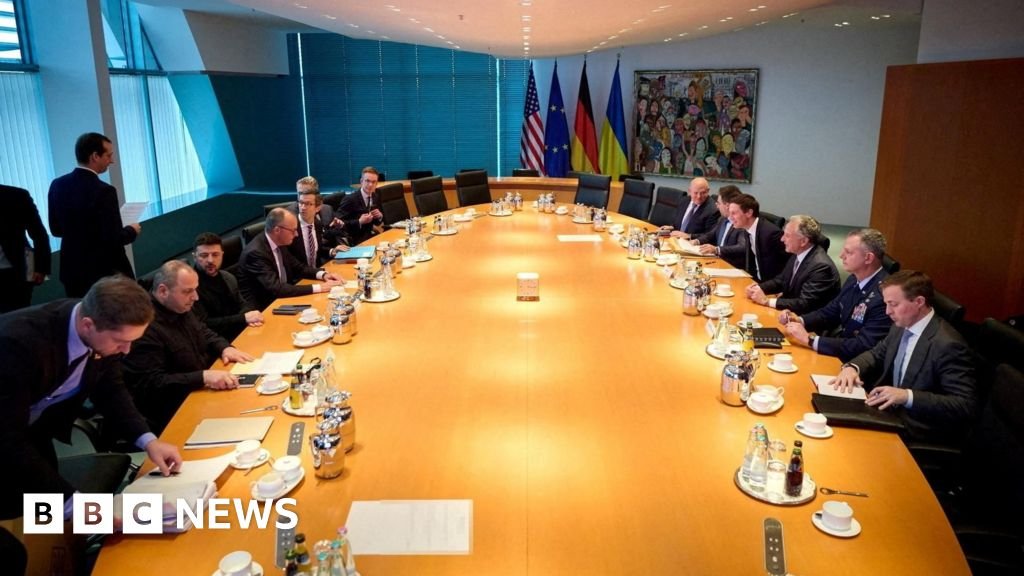
Discussions aimed at establishing a peace agreement between Ukraine and Russia are taking place in Berlin, entering their second day. Ukrainian President Volodymyr Zelensky and his lead negotiator, Rustem Umerov, engaged in a five-hour meeting on Sunday with US envoy Steve Witkoff and Jared Kushner, former President Trump’s son-in-law, along with German Chancellor Friedrich Merz. Following the talks, a US statement indicated that significant progress had been achieved, prompting the continuation of the dialogue on Monday morning.
Shifting Goals for Ukrainian NATO Membership
Before the discussions commenced, President Zelensky indicated a willingness to forgo Ukraine’s aspirations for NATO membership in exchange for solid security guarantees. Acknowledging that “some partners from the US and Europe” do not support NATO membership for Ukraine, Zelensky expressed a desire for robust security assurances modeled after NATO’s Article 5, which pertains to mutual defense.
“And this is already a compromise on our part,” Zelensky stated during the meeting.
Key Participants and Context of the Discussions
Witkoff has visited Moscow multiple times for discussions with President Vladimir Putin. However, this marked his first face-to-face encounter with Zelensky in Berlin. The meeting also included General Alexus Grynkewich, the NATO Supreme Allied Commander Europe.
Further conversations are anticipated to involve additional European leaders, alongside Ursula von der Leyen, President of the European Commission, on Monday evening.
Core Issues and Peace Proposal
The primary focus of the Berlin discussions centers around a 20-point peace proposal submitted by Ukraine to the US. This initiative seeks to counter an earlier American plan that was perceived as heavily skewed in favor of Russia. While specific details have not been disclosed, Zelensky clarified that the points outlined in the proposal are intended to serve as a “foundation” for Ukraine’s reconstruction and necessary security guarantees.
From Russia’s standpoint, Ukraine’s NATO membership is a non-negotiable issue, with Moscow insisting that any ambitions related to joining the alliance be permanently abandoned. The Kremlin emphasized that this matter is fundamental and warrants special attention.
Concerns Over Security Guarantees
The United States has consistently reiterated its opposition to Ukraine joining NATO. However, there is considerable concern in Kyiv that a peace agreement lacking stringent security guarantees might leave the door open for further Russian aggression.
Complexities of Sovereignty and Territorial Issues
Prior to the talks, Zelensky addressed the contentious issue of sovereignty over the Donbas region, which is largely under Russian occupation. He expressed openness to freezing the conflict along the current front lines but made it clear that he would not order his troops to withdraw from the territories still under Ukrainian control unless Russian forces did the same in their occupied areas. Zelensky insisted that for the arrangement to be equitable, Russia would need to pull back an equal distance.
Future Steps and Economic Support for Ukraine
Any agreement forged by the Ukrainian, American, and European representatives will ultimately need to be presented to Moscow. Zelensky noted that the US delegation would essentially convey the Russian viewpoint, including their signals and readiness to negotiate.
The Kremlin has expressed its expectation for the US to provide a detailed overview of the concepts discussed. These negotiations unfold at a critical juncture for Ukraine, which faces its fourth winter of conflict while grappling with ongoing power outages resulting from Russian strikes on its energy infrastructure. Over the weekend, over a million households in Ukraine lost electricity due to extensive attacks.
Later this week, EU nations will participate in a vote concerning a proposal to allocate €90 billion (£78.6 billion) worth of frozen Russian assets held by a financial institution in Belgium to support Ukraine’s economy. While EU governments have agreed to immobilize the Russian assets indefinitely, there remains a lack of consensus on whether these funds can be redirected to Ukraine. Belgium has expressed reservations regarding the proposal, and other countries including Italy are advocating for “alternative options” in response.
EU foreign policy chief Kaja Kallas acknowledged the complexity of the ongoing discussions, stating, “But we’re doing the work, and we still have some days left.”
Conclusion
The ongoing negotiations between Ukraine and the US in Berlin are pivotal in shaping the future security landscape for Ukraine amidst ongoing conflict. The discussions touch on critical issues, including NATO membership, territorial sovereignty, and international economic support.
- Discussions on peace between Ukraine and the US are ongoing in Berlin.
- Zelensky is willing to compromise on NATO membership for security guarantees.
- Focus is on a new Ukrainian peace proposal countering earlier American plans.
- EU nations will vote on reallocating frozen Russian assets to support Ukraine’s economy.